
On this page · 7 sections
Why Texas for Your LLC?
Texas stands as a premier destination for business formation, consistently ranking among the top states for economic growth and entrepreneurial activity. Its pro-business environment, absence of state income tax for individuals, and a legal framework that supports flexible business structures make it particularly appealing for Limited Liability Companies (LLCs). For founders looking for a robust market with a diverse economy, Texas offers unparalleled opportunities. The state's massive consumer base, access to international trade routes, and a rapidly expanding workforce contribute to a dynamic ecosystem where businesses can thrive. Furthermore, Texas law provides significant liability protection for LLC members, shielding personal assets from business debts and legal actions, a critical benefit for any entrepreneur. This separation of personal and business finances is often a primary driver for choosing an LLC over a sole proprietorship or partnership. Texas also offers a straightforward and relatively efficient process for forming an LLC, especially when compared to some other states. Check out our guide on starting a business in Texas for step-by-step instructions. The Secretary of State's office is generally responsive, and the legal requirements are clearly defined. The state's commitment to fostering a competitive business landscape means less red tape and more support for new ventures. Whether you're in tech, energy, healthcare, or retail, the Texas market provides fertile ground for innovation and expansion. The state's regulatory environment is designed to encourage investment and job creation, making it an attractive choice for both nascent startups and established companies seeking to relocate or expand. Understanding these foundational benefits is the first step in appreciating why a Texas LLC can be the right move for your venture.
Choosing Your Texas LLC Name
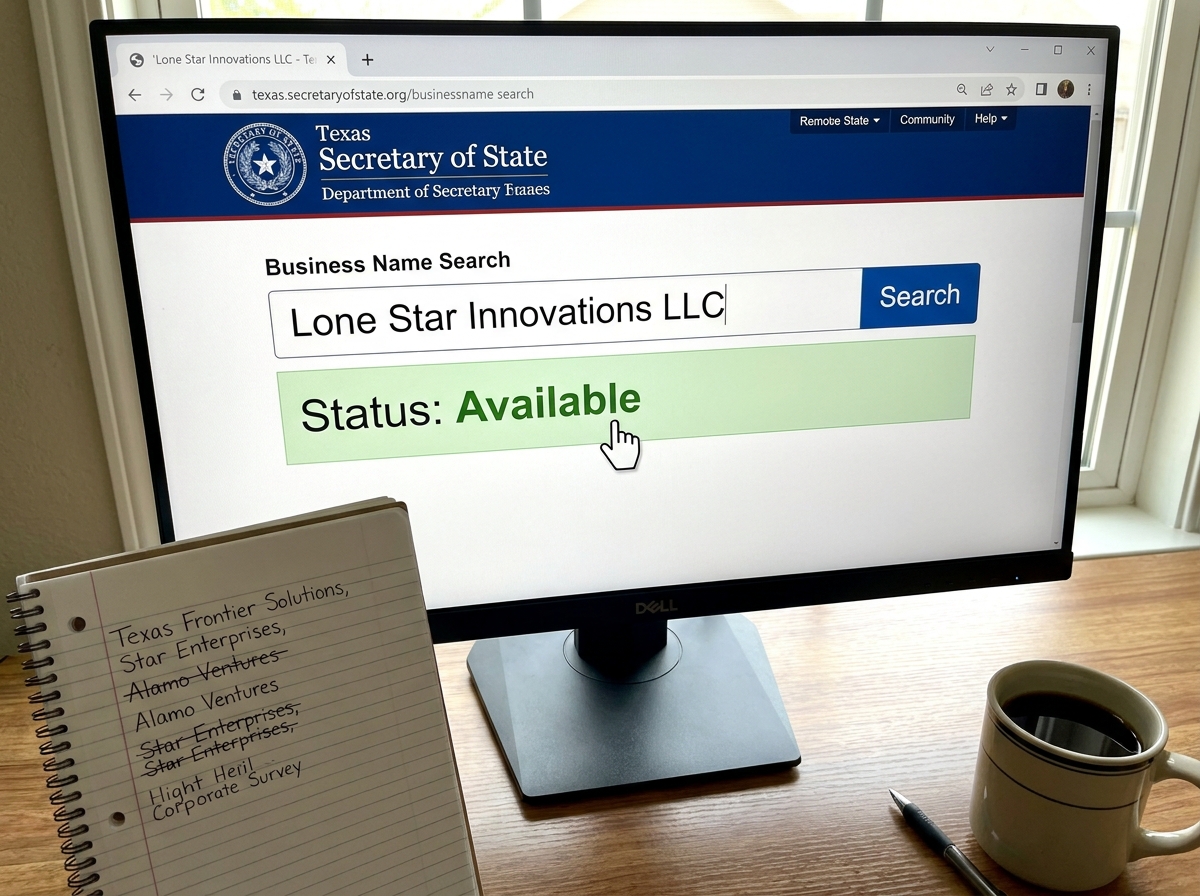
Selecting the right name for your Texas LLC is more than just a creative exercise; it's a critical legal and branding step. Your chosen name must comply with Texas state statutes and clearly identify your entity as a Limited Liability Company. Specifically, the name must include one of the following designations: "Limited Liability Company," "Limited Company," "LLC," or "LC." Abbreviations of these terms are also generally acceptable. Beyond legal requirements, your name should ideally be memorable, relevant to your business, and available for use. The first step in this process is to conduct a thorough name availability search. The Texas Secretary of State (SOS) offers an online business name search tool that allows you to check if your desired name is already in use by another registered entity. This search is crucial because Texas law prohibits the registration of an LLC name that is deceptively similar to an existing name on file. While the SOS search provides a good initial check, it's also advisable to search for federal and state trademarks to ensure your chosen name doesn't infringe on intellectual property rights. Our resource on LLC registration in Texas breaks this down further. Additionally, consider checking domain name availability and social media handles to maintain brand consistency across all platforms. If your preferred name is not immediately available, you might consider slight variations or adding a descriptive word. Once you've identified an available name, you can reserve it with the Texas SOS by filing an Application for Reservation of an Entity Name (Form 501). This reservation holds the name for 120 days, giving you time to prepare and file your Certificate of Formation. The filing fee for name reservation is $40. This step is optional but highly recommended if you need time before formally establishing your LLC, as it prevents other entities from claiming your desired name in the interim. A well-chosen name sets the stage for your LLC's identity and market presence, so dedicate sufficient time to this initial phase.
Appointing a Texas Registered Agent
Every Texas LLC is legally required to designate and maintain a registered agent. This individual or entity acts as the official point of contact for your LLC, responsible for receiving legal documents, service of process (e.g., lawsuits), and official government correspondence from the Texas Secretary of State. The registered agent must have a physical street address in Texas (not a P.O. Box) where they can be reached during normal business hours. This requirement ensures that there is always a reliable way for the state and legal parties to communicate with your business. Choosing your registered agent is a critical decision. While you can technically serve as your own registered agent if you meet the residency requirements, this often comes with several drawbacks. First, your registered agent address becomes public record, meaning your personal address could be exposed if you use your home. Second, you must be available at that address during business hours, which can be disruptive to your operations or travel plans. If you're exploring this further, our guide on how to register an LLC in Texas is a helpful next step. Missing critical legal documents could lead to severe consequences for your business, including default judgments. Third, maintaining a professional image often means separating your personal residence from your business's official contact point. Many founders opt to use a professional registered agent service, which provides a dedicated physical address in Texas and ensures prompt handling of all official correspondence. These services offer privacy, reliability, and peace of mind, allowing you to focus on running your business without the constant worry of missing important legal notices. Professional registered agents are experienced in compliance and often provide digital scanning and forwarding of documents, ensuring you receive everything in a timely manner, no matter where you are. The cost for a professional registered agent service is typically around $100-$150 per year, a small investment for the significant benefits it provides. Registered agent service is required in every state and is priced separately at $79/year ($49/year in Wyoming).
Filing the Certificate of Formation
The Certificate of Formation is the foundational legal document that officially creates your Texas LLC. This document is filed with the Texas Secretary of State and serves as public notice of your LLC's existence. Think of it as your LLC's birth certificate. The information required on the Certificate of Formation (Form 205) is specific and must be accurate. Key details include:
- Entity Name: The exact name of your LLC, including the required designation (e.g., LLC).
- Registered Agent and Registered Office: The name and physical street address of your Texas registered agent.
- Governing Authority: You must specify whether the LLC will be managed by its members (owners) or by a manager(s) appointed by the members.
- Purpose: While Texas allows for a broad statement of purpose (e.g., "for any lawful purpose"), you can also specify a particular business activity.
- Organizer(s): The name and address of the person or entity filing the document. This person does not need to be a member or manager of the LLC.
The Certificate of Formation can be filed online through the Texas SOSDirect system or by mail. Online filing is generally faster, with processing times often within a few business days, whereas mail filing can take several weeks. The filing fee for the Certificate of Formation is $300. It is crucial to ensure all information is correct before submission, as amendments later can incur additional fees and delays. The Texas SOS provides detailed instructions and forms on its website to guide you through the process.
Once your Certificate of Formation is approved, the Texas Secretary of State will return a stamped copy of the filed document. This marks the official legal establishment of your LLC. Keep this document in a secure place, as it is a vital record for your business. Lovie streamlines this entire process, preparing and submitting your Certificate of Formation to the Texas Secretary of State on your behalf, ensuring accuracy and expediting your LLC's official establishment.

Crafting Your Texas LLC Operating Agreement
While not legally required to file with the Texas Secretary of State, a comprehensive LLC Operating Agreement is arguably the single most important internal document for your Texas LLC. This agreement serves as a binding contract among the members, outlining the ownership structure, operational procedures, management responsibilities, and financial arrangements of your business. Without a robust operating agreement, your LLC would default to Texas state statutes for governance, which may not align with your specific business needs or member intentions.
Key provisions to include in your Texas LLC Operating Agreement typically cover:
- Membership Interests: Details on each member's capital contributions, ownership percentages, and voting rights.
- Management Structure: Whether the LLC is member-managed (all members participate in daily decisions) or manager-managed (members appoint specific managers to run the business).
- Profit and Loss Distribution: How profits and losses will be allocated among members.
- Decision-Making Process: Procedures for major business decisions, including voting thresholds.
- Admission of New Members: The process for bringing in new owners.
- Exit Strategies: Provisions for the departure or death of a member, including buy-sell agreements.
- Dissolution: The steps to be taken if the LLC needs to be formally dissolved.
Creating a clear and detailed operating agreement from the outset helps prevent future disputes among members, provides clarity on roles and responsibilities, and strengthens the LLC's limited liability protection. It acts as an internal constitution, guiding the business through various scenarios, from daily operations to unforeseen challenges. Even for single-member LLCs, an operating agreement is highly recommended as it helps delineate the business from personal assets, reinforcing the corporate veil. Lovie provides expertly drafted, customizable operating agreement templates as part of its formation service, giving Texas founders a solid legal foundation without the need for expensive legal counsel.
Obtaining an EIN and Other Numbers
Once your Texas LLC is officially formed by the Secretary of State, the next crucial step is to obtain an Employer Identification Number (EIN) from the Internal Revenue Service (IRS). An EIN is essentially a Social Security number for your business, a unique nine-digit number required for several key activities:
- Opening a Business Bank Account: Most banks require an EIN to establish a business checking or savings account.
- Hiring Employees: If your LLC plans to hire employees, an EIN is mandatory for tax purposes.
- Filing Federal and State Taxes: Your LLC will use its EIN to file various tax returns with the IRS.
- Applying for Business Licenses and Permits: Many local and state licenses require an EIN.
You can apply for an EIN online directly through the IRS website, and the process is typically instant once completed. There is no fee for obtaining an EIN. To apply, you'll need to have your LLC's legal name and address, as well as the name and Social Security number (or individual taxpayer identification number) of the responsible party (usually a member or manager). It's a straightforward process, but accuracy is key to avoid delays.
Beyond the EIN, your Texas LLC may need other state-specific numbers or registrations depending on your industry and activities. For instance, if you plan to collect sales tax, you'll need to register for a Sales Tax Permit with the Texas Comptroller of Public Accounts. Businesses operating in regulated industries might require specific professional licenses. It's important to research federal, state, and local requirements pertinent to your business type. A general business license is not required at the state level in Texas, but local municipalities often have their own licensing requirements. Lovie's $29 one-time fee covers formation preparation and filing, with compliance reminders included; state filing fees are paid directly to your state, and registered agent service is priced separately at $79/year ($49/year in Wyoming).
Ongoing Texas LLC Compliance
Forming your Texas LLC is just the beginning; maintaining its legal standing requires ongoing compliance with state and federal regulations. Neglecting these requirements can lead to penalties, loss of good standing, or even the dissolution of your LLC, jeopardizing your personal liability protection. Understanding your ongoing obligations is crucial for long-term success.
One of the primary state-level compliance requirements in Texas is the Franchise Tax. While Texas doesn't have a state income tax for individuals, most LLCs are subject to this tax, which is essentially a tax on the privilege of doing business in Texas. The tax is calculated based on the LLC's margin, and most LLCs must file an annual Public Information Report (PIR) and a Franchise Tax Report with the Texas Comptroller of Public Accounts. Even if your revenue falls below the no-tax-due threshold (which is $1,230,000 for report year 2026), you are still generally required to file a "No Tax Due Report" and the PIR. These reports are typically due by May 15th each year.
Beyond state filings, your LLC must also adhere to federal tax obligations. Depending on how your LLC is taxed (e.g., as a disregarded entity, partnership, S-corp, or C-corp), you'll have specific filing requirements with the IRS. It's advisable to consult with a tax professional to determine the most advantageous tax classification for your Texas LLC. Additionally, ensure you maintain accurate financial records, separate business and personal finances, and keep your operating agreement updated as your business evolves. Regular meetings (even for single-member LLCs) and clear documentation of significant business decisions can also help reinforce the corporate veil. Lovie's $29 one-time fee covers formation preparation and filing, with compliance reminders included; state filing fees are paid directly to your state, and registered agent service is priced separately at $79/year ($49/year in Wyoming).
Frequently asked questions
How long does it take to set up an LLC in Texas?
The processing time for a Texas LLC's Certificate of Formation can vary. Online filings through the Texas SOSDirect system are generally processed much faster, often within 3-5 business days. Mail filings typically take several weeks, sometimes up to 4-6 weeks, depending on the volume of submissions at the Texas Secretary of State. Expedited processing services may be available for an additional fee, reducing the turnaround time to a few days. Using a service like Lovie can streamline the submission process, ensuring your documents are filed correctly and promptly, but state approval times are ultimately controlled by the Texas Secretary of State.
What is the total cost to form an LLC in Texas?
The primary state filing fee for a Texas LLC is $300 for the Certificate of Formation. This is a one-time fee paid to the Texas Secretary of State. Beyond this, there's a $40 fee if you choose to reserve your business name. If you opt for a professional registered agent service, expect to pay around $100-$150 annually. Additionally, you'll need to factor in potential costs for business licenses, permits, and any professional services like legal or accounting advice. Lovie's single $29 one-time fee with state filing fees billed separately, eliminating hidden costs and simplifying your budget.
Do I need a lawyer to form an LLC in Texas?
No, you are not legally required to hire a lawyer to form an LLC in Texas. The process can be completed by individuals or through business formation services. However, a lawyer can provide valuable advice on complex legal structures, specific industry regulations, or drafting a highly customized operating agreement. For most standard LLC formations, services like Lovie offer comprehensive assistance, preparing and submitting all necessary documents, including providing operating agreement templates, which can be sufficient for many founders without the added expense of legal counsel.
What are the annual requirements for a Texas LLC?
Texas LLCs have two primary annual compliance requirements: filing an annual Public Information Report (PIR) and, for most, a Franchise Tax Report with the Texas Comptroller of Public Accounts. These are typically due by May 15th each year. Even if your LLC's revenue falls below the no-tax-due threshold (which is $1,230,000 for report year 2026), you generally still need to file a "No Tax Due Report" and the PIR. Additionally, you must maintain a registered agent with a physical street address in Texas. Failing to meet these ongoing requirements can result in penalties or loss of good standing.
Can I form a Texas LLC if I live in another state?
Yes, you can absolutely form a Texas LLC even if you do not reside in Texas. Many entrepreneurs choose to form their LLCs in Texas due to its favorable business climate, even if their primary residence is elsewhere. The key requirement is that your Texas LLC must maintain a registered agent with a physical street address within Texas. This ensures that your business can always receive legal and official correspondence within the state. Using a professional registered agent service is a common solution for out-of-state owners, providing the necessary local presence without requiring you to live there.
What is the difference between a member-managed and manager-managed LLC in Texas?
In a member-managed LLC, all members (owners) directly participate in the day-to-day operations and decision-making of the business. This structure is common for smaller LLCs with a few active owners. In contrast, a manager-managed LLC appoints one or more managers (who can be members or external individuals) to handle daily operations, while members retain ownership and strategic oversight. This structure is often preferred for larger LLCs, those with passive investors, or when members prefer to delegate operational responsibilities. The choice is documented in your Certificate of Formation and Operating Agreement.
Texas Formation Data Insights
| State Filing Fee | $300 |
| Annual Fee | $0 (No annual fee) |
| First Year Total | $300 |
| Processing Time | 6.2 days avg (official: 5-7 days) |
| Corporate Tax Rate | No corporate income tax |
Key Insights
- Texas'de LLC kurulum maliyeti ulusal ortalamanın $76 üzerinde — toplam ilk yıl maliyeti $300.
- Lovie platformu üzerinden Texas LLC başvuruları ortalama 6.2 iş gününde onaylanmaktadır (eyalet resmi süresi: 5-7 gün).
- Texas merkezli işletmeler için EIN onay süresi ortalama 6.7 gündür.
- Texas kurumlar vergisi uygulamaz — bu durum özellikle yüksek kâr marjlı işletmeler için önemli bir avantaj sağlar.
Data sources: State Secretary of State offices, IRS, Tax Foundation (2026). Platform metrics based on anonymized Lovie user data.
Key Concepts: Business Formation
US Business Formation guides entrepreneurs through the business formation process with actionable steps. Key components include LLC formation, entity registration, and state filing, each playing a critical role in the business formation process. Understanding liability protection and tax optimization is essential, as these factors directly impact legal compliance.
When evaluating business formation options, factors such as business entity types and formation process should inform your decision-making process.
Entity Relationships
- Business Formation requires LLC formation
- Business Formation includes entity registration
- Business Formation establishes state filing
- Business Formation defines business structure selection
Quick answers
What do I need to know about Secretary Of State Nc Llc Lookup for my business?
Understanding Secretary Of State Nc Llc Lookup is essential for business compliance and operational success. The specific requirements vary by state and industry.
How does Secretary Of State Nc Llc Lookup affect my business formation?
This aspect of business formation directly impacts your legal standing, tax obligations, and operational flexibility.
Explore Formation Guides
State-specific formation guides, cost breakdowns, compliance checklists, and expert comparisons — updated for 2026.
EIN & Tax ID Guides
- How to Get an EIN for Drone Services Georgia (2026) | Lovie
- How to Get an EIN for Mobile Developer Kansas
- How to Get an EIN for Membership Site Iowa (2026) | Lovie
C-Corp Formation Guides
- How to Form a C-Corp for Freelancing Georgia (2026) | Lovie
- How to Form a C-Corp for Cannabis Louisiana (2026) | Lovie
- How to Form a C-Corp for AI ML Arizona (2026) | Lovie
Popular Guides

Lovie is not a government agency, law firm, or professional advisory organization. Lovie is a private business-formation service that prepares and submits filings to the appropriate state agencies on your behalf — we do not issue government documents, and state approval times are not controlled by Lovie. Information on this page is general and not legal, tax, or financial advice.