
On this page · 8 sections
- What is an LLC Banking Resolution?
- Why Your LLC Needs a Banking Resolution
- Key Components of a Banking Resolution
- How to Prepare Your LLC Banking Resolution
- Multi-Member LLCs and Banking Resolutions
- Single-Member LLC Banking Resolution Requirements
- Beyond the Resolution: Opening Your LLC Bank Account
- Lovie and Your LLC Banking Success
What is an LLC Banking Resolution?
When you establish a Limited Liability Company (LLC), separating personal and business finances is paramount. This separation isn't just good practice; it's a cornerstone of the liability protection an LLC offers. Opening a dedicated business bank account is the critical first step in achieving this. However, banks require formal assurance that the individuals acting on behalf of the LLC are genuinely authorized to do so. This is where the LLC banking resolution comes in. It's a formal, internal document adopted by the LLC's members or managers, explicitly stating who has the authority to open, manage, and transact on the company's bank accounts. Essentially, it's a written directive from the LLC itself, empowering specific individuals to interact with financial institutions on its behalf. This connects to our resource on how to register an LLC in Arkansas, which covers the details. Think of it as your LLC’s official voice, telling the bank, "These are the people authorized to handle our money." Without this clear directive, a bank faces a significant compliance risk, as it cannot independently verify the legitimacy of individuals claiming to represent a new business entity. The banking resolution eliminates this ambiguity, providing a legally sound framework for financial operations. It is distinct from your LLC's Operating Agreement, though often referenced within it. While the Operating Agreement outlines the general management structure and powers, the banking resolution focuses specifically on banking authority, offering a granular level of detail required by financial institutions. This document protects both the bank and the LLC by ensuring that all financial activities are conducted by duly appointed representatives, safeguarding the company's assets and maintaining its corporate veil.
Why Your LLC Needs a Banking Resolution
The necessity of an LLC banking resolution extends beyond mere procedural formality; it serves several critical functions for your business. First, and most obviously, it's often a mandatory requirement from banks. Most financial institutions, especially those with robust compliance departments, will not open a business account for an LLC without this document. They need to verify that the person signing the account agreement has explicit permission from the LLC itself. This protects the bank from potential fraud or disputes over unauthorized transactions down the line. Second, it provides internal clarity and control for your LLC. In a multi-member LLC, it prevents any single member from unilaterally opening accounts or making significant financial decisions without proper authorization. It codifies who holds financial power, reducing ambiguity and potential conflict among members. This is particularly vital as your business grows and involves more individuals or managers. For related guidance, see our article on forming an LLC in California. Third, a banking resolution acts as a protective layer for the LLC's corporate veil. By clearly delineating who can manage business funds, it reinforces the separation between personal and business liabilities. Commingling funds or having unauthorized individuals access business accounts can weaken this protection, potentially exposing personal assets to business debts. Finally, it streamlines future financial processes. When you need to add signatories, change authorized personnel, or open additional accounts, an existing banking resolution provides a clear precedent and framework. It simplifies compliance and ensures continuity in your financial management, allowing you to focus on growth rather than administrative hurdles. For example, in states like Delaware, where LLCs are often formed for their flexible governance structures, a clear banking resolution is crucial for establishing operational legitimacy.
Key Components of a Banking Resolution
A well-drafted LLC banking resolution is precise and comprehensive, leaving no room for misinterpretation regarding financial authority. Several core components are essential for its validity and effectiveness. First, it must clearly identify the LLC: its full legal name, the state of formation, and its registered address. This ensures the resolution is unequivocally tied to the correct legal entity. Second, it needs to name the specific financial institution where the account will be opened, alongside the type of account (e.g., checking, savings, money market). While some general resolutions exist, many banks prefer a resolution tailored to them. Third, and most crucially, the resolution must explicitly list the individual(s) authorized to act on behalf of the LLC. This includes their full legal names, titles within the LLC (e.g., Member, Manager, President), and sometimes their addresses. For more details, see our guide on forming an LLC in Colorado. It also details the scope of their authority: opening accounts, making deposits, withdrawing funds, signing checks, initiating electronic transfers, and accessing account information. The resolution should specify if these actions require a single signatory or multiple signatories for certain transaction types or amounts. Fourth, it typically includes a statement affirming that the resolution was duly adopted by the LLC's members or managers in accordance with its Operating Agreement and state law. This lends legal weight to the document. Finally, the resolution must be signed and dated by the LLC's authorized members or managers, often with their titles, and sometimes notarized, depending on bank requirements. Some banks may also request a copy of the LLC’s Operating Agreement or Certificate of Formation to cross-reference the authority granted. For instance, a bank in New York might require notarization, whereas one in Wyoming might not, highlighting the importance of checking with your specific bank.
How to Prepare Your LLC Banking Resolution
Preparing an LLC banking resolution involves a few structured steps to ensure accuracy and legal compliance. While the process isn't overly complex, precision is key.## Step 1: Review Your Operating AgreementBegin by reviewing your LLC's Operating Agreement. This foundational document outlines the management structure and the authority of members or managers. Your banking resolution must align with these provisions. For example, if your Operating Agreement states that major financial decisions require unanimous consent, your banking resolution should reflect this for opening new accounts.## Step 2: Draft the ResolutionUsing a template or drafting from scratch, include all the key components discussed previously: LLC identification, bank details, authorized individuals, and the scope of their powers. Be specific about transaction limits if applicable, and whether single or multiple signatures are required for certain actions. Many banks offer their own banking resolution forms or templates, which can simplify this step. It’s often best to inquire with your chosen bank first, as using their preferred format can expedite the process.## Step 3: Adopt the ResolutionFormally adopt the resolution. For most LLCs, this involves a vote or written consent by the members or managers, as dictated by your Operating Agreement. Document this adoption in your LLC's internal records, such as meeting minutes or a written consent form. Even for a single-member LLC, formally documenting the decision is crucial for maintaining the corporate veil.## Step 4: Sign and NotarizeOnce adopted, the resolution must be signed by the authorized members or managers. Depending on your bank's requirements and state law, notarization may be necessary. A notary public verifies the identity of the signers, adding an extra layer of authenticity. Always check with your bank about their specific notarization requirements before presenting the document.## Step 5: Keep RecordsMaintain a copy of the signed and, if applicable, notarized banking resolution in your LLC's official records, alongside your Operating Agreement and Certificate of Formation. This ensures easy access for future reference or if additional banks require it.## Lovie simplifies this process by providing comprehensive operating agreement templates that can be customized to include clear provisions for banking authority, streamlining your path to opening a business bank account. We assist with organizing all your formation documents, making compliance straightforward.

Multi-Member LLCs and Banking Resolutions
For multi-member LLCs, the banking resolution becomes an even more critical governance document. With multiple owners, clear delineation of financial authority prevents misunderstandings, disputes, and potential legal challenges. In these structures, the Operating Agreement typically dictates how decisions are made, including those related to banking. The banking resolution then operationalizes these rules for financial institutions. For instance, if your multi-member LLC has three members and your Operating Agreement specifies that any transaction over $5,000 requires the approval of two members, the banking resolution should reflect this. It would name the authorized individuals and then state the specific conditions under which they can act, such as requiring two signatures for checks exceeding a certain amount, or requiring a majority vote for opening new lines of credit. This level of detail protects all members by ensuring that financial actions align with the agreed-upon governance structure. Without a clear resolution, a single member might theoretically open an account or incur debt in the LLC's name without the knowledge or consent of others, leading to significant internal conflict and potential legal liabilities for the LLC. The resolution brings transparency and accountability to financial management, which is paramount in a collaborative business environment. It also serves as a critical reference point for the bank, reassuring them that they are interacting with the LLC's legitimate representatives according to the entity's own established rules. Furthermore, as membership changes or new managers are appointed, the banking resolution can be updated to reflect these changes, ensuring that financial authority remains current and properly documented. Regular review, perhaps annually, is a prudent practice for multi-member LLCs to ensure the resolution still accurately reflects the current structure and needs of the business.
Single-Member LLC Banking Resolution Requirements
While often perceived as less complex, single-member LLCs (SMLLCs) also benefit significantly from a banking resolution, and many banks will still require one. The primary purpose for an SMLLC is to formally document the owner's authority to act on behalf of the LLC, reinforcing the separation between personal and business finances. Even though there's only one owner, the LLC is a distinct legal entity. The banking resolution serves as a formal statement from the LLC, authorizing its sole member (or another appointed individual, though less common for SMLLCs) to conduct banking activities. This formal documentation is crucial for maintaining the corporate veil, preventing the commingling of funds, and demonstrating that the business operates as a separate legal entity. Without it, a bank might view the SMLLC as an extension of the individual, which could weaken liability protection in a legal challenge. For example, if an SMLLC in California faces a lawsuit, a well-documented banking resolution helps prove that the business was operated distinctly from the owner's personal affairs. The components of an SMLLC banking resolution are similar to those for multi-member LLCs, though simpler. It will identify the LLC, the bank, and the sole member as the authorized individual. It will grant comprehensive authority to open, manage, and transact on the business account. While notarization might still be required by some banks, the internal adoption process is straightforward, typically involving the sole member signing the document in their capacity as the LLC's owner. It’s essential for SMLLC owners not to overlook this step, viewing it as a critical piece of their compliance and liability protection strategy. It solidifies the legal distinction of the LLC in the eyes of financial institutions and the law.
Beyond the Resolution: Opening Your LLC Bank Account
While the banking resolution is a critical document, it's just one piece of the puzzle when opening your LLC's business bank account. You'll need to gather several other key documents and pieces of information to complete the process.## Required Documents1. Employer Identification Number (EIN): This 9-digit number is issued by the IRS and is essentially your LLC's social security number for tax purposes. Almost all banks require an EIN to open a business account. Lovie's $29 one-time fee covers formation preparation and filing, with compliance reminders included; state filing fees are paid directly to your state, and registered agent service is priced separately at $79/year ($49/year in Wyoming). Certificate of Formation (or Articles of Organization): This is the document officially filed with your state's Secretary of State that legally creates your LLC. The bank needs proof that your LLC is a legitimate, registered entity.3. LLC Operating Agreement: While not always strictly required, many banks will ask for a copy of your Operating Agreement. It outlines the ownership structure, management responsibilities, and operational procedures of your LLC.4. Business Licenses and Permits: Depending on your industry and location, you may need to present specific business licenses or permits. For example, a restaurant in New York City would need a food service establishment permit.5. Personal Identification: The authorized signatories on the account will need to provide valid government-issued photo identification (e.g., driver's license, passport) and sometimes proof of address.## Choosing a BankSelecting the right bank is as important as having the correct documentation. Consider factors like: - Fees: Look for transparent fee structures, low or no monthly maintenance fees, and reasonable transaction costs. - Services: Evaluate online banking capabilities, mobile apps, payment processing options, and access to business loans or lines of credit. - Location: While online banking is prevalent, physical branch access can still be beneficial for certain transactions or support. Lovie's $29 one-time fee covers formation preparation and filing, with compliance reminders included; state filing fees are paid directly to your state, and registered agent service is priced separately at $79/year ($49/year in Wyoming). Our goal is to make setting up your business's financial infrastructure as smooth as possible.
Lovie and Your LLC Banking Success
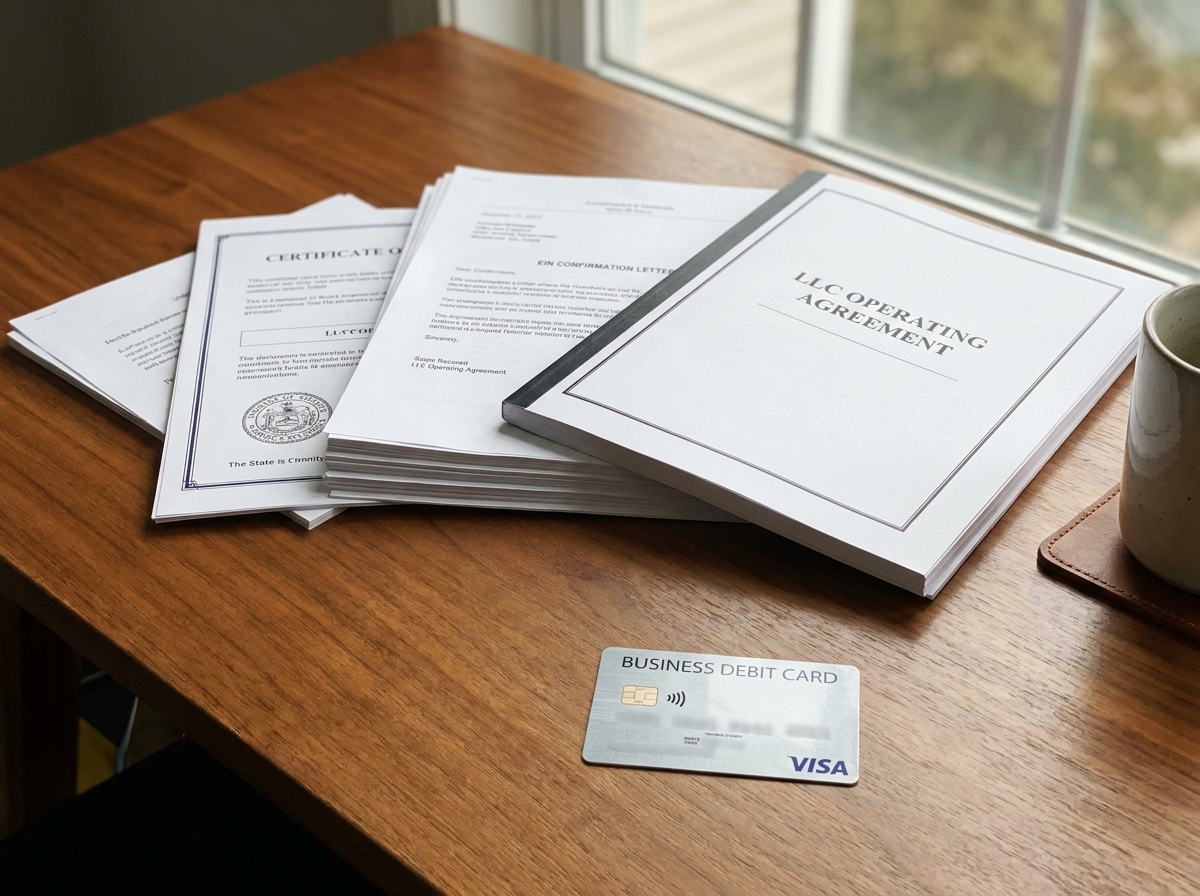
Establishing your LLC and setting up its financial infrastructure can feel like a labyrinth of paperwork and legalities. Lovie is designed to demystify this process, providing an AI-powered platform that handles your company formation across all 50 US states. Our comprehensive $29 one-time fee includes everything you need to get your LLC off the ground and ready for banking. This includes the preparation and submission of your formation filing to the state, assistance with securing your Employer Identification Number (EIN) from the IRS, and customizable operating agreement templates that can be tailored to include specific banking resolutions. By centralizing these critical services, Lovie ensures that you have all the necessary documentation in hand when you approach a bank to open your business account. We understand that time is money for founders, which is why our platform offers instant filing-status visibility and a conversational UI that simplifies complex administrative tasks. For instance, our operating agreement templates are crafted to be robust and compliant, giving you a solid foundation for your LLC's governance, including provisions for banking authority. This means less time spent researching legal requirements and more time focusing on building your business. Our service is particularly valuable for the diverse range of founders we serve, from AI operators and e-commerce entrepreneurs to real estate investors and international founders, all of whom need a reliable, compliant path to establishing their business's financial identity. With Lovie, you're not just forming an LLC; you're building a solid foundation for long-term success, supported by comprehensive tools and 24/7 support. We prepare the documents; you focus on your vision.
Frequently asked questions
Is an LLC banking resolution legally required in all states?
While not every state explicitly mandates an LLC banking resolution by law, nearly all banks will require one to open a business account. This is a bank's internal policy to ensure they are dealing with authorized representatives of the LLC. It's a best practice regardless of state law to have this document prepared.
Can I use my LLC Operating Agreement instead of a separate banking resolution?
Some banks may accept specific clauses within a well-drafted LLC Operating Agreement that explicitly grant banking authority to certain individuals. However, many banks prefer a standalone banking resolution for clarity and ease of verification. It's always best to check with your chosen bank's specific requirements.
Who needs to sign the LLC banking resolution?
The LLC banking resolution must be signed by the authorized members or managers of the LLC, as specified in your LLC's Operating Agreement. For a multi-member LLC, this typically means a majority or all of the managing members or designated officers. For a single-member LLC, the sole member signs in their capacity as the owner/manager.
Does a banking resolution need to be notarized?
Whether a banking resolution needs to be notarized depends on the specific bank's policies. While not universally required by law, many financial institutions request notarization to add an extra layer of authentication and verify the identities of the signers. Always confirm this requirement with your bank beforehand.
What if my LLC's authorized signatories change?
If your LLC's authorized signatories or banking authority changes, you must update your banking resolution immediately. This involves drafting a new resolution or an amendment, formally adopting it according to your LLC's operating agreement, and providing the updated document to your bank. Failure to do so can lead to delays or issues with account access.
Can I get a template for an LLC banking resolution?
Yes, many banks offer their own banking resolution templates, which is often the easiest route as it ensures compliance with their specific requirements. Additionally, legal service providers and business formation companies like Lovie often provide templates or guidance within their operating agreement packages.
How long is an LLC banking resolution valid?
An LLC banking resolution typically remains valid indefinitely unless superseded by a new resolution or amendment, or if the authorized signatories change. However, some banks may periodically request updated resolutions to ensure their records are current. It's good practice to review it annually.
Key Concepts: Business Formation
US Business Formation guides entrepreneurs through the business formation process with actionable steps. Key components include LLC formation, entity registration, and state filing, each playing a critical role in the business formation process. Understanding liability protection and tax optimization is essential, as these factors directly impact legal compliance.
When evaluating business formation options, factors such as business entity types and formation process should inform your decision-making process.
Entity Relationships
- Business Formation requires LLC formation
- Business Formation includes entity registration
- Business Formation establishes state filing
- Business Formation defines business structure selection
Quick answers
What do I need to know about Banking Resolution Llc for my business?
Understanding Banking Resolution Llc is essential for business compliance and operational success. The specific requirements vary by state and industry.
How does Banking Resolution Llc affect my business formation?
This aspect of business formation directly impacts your legal standing, tax obligations, and operational flexibility.
Explore Formation Guides
State-specific formation guides, cost breakdowns, compliance checklists, and expert comparisons — updated for 2026.
LLC Formation Guides
- How to Form an LLC for Virtual Assistant Hawaii
- How to Form an LLC for Web Developer West Virginia
- How to Form an LLC for Drone Services Wyoming
- How to Form an LLC for Freelancing California
Popular Guides
Cost by Entity & State
- Sole Proprietorship Cost Alabama Formation Costs
- Nonprofit Cost Michigan Formation Costs (2026) | Lovie
- C Corp Cost South Carolina Formation Costs (2026) | Lovie

Lovie is not a government agency, law firm, or professional advisory organization. Lovie is a private business-formation service that prepares and submits filings to the appropriate state agencies on your behalf — we do not issue government documents, and state approval times are not controlled by Lovie. Information on this page is general and not legal, tax, or financial advice.