Learn how the american company register works across all 50 state portals and the SEC EDGAR database to look up any U.S. business quickly and accurately.
By Omer Aydin ·
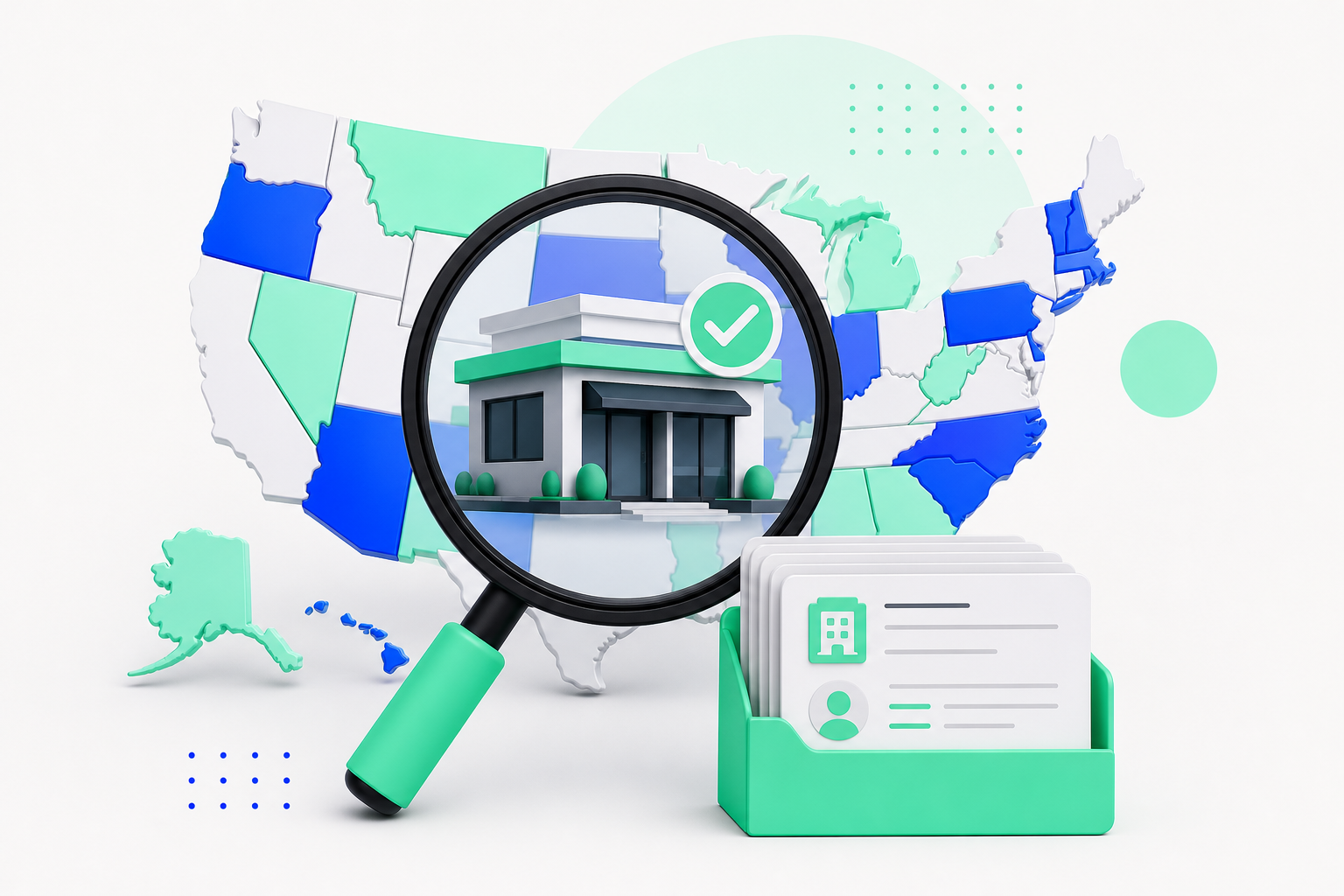
There is no single American company register. The U.S. splits business registration across 50 state Secretary of State offices, each running its own portal with its own data format and search rules. To look up any business, you first identify its home state, then search that state's official registry. For public-company financials, you use the SEC's EDGAR database. This guide maps the whole system and gives you a clear path to the right source every time.
No federal agency maintains a single searchable register of all U.S. businesses. Registration is a state function, not a federal one, and each of the 50 states runs its own system independently. That fragmentation confuses even experienced researchers.
The scale of that fragmentation is significant. As of July 2026, there are at least 91,852,971 business registration records across all 50 U.S. state registries, according to GovFiles's 2026 report. That figure counts every active and inactive record held by each state, including LLCs, corporations, partnerships, and sole proprietorships that filed at the state level.
You will sometimes see different totals cited from federal sources. In September 2026, the U.S. Census Bureau recorded 534,947 seasonally adjusted business applications in a single month, and Registered Agents Inc reports that 5.31 million new businesses were formed between January and September 2026. These numbers are not comparable to the GovFiles registry count. The Census figure tracks new applications, not the total stock of registered entities. The Registered Agents Inc figure covers new formations in one year. The GovFiles total is a cumulative snapshot of every record held across all 50 state databases. Each source measures something different.
The closest thing to a federal role in this system is the Secretary of State office in each state. That office is the official custodian of business formation records for its jurisdiction. It records the entity's legal name, registered agent, formation date, current status, and filing history. It does not coordinate with other states and does not publish a national feed.
State Secretary of State portals and the SEC's EDGAR database answer different questions. Pick the wrong source and you waste time, or worse, draw the wrong conclusion about a company's status.
State registries tell you whether a legal entity exists, whether it is in good standing, who its registered agent is, and what documents it has filed with the state. This covers the vast majority of U.S. businesses, because most are private companies that never register with the SEC.
EDGAR is a different tool for a different purpose. The SEC's EDGAR system provides free public access to financial statements, annual reports (10-K), and operational filings for all U.S. public companies. It does not include private company financials, and it only covers companies registered with the SEC. If you search EDGAR for a private LLC or a small corporation, you will find nothing, not because the company does not exist, but because it has no obligation to file with the SEC.
The table below maps the two sources against the most common research tasks.
| Research goal | Best source | Free? |
|---|---|---|
| Confirm a company's legal existence | State Secretary of State portal | Yes |
| Find a company's registered agent | State Secretary of State portal | Yes |
| Check active / inactive / dissolved status | State Secretary of State portal | Yes |
| View formation documents and amendments | State Secretary of State portal | Usually free; some states charge |
| Obtain a certificate of good standing | State Secretary of State portal | Fee-based |
| Review annual reports and 10-K filings | SEC EDGAR | Yes |
| Access financial statements for a public company | SEC EDGAR | Yes |
| Find shareholder or ownership data | Neither (see limitations section below) | N/A |
For private companies, your starting point is always the state registry. EDGAR is only relevant once you know you are researching a publicly traded company.
The lookup process has a consistent structure regardless of which state you are searching. Follow these steps in order.
A note on California: California runs one of the largest and most queried registries in the country. If your target company is incorporated or qualified to do business in California, the california company register walkthrough covers the specific search interface, entity status codes, and what each result field means.
Common pitfalls to avoid:
California has the highest number of registered companies in the United States, totaling 7,660,543. That volume makes its registry one of the most queried in the country, and also one of the more nuanced to navigate if you are used to simpler state portals.
The California Secretary of State runs its business entity search through the Business Search portal at bizfileonline.sos.ca.gov. Access is free, and no account is required to run a basic search. You can search by entity name, entity number, or agent for service of process. Name searches are the most common starting point, but they are case-insensitive and return partial matches, so a broad search term can return hundreds of results.
Once you locate a record, the free result shows you the entity name, entity number, formation date, jurisdiction of formation, registered agent (listed as "agent for service of process"), and current status. California uses a specific set of status codes that are worth knowing before you interpret results:
For a more detailed search of the California registry, including a California Secretary of State business name search by entity number or agent name, the dedicated walkthrough covers each field in the portal and explains how California's entity number system differs from other states.
Certified copies of formation documents and certificates of good standing are available through the same portal but require a fee. If you need one for a lender, a counterparty, or a contract, budget for that cost and allow processing time, especially during peak filing periods.
State registries confirm that a legal entity exists. They do not tell you who owns it, who controls it, or how it is financed. Setting accurate expectations before you search keeps you from drawing wrong conclusions.
No shareholder or beneficial ownership data. U.S. state registries do not publish shareholder lists or beneficial ownership information. You will see the registered agent, the formation date, and in some states the names of officers or directors, but the identity of the people who own equity in the company is not part of the public record at the state level. This is a fundamental structural difference from registries in the UK, where Companies House publishes persons of significant control. If ownership transparency is what you need, a state registry search will not give it to you.
Foreign qualification records are not separate companies. When a business formed in Delaware registers to operate in Texas, Texas creates its own record for that entity. That Texas record is a foreign qualification filing, not a new company. The same legal entity now appears in two state databases. Researchers who do not account for this can double-count companies or misidentify a company's home state. The home state is always where the entity was originally formed, not where it filed for foreign qualification.
Status reflects filings, not operations. A company can show as "active" in a state registry while being completely dormant, or show as "suspended" while its principals continue operating informally under a different name. The registry tracks filing compliance, not business activity.
No federal coordination. Because each state operates independently, there is no mechanism to confirm whether a company is registered in multiple states, dissolved in one but active in another, or operating under a name that conflicts with an entity in a different jurisdiction. Your search in one state tells you only what that state knows.
Use this table to match your research goal to the right source before you start. The right source depends on what you are trying to confirm, not on how well-known the company is.
| What you want to know | Where to look | Cost |
|---|---|---|
| Is this company legally registered? | Secretary of State portal in the formation state | Free |
| Is this company in good standing? | Secretary of State portal in the formation state | Free (basic status); fee for certified certificate |
| Who is the registered agent? | Secretary of State portal in the formation state | Free |
| What documents has the company filed? | Secretary of State portal in the formation state | Usually free; some states charge per document |
| Does this company operate in a second state? | Secretary of State portal in that second state | Free (foreign qualification record) |
| What is the company's home state of formation? | Secretary of State portal where it was originally formed | Free |
| Annual reports and 10-K filings | SEC EDGAR | Free |
| Financial statements for a public company | SEC EDGAR | Free |
| Shareholder or beneficial ownership data | Not available in state registries or EDGAR for private firms | N/A |
| Certified proof of existence for a contract or lender | Secretary of State portal (certificate of good standing) | Fee-based |
The practical skill is knowing which question you are actually trying to answer before you open a search portal.
If you have been navigating state portals to research an existing business, you already know how fragmented the system is. Forming a new one through those same portals adds another layer: selecting a state, preparing formation documents, applying for an EIN, and staying current on annual filings.
Lovie Formation is an AI-powered company formation service for tech startups. You describe your business in a chat interface, and Lovie prepares and submits your formation documents to the correct state, handles the IRS EIN application, and manages your registered agent and ongoing compliance. If you work in an IDE, Lovie connects to Cursor, Claude, and Windsurf via the Model Context Protocol, so you can kick off formation without leaving your editor. The first year of registered agent service is included in the formation price; it renews at $79 per year after that.
Prices and plan limits verified as of October 2026.
Go to the official Secretary of State portal for the state where the company was formed. Run a name search and open the entity's detail page. The registered agent's name and address appear on that page at no cost. If you need a certified copy of the registered agent information for legal or contractual purposes, most states charge a fee for that document. For help appointing a registered agent for your own company, that process is separate from a registry lookup.
Not through state registries. State Secretary of State portals search by entity name or state-assigned entity number, not by federal Employer Identification Number. The IRS issues EINs and does not maintain a public searchable database of them. If you need to verify a company's EIN, you typically need the company to provide it directly, or you can find it on publicly filed tax documents for nonprofit organizations, which are required to disclose their EIN on Form 990.
Delaware's Division of Corporations search returns the first 50 results in alphabetical order, not by relevance. If your search term is broad, your target company may exist but sit outside those first 50 results. Use the company's exact legal name rather than a keyword or trade name. Also confirm that the company you are searching is actually incorporated in Delaware. Many well-known companies are, but some are incorporated in Nevada, Wyoming, or their home state instead.
A small number of states publish bulk registry data for download or via API. Delaware, Wyoming, and a handful of others make structured data available to developers and researchers. Most states offer only a web-based search interface with no bulk export option. The GovFiles project aggregates records across all 50 states and is one of the more complete attempts to consolidate that data in one place, though coverage and freshness vary by state.
A foreign qualification record is created when a company formed in one state registers to legally conduct business in a second state. The company does not become a new legal entity. It remains the same entity, incorporated in its home state, but it now has a filing record in the second state as well. When you search that second state's registry, you will find the record, but it will usually indicate the company's state of formation. Always trace the entity back to its formation state for authoritative status information.
No. The U.S. has no federal equivalent to Companies House. The UK's Companies House is a single national registry that covers all registered companies in England, Wales, Scotland, and Northern Ireland. The U.S. equivalent function is distributed across 50 separate Secretary of State offices, each operating independently with its own portal, data format, and fee schedule. The SEC's EDGAR database covers public companies only. For private companies, there is no national consolidation point.
The U.S. has no single American company register. Business registration is a state function, and each of the 50 Secretary of State offices maintains its own independent database. To look up any company, identify its home state, search that state's official portal, and use SEC EDGAR only if the company is publicly traded.
Before you search, decide exactly what you need to confirm: legal existence, registered agent, good standing, or public financials. The decision table in this guide maps each goal to the right source. If your target is a California entity, start with the California registry, which holds more than 7,660,543 records and uses its own status codes and entity number system. Knowing what registries do not publish, including shareholder data, beneficial ownership, and cross-state coordination, tells you when a registry search is enough and when you need to look further.