Learn when foreign qualification LLC rules apply and how to register out of state to stay compliant and avoid fines, back taxes, and penalties.
By Omer Aydin ·
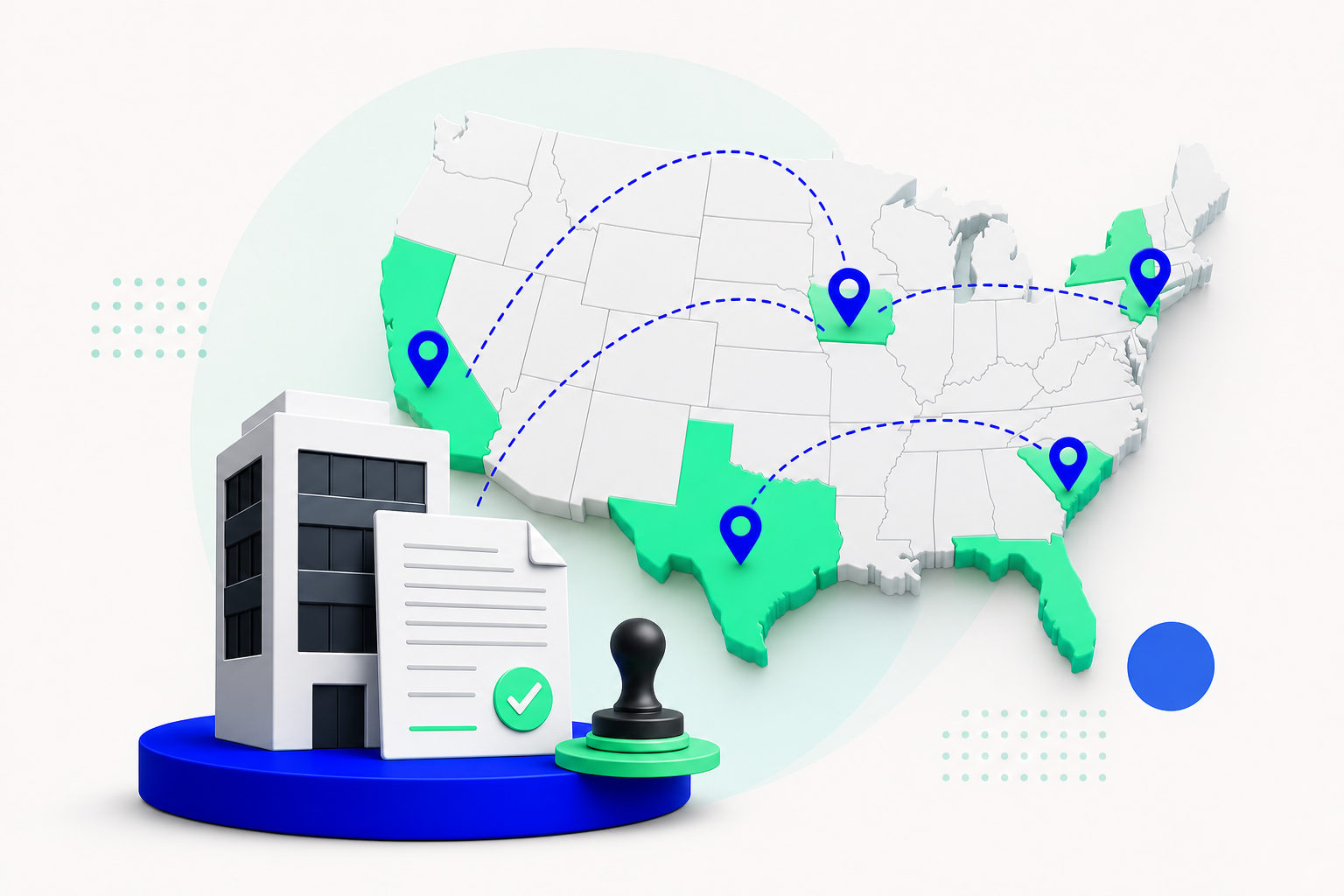
!A US map with LLC registration documents illustrating foreign qualification across states
Foreign qualification lets an LLC formed in one state legally operate in another. You need it when your business has a physical presence, employees, property, or regular transactions in a second state. Skipping it can mean fines, back taxes, and loss of access to that state's courts. This guide covers the two decisions that trip founders up most often, then walks through the filing process step by step.
This article is not legal, tax, or accounting advice. Your company's counsel should review your specific situation before you file in any state.
A domestic LLC is one formed in the state where it filed its original articles of organization. That state is its legal home. A foreign LLC is the same entity operating in a second state where it was not originally formed. "Foreign" here means out-of-state, not international.
The distinction matters because every state has its own rules for businesses that want to operate within its borders. When you form in Delaware but hire employees in Texas, Texas sees your company as a foreign entity. You must register there separately to get legal standing in that state's courts, enter contracts that hold up locally, and avoid penalties for operating without authorization.
According to GovFiles's 2026 data, roughly 8.2 million U.S. business registrations are out-of-state foreign qualifications rather than domestic formations. The same research shows that the share of foreign-entity registrations ranges from about 1% in Delaware to roughly 11% in states like Washington and North Carolina. Those numbers reflect how common multi-state operations have become, especially for tech startups that hire remotely from day one.
Registering as a foreign LLC does not create a new company. It authorizes your existing LLC to do business in the new state under the same EIN and ownership structure.
Most states use a "transacting business" standard to decide whether registration is required. The definition varies by state, so no single rule applies everywhere. That said, several activities consistently trigger the requirement across most jurisdictions.
You almost certainly need to register as a foreign LLC if your company:
The remote-employee question is one most guides gloss over. Many states treat a full-time employee working from home as enough to establish a business presence, even if your company has no office there. If you hired a developer in Austin or a sales lead in Atlanta, check those states' statutes before assuming you are clear.
Activities that typically do not trigger registration include holding board meetings in a state, maintaining a bank account for general operations, or making occasional sales to customers there without a systematic presence.
Real Cost Report's 2026 research found that roughly 80% of small LLC owners would benefit more from forming a domestic entity in their home state than qualifying an out-of-state entity. That is a general finding, not a rule for your situation. If your business genuinely operates in multiple states, foreign qualification is the correct path. The question is whether your activity in a given state actually meets that state's threshold.
When you are unsure, that uncertainty is itself a reason to get a legal opinion rather than guess.
Foreign qualification and tax nexus are separate obligations. Completing one does not satisfy the other.
Foreign qualification is a corporate-law requirement. It gives your LLC legal standing in the state: the right to sue, to enforce contracts, and to operate without penalty. Tax nexus is a revenue-law concept. It determines whether a state can require you to collect sales tax, pay income tax, or file state returns. You can have tax nexus in a state without having formally registered as a foreign LLC, and you can register as a foreign LLC without immediately triggering every tax obligation.
California is a clear example of why this matters. ForeignLLCTax.com's 2026 research indicates that an LLC may owe California's minimum $800 annual franchise tax once it meets the state's doing-business standard, even if it has never formally filed for foreign qualification. In other words, the tax clock can start before the paperwork does.
Your registered agent filing and your state tax registration are not the same form, and they may not go to the same agency.
Operating in a state without foreign qualification is not a gray area. Most states treat it as a violation with real financial consequences.
Texas charges $750 for each year or part of a year a foreign entity operated without authorization. The Texas Secretary of State also imposes late filing fees once a foreign entity has transacted business in the state for more than 90 days without registering. Those figures apply to Texas specifically and should not be assumed to match what other states charge.
California's exposure is different in structure. Because the franchise tax obligation can begin before you file, an unregistered LLC may owe back taxes plus interest on top of any registration penalties. The corporate-law violation and the tax liability compound each other.
Beyond fines, most states bar unregistered foreign entities from using their courts to enforce contracts or bring lawsuits. If a customer in a new state refuses to pay and you have not registered there, you may not be able to sue until you cure the registration gap, and some states require you to pay all back fees and penalties before they restore that access.
The cost of delaying is clear. The filing itself is straightforward. The penalties for skipping it are not.
The process follows the same general sequence in most states, though the form names and fees differ. Work through these steps in order.
Step 1. Identify all states where the LLC has a physical or operational footprint. Start with a clear-eyed audit. List every state where you have employees, lease space, own property, or conduct regular transactions. This step often surfaces states founders had not considered, such as a state where a remote contractor was recently converted to a full-time employee.
Step 2. Evaluate the "transacting business" statutes for each target state. Pull the relevant statute or check the Secretary of State's website for each state on your list. The standard varies. Some states publish guidance on what does and does not count as doing business. If the language is ambiguous for your situation, this is the point to get a legal opinion.
Step 3. Search the business database of the target state to confirm your LLC name is available. Most states require you to operate under your existing LLC name. If that name is already taken by another entity in the target state, you will need to register under an assumed name or trade name. Run the search before you prepare any documents.
Step 4. Obtain a Certificate of Good Standing from your home state. Most states require this as part of the foreign registration application. It proves your LLC is current on its home-state filings and in good standing. Your home state's Secretary of State office issues it, usually for a small fee. See the Certificate of Authority LLC page for more on how this document works in the registration process. The LLC formation overview covers the broader steps that lead up to this point.
Step 5. Appoint a registered agent with a physical street address in the target state. Every state requires a registered agent who can accept legal documents on your behalf. That agent must have a physical address in the state, not a P.O. box. If you do not have a physical presence there yet, a registered agent service fills this role.
Step 6. Submit the Foreign Registration Statement or Application for Certificate of Authority through the state portal. The form name varies. Filing fees vary by state, for example $180 online in Washington. Other states set their own fee schedules. If you prefer not to handle the portal yourself, a service like ZenBusiness handles the administrative paperwork and submission on your behalf. For ongoing compliance after you register, the LLC annual compliance guide covers what to track once you are active in a new state.
Step 7. Update your business records and calendar recurring deadlines. Foreign qualification is not a one-time event. Most states require annual reports and may impose franchise taxes. Add those deadlines to your compliance calendar the day you receive confirmation of registration.
Requirements differ meaningfully across states. The table below covers four states that come up most often for tech founders. Fees and rules change, so confirm current figures with each state's Secretary of State before filing.
| State | Filing name | Registered agent required | Annual report required | Notable penalty or tax |
|---|---|---|---|---|
| Texas | Application for Registration of Foreign LLC | Yes, with TX street address | Yes (annual franchise tax report) | $750 per-year penalty for operating unregistered; late fees after 90 days |
| California | Application to Register a Foreign LLC | Yes, with CA street address | Yes (Statement of Information) | $800 minimum annual franchise tax can be owed before formal registration; back taxes and interest may accrue on top of registration penalties |
| Georgia | Application for Certificate of Authority | Yes, with GA street address | Yes (annual registration) | Unregistered entities may be barred from the state's courts |
| Washington | Foreign LLC Registration | Yes, with WA street address | Yes (annual report) | $180 online filing fee |
For California specifically, a temporary reduction applies to the first-year franchise tax for taxable years starting between 2027 and 2029 only. That window does not change the standard $800 minimum that applies outside it. If you are registering now, plan around the standard rate. For a closer look at the California process, the California foreign LLC registration page walks through the state-specific steps.
Georgia and Washington represent the more straightforward end of the spectrum. California and Texas carry the most consequential penalties for non-compliance, which is why they come up most often in founder questions about whether to delay registration.
The same triggers apply to non-U.S. residents operating a U.S. LLC across state lines. If your LLC has employees, property, or regular transactions in a second state, that state's registration requirement does not change because the owner lives abroad.
What does change is the complexity. Non-residents must still appoint a registered agent with a physical address in each state, and they often face additional steps around tax identification and state-level compliance. If you formed a U.S. LLC as a non-resident and are now expanding into a second state, work through the registration requirements with counsel who understands both the corporate-law and cross-border tax dimensions.
Prices and plan limits verified as of October 2026.
If your LLC maintains employees, a physical location, or regular business activity in Florida, Florida's "transacting business" standard likely applies. Florida requires a registered agent with a Florida street address and imposes annual report obligations on registered foreign entities. The specific threshold for what counts as doing business is set by Florida statute, so review that language or get a legal opinion before assuming you are clear.
New York requires foreign LLCs conducting business in the state to file for authority with the Department of State. What counts as doing business is defined by New York statute and includes maintaining an office, employing workers in the state, or conducting regular transactions there. New York also has publication requirements that add cost and complexity compared to most states. Confirm current requirements directly with the New York Department of State or with counsel.
Yes. U.S. law does not restrict LLC ownership by citizenship or residency. A non-U.S. citizen can form and own a U.S. LLC and qualify it as a foreign entity in additional states using the same process as a U.S. resident. The added complexity involves tax identification, potential withholding obligations, and ensuring each state's registered agent requirement is met by someone with a physical address in that state.
A bank account alone, maintained for general business operations, typically does not trigger foreign qualification. Most states exclude this from their definition of transacting business. However, if the account is tied to a physical office, local payroll, or in-state operations, those surrounding facts may push you over the threshold. The account is rarely the deciding factor on its own.
Processing time varies by state and by whether you file online or by mail. Some states confirm registration faster than others. The preparation work — gathering a Certificate of Good Standing, confirming name availability, and appointing a registered agent — often takes longer than the filing itself. Build in enough lead time before you need to be legally active in the new state, and check the target state's Secretary of State website for current processing estimates.
Foreign qualification is a legal requirement triggered by real business activity, not a filing you choose to do when it feels convenient. If your LLC has employees, property, or regular transactions in a second state, that state likely requires you to register before you can enforce contracts, use its courts, or avoid accumulating penalties.
Start by auditing every state where your LLC actually operates. Then check each state's transacting-business statute, confirm your name is available, get a Certificate of Good Standing from your home state, and appoint a registered agent with a local address. Once you have confirmed which states require registration, work through each state's Secretary of State portal to file, and add every annual report and franchise tax deadline to your compliance calendar the day you receive confirmation.