
On this page · 8 sections
- What is a Texas Certificate of Good Standing?
- Why Your Texas Business Needs This Document
- How to Obtain a Texas Certificate of Good Standing
- Processing Times and Fees
- Maintaining Good Standing in Texas
- Common Pitfalls and How to Avoid Them
- When is a Certificate of Good Standing Not Needed?
- Lovie and Your Texas Business Compliance
What is a Texas Certificate of Good Standing?
In Texas, a Certificate of Good Standing is an official document issued by the Texas Secretary of State, often referred to interchangeably as a Certificate of Existence. This crucial document serves as definitive proof that your business entity, whether it's a Limited Liability Company (LLC), Corporation, or another registered entity, is legally recognized and authorized to operate within the state. It essentially confirms that your business has fulfilled all statutory requirements, including filing necessary annual reports or information reports (if applicable), paying all required state fees and franchise taxes, and has not had its legal status involuntarily dissolved or suspended by the state. The Texas Business Organizations Code governs the requirements for maintaining good standing, ensuring all registered entities adhere to state regulations. For instance, while Texas LLCs generally do not file annual reports, they are subject to franchise tax requirements if their revenue exceeds a certain threshold. Corporations, on the other hand, have more defined annual filing obligations. For related guidance, see our article on setting up your Texas LLC. This certificate is a snapshot of your company's compliance status at a specific point in time, verifying its legitimate and active presence in the Lone Star State. It assures third parties that your business is a credible and legally compliant entity, operating in accordance with Texas law. Without this official validation, many routine and critical business activities can become significantly more complicated, if not impossible. It's a fundamental piece of documentation for any Texas-based entity committed to its credibility and long-term operational success.
Why Your Texas Business Needs This Document
A Texas Certificate of Good Standing isn't merely a bureaucratic formality; it's a cornerstone for numerous vital business operations. Its primary purpose is to provide assurance to external parties about your business's legal integrity and compliant status. Consider these common scenarios where this certificate becomes indispensable: 1. Opening Business Bank Accounts: Financial institutions often require proof of your business's legal existence and good standing before allowing you to open a new account or secure lines of credit. 2. Securing Loans or Financing: Lenders, whether for small business loans or larger corporate financing, will almost always request this document to verify your entity's legitimacy and minimize their risk. 3. Entering into Contracts: When negotiating significant contracts, especially with government agencies, large corporations, or out-of-state partners, the other party will typically ask for a Certificate of Good Standing to confirm your legal capacity to enter agreements. 4. For more details, see our guide on how to register an LLC in Texas. Registering to Do Business in Other States (Foreign Qualification): If your Texas-based business plans to expand its operations into another state, that state's Secretary of State will require a Certificate of Good Standing from Texas as part of the foreign qualification process. This proves your business is legitimately formed in Texas before it can operate elsewhere. 5. Selling Your Business or Undergoing Due Diligence: During mergers, acquisitions, or the sale of your business, potential buyers or investors will conduct extensive due diligence, and a current Certificate of Good Standing will be a critical document to demonstrate your company's legal health. 6. Renewing Certain Licenses or Permits: Depending on your industry, some professional licenses or permits in Texas may require periodic verification of your business's good standing. Essentially, it acts as a universal trust signal, streamlining interactions with financial institutions, other businesses, and government bodies. Ignoring its importance can lead to costly delays and missed opportunities for your Texas enterprise.
How to Obtain a Texas Certificate of Good Standing
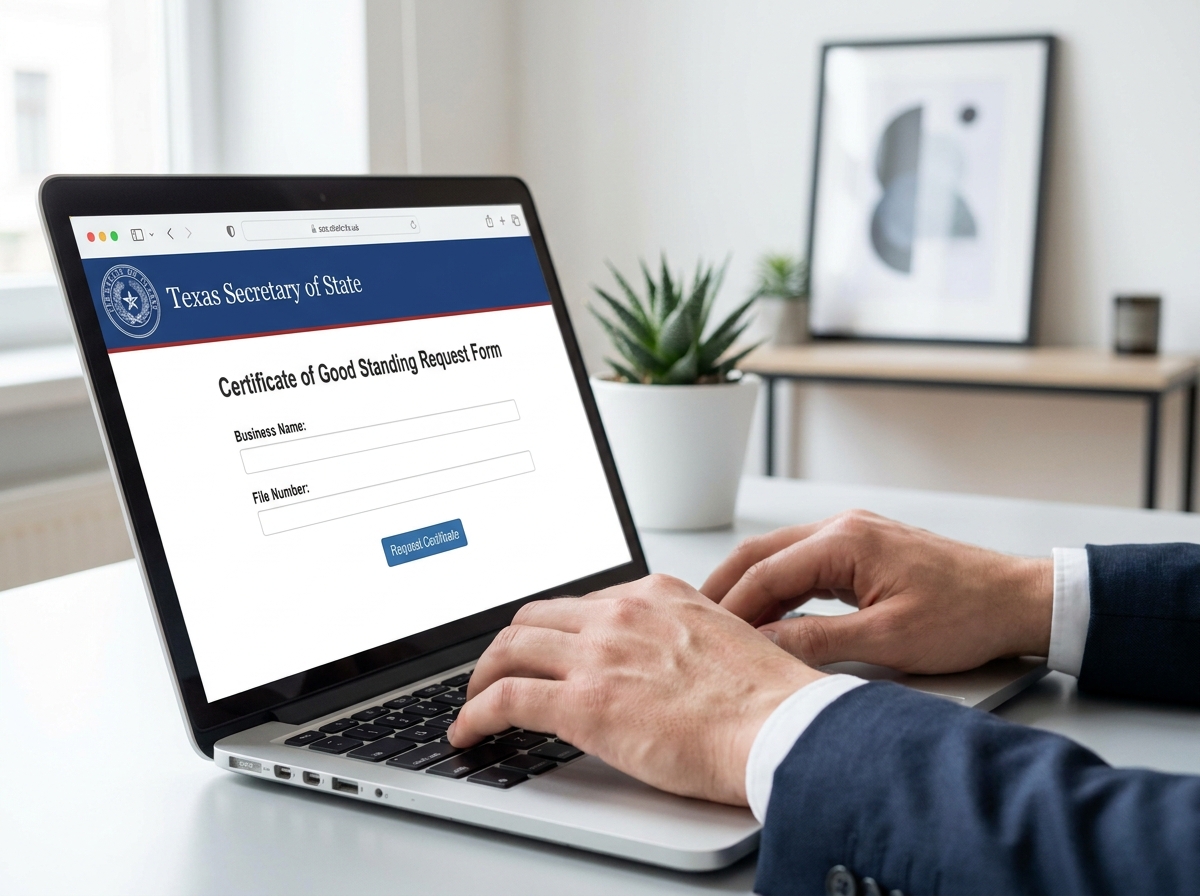
Obtaining a Certificate of Good Standing from the Texas Secretary of State is a straightforward process, provided your business is already compliant. There are several methods available: ## Online Request The most efficient way to obtain your certificate is through the Texas Secretary of State's SOSDirect website. This online portal allows you to search for your entity and request the certificate electronically. You will need your entity's Texas Taxpayer ID Number or File Number. 1. Visit the SOSDirect website. 2. Log in or create an account if you don't have one. 3. Navigate to the 'Certificates' section. 4. Search for your business entity using its file number or name. 5. Select 'Certificate of Fact - Status' (this is the official name for a Certificate of Good Standing in Texas). 6. Pay the required fee using a credit card. You can learn more about forming an LLC in Texas to understand the full picture. The certificate will typically be available for download instantly or sent via email. ## Mail or Fax Request You can also request the certificate by submitting a written request to the Secretary of State. Your request should include: - The exact legal name of your business entity. - Its Texas file number (if known). - A clear statement requesting a 'Certificate of Fact - Status'. - Your mailing address for delivery. - A check or money order for the applicable fee. Send your request to: Statutory Documents Section, Office of the Secretary of State, P.O. Box 12887, Austin, Texas 78711-2887. ## In-Person Request For immediate physical pickup, you can visit the Secretary of State's office in Austin. Be prepared with your entity's information and payment. This option is ideal if you need the physical document on the same day. ## Through a Registered Agent or Business Service Many registered agent services, including Lovie, can assist in preparing and submitting requests for Certificates of Good Standing on behalf of their clients, often as part of a broader compliance service. This can be particularly useful for businesses needing to ensure all state filings are managed efficiently and correctly. Regardless of the method, ensure your business is indeed in good standing before making the request to avoid delays or rejection.
Processing Times and Fees for Texas Certificates
Understanding the processing times and associated fees is crucial when planning to obtain your Texas Certificate of Good Standing. The Texas Secretary of State strives for efficiency, but timelines can vary based on the submission method and current workload. ## Fees As of 2026, the standard fee for a Certificate of Fact - Status (Certificate of Good Standing) from the Texas Secretary of State is $15. This fee applies whether you request it online, by mail, or in person. There are no additional expedited fees for this specific document through the SOSDirect system, as online requests are processed almost instantly. ## Processing Times 1. Online (SOSDirect): This is by far the fastest method. Certificates requested through the SOSDirect portal are typically generated and available for download or emailed within minutes of payment. This makes it the preferred option for urgent needs. 2. In-Person: If you visit the Secretary of State's office in Austin, you can usually obtain the certificate on the same day, often within a few hours, depending on the queue. 3. Mail or Fax: Requests submitted via mail or fax take considerably longer. You should anticipate a processing time of approximately 3-5 business days from the date of receipt, plus additional time for mail delivery. During peak filing seasons, these times can extend further. ## Important Considerations - Payment Methods: Online requests generally require a credit card. Mail-in requests require a check or money order made payable to the 'Secretary of State.' In-person requests may accept credit cards, checks, or cash. - Expedited Service: While the SOSDirect system offers immediate processing for Certificates of Fact, other types of filings (like formation documents) might have expedited options with additional fees. It's important not to confuse these. - Third-Party Services: If you use a third-party service like Lovie to assist with obtaining your certificate, they will handle the submission and fee payment on your behalf, often leveraging the fastest methods to ensure prompt delivery. This can save you time and reduce the administrative burden, especially if you're managing multiple compliance tasks. Always factor in these timelines, especially if you have an impending deadline for a loan application, contract, or foreign qualification.
Maintaining Good Standing for Your Texas Business
Achieving good standing is only the first step; maintaining it consistently is vital for your business's long-term health and compliance in Texas. The requirements can vary slightly depending on your entity type (LLC vs. Corporation), but the core principles remain. ## Key Requirements for Maintaining Good Standing 1. Texas Franchise Tax: All entities formed or registered to do business in Texas, including LLCs and corporations, are subject to the Texas Franchise Tax, administered by the Texas Comptroller of Public Accounts. Even if your business falls below the 'no tax due' threshold (which was $1,230,000 for 2024 and 2025 reporting periods), you are still required to file a Public Information Report (PIR) and an Information Report. Failure to file these can lead to forfeiture of your entity's right to transact business in Texas, revoking its good standing. The annual due date for these reports is May 15th. 2. Registered Agent: Every registered entity in Texas must maintain a registered agent with a physical street address (not a P.O. Box) in Texas. This agent is responsible for receiving official legal and tax correspondence on behalf of your business. If your registered agent resigns, moves without updating their address, or becomes otherwise unavailable, your business could lose its good standing. You must promptly update the Secretary of State with any change in your registered agent or their address. 3. Annual Filings (for Corporations): While Texas LLCs generally don't have an annual report filing requirement with the Secretary of State, Texas Corporations must file an annual Public Information Report (PIR) with the Texas Comptroller of Public Accounts along with their franchise tax report. This report updates the state on officers, directors, and registered agent information. 4. Registered Office: Your business must maintain a registered office in Texas, which is the physical address of your registered agent. ## Consequences of Losing Good Standing If your business loses its good standing, the Texas Secretary of State can forfeit its certificate of formation or registration. This means: - You cannot legally conduct business in Texas. - You may lose the ability to defend your business in court. - You cannot obtain loans or enter new contracts. - Your personal liability protections (for LLCs and corporations) could be jeopardized. Reinstating good standing involves filing all delinquent reports, paying all outstanding fees and penalties, and sometimes applying for reinstatement. Proactive compliance is always less costly and less stressful than reactive reinstatement.
Common Pitfalls and How to Avoid Losing Good Standing
Even seasoned business owners can fall into traps that jeopardize their good standing in Texas. Being aware of these common pitfalls and implementing proactive strategies can save you significant headaches and costs. ## Pitfalls to Watch For 1. Forgetting Franchise Tax Filings: This is perhaps the most common reason for forfeiture. Many new LLC owners mistakenly believe that because Texas doesn't have an income tax, they are exempt from all state taxes or reporting. However, the Texas Franchise Tax, even if you owe $0, requires an annual filing (Public Information Report and Information Report) by May 15th. Even small businesses below the 'no tax due' threshold must file. 2. Outdated Registered Agent Information: If your registered agent moves or resigns, and you don't update the Texas Secretary of State promptly, your business could be deemed non-compliant. The state needs a reliable contact point for official correspondence. 3. Ignoring Mail from the Secretary of State or Comptroller: Official notices often contain critical compliance deadlines or warnings. Disregarding them can lead to inadvertent non-compliance. 4. Assuming 'No Tax Due' Means No Filing: As mentioned, even if your revenue is below the franchise tax threshold, you must still file the required information reports. This is a critical distinction many founders miss. 5. Lack of Internal Tracking: Without a system to track filing deadlines and compliance requirements, it's easy to miss crucial dates, especially as your business grows or you manage multiple entities. ## Strategies for Prevention 1. Set Up Calendar Reminders: Proactively mark your calendar for the May 15th franchise tax and information report deadlines. 2. Use a Reliable Registered Agent Service: Services like Lovie not only act as your registered agent but also provide compliance alerts and often assist with annual report reminders, ensuring you don't miss critical deadlines. 3. Regularly Review Your Entity Information: Annually, check the Texas Secretary of State's website (SOSDirect) to ensure your business's information, especially your registered agent, is up-to-date. 4. Delegate Compliance Tasks: Consider delegating compliance monitoring to a professional service or an internal team member who understands the nuances of Texas regulations. 5. Keep Accurate Financial Records: Accurate bookkeeping makes preparing your franchise tax reports much simpler and reduces the risk of errors. By being diligent and leveraging available resources, you can ensure your Texas business consistently maintains its good standing, avoiding unnecessary complications and maintaining its legal integrity.
When Is a Certificate of Good Standing Not Needed?
While a Certificate of Good Standing is vital for many significant business activities, it's not a document you'll need for every single transaction or interaction. Understanding when it's not required can save you time and the small associated fee. ## Scenarios Where It's Typically Not Required 1. Routine Internal Operations: For day-to-day internal business activities, such as managing payroll, creating marketing materials, or conducting internal meetings, a Certificate of Good Standing is irrelevant. It's an external-facing document. 2. Basic Vendor Relationships: If you're simply purchasing supplies from a local vendor or signing a standard, low-value service agreement, the vendor is unlikely to request this certificate. They're usually more concerned with payment terms and service delivery. 3. Informal Business Inquiries: When you're simply exploring partnerships, discussing potential collaborations, or making general inquiries with other businesses, they won't typically ask for official proof of your entity's status. 4. Personal Transactions (Even if Business-Related): If you're using a personal credit card for a business expense (which is generally not recommended for established businesses but common for sole proprietors or very new ventures), the vendor won't request a Certificate of Good Standing. 5. Sole Proprietorships and General Partnerships: These unincorporated business structures are not registered with the Texas Secretary of State in the same way an LLC or Corporation is. Therefore, they cannot obtain a Certificate of Good Standing (or Certificate of Existence) because they don't have a distinct legal existence from their owners. Their legitimacy is typically proven through business licenses, permits, and tax IDs. 6. Applying for an EIN (Employer Identification Number): The IRS does not require a Certificate of Good Standing to issue an EIN. You primarily need your business's legal name and address, and the responsible party's information. 7. Standard Utility Applications: When setting up utility services (electricity, internet, water) for a business location, providers typically ask for basic business information and a tax ID, but rarely a Certificate of Good Standing. While these scenarios don't demand the certificate, it's essential to recognize that the moment your business steps into a more formal or high-stakes interaction—be it with a bank, a major client, or another state's government—the Certificate of Good Standing will likely become a prerequisite. When in doubt, it's always safer to have a current certificate on hand, especially if you anticipate any of the situations outlined in the 'Why You Need It' section.
Lovie and Your Texas Business Compliance
Navigating the intricacies of state compliance, from initial formation to maintaining good standing, can be a complex and time-consuming endeavor for any founder. This is where Lovie, as your AI-powered company formation and compliance partner, offers significant value for your Texas business. Lovie is designed to streamline the entire lifecycle of your business entity, ensuring you meet Texas state requirements without the typical administrative burden. ## How Lovie Assists with Texas Compliance 1. Initial Formation and Filings: Lovie simplifies the process of forming your Texas LLC or Corporation, preparing and submitting all necessary formation documents (e.g., Certificate of Formation for LLCs) with the Texas Secretary of State. We handle the initial setup, ensuring your entity is correctly registered from day one. 2. Registered Agent Service: A critical component of maintaining good standing in Texas is having a reliable registered agent. Registered agent service is required in every state and is priced separately at $79/year ($49/year in Wyoming). This ensures your business always has a physical address for official correspondence and receives important legal and tax notices promptly. 3. Lovie's $29 one-time fee covers formation preparation and filing, with compliance reminders included; state filing fees are paid directly to your state, and registered agent service is priced separately at $79/year ($49/year in Wyoming). We provide proactive alerts, helping you avoid inadvertent forfeiture and maintain continuous good standing. 4. Assistance with Certificates of Good Standing: While Lovie doesn't issue government documents, we can assist in preparing and submitting requests for your Texas Certificate of Good Standing (Certificate of Fact - Status) on your behalf. This ensures the request is correctly filed with the Texas Secretary of State, leveraging the most efficient methods to get your document quickly. 5. Digital Mail Scanning: As part of our registered agent service, Lovie offers digital mail scanning, ensuring you receive critical documents, including any official notices from the Secretary of State or Comptroller, digitally and in real-time. This helps you stay informed and responsive to compliance needs. Lovie's comprehensive platform is built to provide peace of mind, allowing you to focus on growing your business while we handle the foundational compliance. Our goal is to make staying in good standing in Texas, and across all 50 states, as seamless and effortless as possible for modern founders. Start your Texas business with Lovie and experience hassle-free compliance management from day one.
Frequently asked questions
What is the difference between a Certificate of Good Standing and a Certificate of Existence in Texas?
In Texas, a Certificate of Good Standing and a Certificate of Existence refer to the exact same document. The Texas Secretary of State officially calls it a 'Certificate of Fact - Status.' This document confirms that a business entity (like an LLC or Corporation) is legally registered, has met all state filing requirements, paid applicable fees and taxes, and is authorized to transact business in Texas.
How long is a Texas Certificate of Good Standing valid?
A Texas Certificate of Good Standing is a snapshot in time, reflecting your business's status on the date it was issued. It does not have an expiration date itself, but the information it certifies can change. Most entities requesting it (banks, lenders, other states) will require a certificate issued within the last 30 to 90 days to ensure the information is current.
Can I get a Certificate of Good Standing for a sole proprietorship in Texas?
No, a sole proprietorship cannot obtain a Certificate of Good Standing in Texas. This document is only applicable to business entities that are formally registered with the Texas Secretary of State, such as LLCs, corporations, and limited partnerships. Sole proprietorships are not separate legal entities from their owners and therefore do not receive such certificates.
What happens if my Texas business loses its good standing?
If your Texas business loses its good standing, it means its right to transact business in the state has been forfeited. This can prevent you from opening bank accounts, securing loans, entering contracts, or defending yourself in court. It can also lead to the loss of personal liability protection for LLC and corporate owners. Reinstatement typically involves filing all delinquent reports and paying all outstanding fees and penalties.
Does Texas require annual reports for LLCs to maintain good standing?
Texas LLCs do not file annual reports directly with the Texas Secretary of State in the same way corporations do. However, to maintain good standing, all Texas LLCs (and corporations) must file an annual Public Information Report (PIR) and Information Report with the Texas Comptroller of Public Accounts and pay the Texas Franchise Tax (even if zero tax is due). Failure to file these can lead to forfeiture of good standing.
Can Lovie help me get my Texas Certificate of Good Standing?
Yes, Lovie can assist you in obtaining your Texas Certificate of Good Standing. While we are a private business-formation service and do not issue government documents, we can prepare and submit the request to the Texas Secretary of State on your behalf, leveraging the most efficient methods to help you get your document promptly and ensure your business remains compliant.
Texas Formation Data Insights
| State Filing Fee | $300 |
| Annual Fee | $0 (No annual fee) |
| First Year Total | $300 |
| Processing Time | 6.2 days avg (official: 5-7 days) |
| Corporate Tax Rate | No corporate income tax |
Key Insights
- Texas'de LLC kurulum maliyeti ulusal ortalamanın $76 üzerinde — toplam ilk yıl maliyeti $300.
- Lovie platformu üzerinden Texas LLC başvuruları ortalama 6.2 iş gününde onaylanmaktadır (eyalet resmi süresi: 5-7 gün).
- Texas merkezli işletmeler için EIN onay süresi ortalama 6.7 gündür.
- Texas kurumlar vergisi uygulamaz — bu durum özellikle yüksek kâr marjlı işletmeler için önemli bir avantaj sağlar.
Data sources: State Secretary of State offices, IRS, Tax Foundation (2026). Platform metrics based on anonymized Lovie user data.
Key Concepts: Business Formation
US Business Formation guides entrepreneurs through the business formation process with actionable steps. Key components include LLC formation, entity registration, and state filing, each playing a critical role in the business formation process. Understanding liability protection and tax optimization is essential, as these factors directly impact legal compliance.
When evaluating business formation options, factors such as business entity types and formation process should inform your decision-making process.
Entity Relationships
- Business Formation requires LLC formation
- Business Formation includes entity registration
- Business Formation establishes state filing
- Business Formation defines business structure selection
Quick answers
What do I need to know about Certificate Of Facts for my business?
Understanding Certificate Of Facts is essential for business compliance and operational success. The specific requirements vary by state and industry.
How does Certificate Of Facts affect my business formation?
This aspect of business formation directly impacts your legal standing, tax obligations, and operational flexibility.
Explore Formation Guides
State-specific formation guides, cost breakdowns, compliance checklists, and expert comparisons — updated for 2026.
LLC Formation Guides
- How to Form an LLC for Virtual Assistant Hawaii
- How to Form an LLC for Web Developer West Virginia
- How to Form an LLC for Drone Services Wyoming
- How to Form an LLC for Freelancing California
Popular Guides
Cost by Entity & State
- Sole Proprietorship Cost Alabama Formation Costs
- Nonprofit Cost Michigan Formation Costs (2026) | Lovie
- C Corp Cost South Carolina Formation Costs (2026) | Lovie

Lovie is not a government agency, law firm, or professional advisory organization. Lovie is a private business-formation service that prepares and submits filings to the appropriate state agencies on your behalf — we do not issue government documents, and state approval times are not controlled by Lovie. Information on this page is general and not legal, tax, or financial advice.