
On this page · 7 sections
Unpacking EIN Reference Code 101 and Its Context
When you embark on the journey of forming a new business entity, whether it's a Delaware LLC for your AI startup or a California C-Corp for your e-commerce venture, obtaining an Employer Identification Number (EIN) from the IRS is a critical early step. This unique nine-digit number acts as your business's federal tax ID, essential for everything from hiring employees to opening a business bank account. During this process, especially when using online application methods or third-party services, founders sometimes encounter cryptic messages, one of which is frequently referred to as 'EIN Reference Code 101'. It's important to clarify upfront: 'EIN Reference Code 101' is not an official IRS error code. You won't find it listed in IRS publications or on their official error message documentation. Instead, it's a term that has emerged within online communities and forums, often associated with applications that might be pending, require manual review, or have encountered a non-standard processing issue within a third-party system. You can learn more about setting up your Arkansas LLC to understand the full picture. Its appearance typically signals a delay or a need for further attention rather than a definitive rejection or a specific, rectifiable error code directly from the IRS. Founders often interpret it as a generic 'something is off' indicator, prompting them to seek clarification. Understanding this distinction is the first step toward effectively addressing the situation and ensuring your EIN application progresses without unnecessary friction. The IRS aims for a streamlined process, but the digital landscape introduces many layers, and 'Code 101' often lives in those layers.
The Core: What an EIN Is and Why It's Indispensable
An Employer Identification Number (EIN) is more than just a sequence of digits; it's the federal government's primary identifier for your business. Think of it as your company's Social Security Number. The IRS uses the EIN to identify businesses for tax purposes, and it's a mandatory requirement for most business structures. For instance, if you're forming an LLC with multiple members, even if you don't plan to hire employees immediately, an EIN is required. Similarly, all corporations (C-Corps and S-Corps) must have an EIN, regardless of their size or employee count. Sole proprietorships, while not always required to have an EIN if they don't have employees, often benefit from obtaining one to separate personal and business finances, especially for banking purposes. Beyond tax filings, an EIN is crucial for a multitude of business operations. You'll need it to open a business bank account, apply for business licenses and permits, file various federal and state tax returns, and even for certain types of business loans or credit applications. We cover this in depth in our resource on how to register an LLC in California. Without an EIN, your business simply cannot operate legally in the United States. For international founders, securing an EIN is a foundational step to establishing a legitimate U.S. presence, enabling them to engage in commerce, hire U.S. personnel, and comply with federal regulations. The process is designed to be straightforward, but understanding its fundamental importance helps underscore why any delay, real or perceived, warrants immediate attention. The IRS estimates that over 4.5 million EINs are issued annually, highlighting its widespread necessity across the American business landscape.
Decoding Delays: Common Causes of EIN Application Hold-Ups
While the IRS typically processes online EIN applications immediately, several factors can lead to delays, which might manifest as a 'Reference Code 101' in a third-party system or simply a prolonged waiting period. Understanding these common pitfalls can help you avoid them. ## Data Mismatches and Inaccuracies One of the most frequent causes is inconsistent information. If the name, address, or responsible party's Social Security Number (SSN) or Individual Taxpayer Identification Number (ITIN) on your EIN application doesn't precisely match IRS records, your application could be flagged for manual review. Even minor typos can cause issues. For example, applying for an EIN for 'Acme LLC' when your state filing lists 'Acme L.L.C.' might trigger a discrepancy. ## Duplicate Applications Submitting multiple EIN applications for the same entity within a short timeframe is another common issue. The IRS assigns only one EIN per entity. If you apply, don't hear back, and then apply again, the system might detect a duplicate, leading to a delay while they reconcile the records. Check out our guide on forming an LLC in Colorado for step-by-step instructions. This is particularly common when founders use different third-party services or apply directly and then through a service. ## Responsible Party Limitations An individual can only be the 'responsible party' for a limited number of entities in a 12-month period if applying online. If you're a serial entrepreneur or forming many entities, you might hit this limit, requiring a different application method. ## Technical Glitches and System Maintenance Occasionally, delays can be attributed to IRS system outages or maintenance. While less common, these can temporarily halt instant processing. ## Non-standard Business Structures Certain complex trusts, estates, or specific types of non-profits might require additional scrutiny, leading to longer processing times. For most standard LLCs and C-Corps, this is rarely the primary cause. By being meticulous with your data and understanding the application rules, you can significantly reduce the chances of encountering these delays.

Official IRS Error Codes: What to Expect from the Source
To truly understand 'EIN Reference Code 101' and its unofficial nature, it's helpful to distinguish it from actual IRS error messages. The Internal Revenue Service does issue specific error codes and messages during its online EIN application process, particularly through the IRS EIN Assistant. These official codes are typically explicit, indicating a precise issue that needs correction. For example, you might encounter messages like 'Entity already has an EIN,' 'Invalid SSN/ITIN for responsible party,' or 'Application cannot be processed online due to prior activity.' Each of these provides clear guidance on the problem and often suggests a direct course of action, such as verifying existing EINs, correcting personal identification numbers, or resorting to fax or mail applications.
Key Differences:
- Source: Official IRS error codes come directly from the IRS application system. 'Reference Code 101' often originates from third-party platforms or internal processing queues.
- Specificity: IRS codes pinpoint exact errors. 'Reference Code 101' is typically generic, signaling a need for manual review or further investigation without specifying the cause.
- Actionability: Official IRS errors usually come with instructions for resolution. 'Reference Code 101' often requires the applicant to proactively contact the service provider or the IRS for clarification.
When applying directly through the IRS, the system is designed to provide immediate feedback. If you don't receive an instant EIN, it's usually accompanied by an explicit message. If you're using a third-party service and encounter a 'Reference Code 101,' it implies that the service itself is encountering an internal processing delay or a flag that prevents automated completion, rather than a direct rejection from the IRS. This distinction is crucial for directing your troubleshooting efforts efficiently and avoiding unnecessary panic. Knowing that the IRS provides clear error messages means that if you're not getting one, the issue might lie elsewhere, or the application is simply in a pending state awaiting manual review.
Action Plan: What to Do If You See 'EIN Reference Code 101'
Encountering 'EIN Reference Code 101' can be unsettling, but with a structured approach, you can effectively resolve the issue. Here's a step-by-step guide:
- Do Not Reapply Immediately: Your first instinct might be to resubmit the application. Resist this urge. As discussed, duplicate applications are a common cause of delays. Wait at least 24-48 hours before taking any further action, as some processing queues might resolve automatically.
- Contact Your Third-Party Provider (If Applicable): If you applied through a service like Lovie, your first point of contact should be their support team. They will have direct insight into their system's status and can often provide more specific information about what 'Code 101' means within their workflow. They can also escalate the issue or advise on next steps, such as confirming data accuracy or submitting a manual application.
- Review Your Application Details: Carefully cross-reference all information submitted on your EIN application with your state formation documents (e.g., Articles of Organization for an LLC, Articles of Incorporation for a C-Corp). Pay close attention to:
- Legal business name (exact match)
- Business address
- Responsible party's name and SSN/ITIN
- Date of formation
- Type of entity
Even a slight discrepancy can cause a flag.
- Check IRS Processing Times: While online applications are usually instant, manual applications (fax or mail) can take weeks. If your application was somehow routed to a manual process, understanding the expected wait time can alleviate anxiety. The IRS publishes current processing times on its website.
- Contact the IRS (If Necessary): If your third-party provider cannot resolve the issue, or if you applied directly, you may need to contact the IRS Business & Specialty Tax Line at 1-800-829-4933. Be prepared with your application details and any reference numbers you received. Explain that you're inquiring about an EIN application that seems to be pending or has a non-standard reference code.
Remember, patience and meticulous record-keeping are your best allies in navigating these administrative hurdles. Avoid making assumptions; always seek direct clarification.
Lovie: Streamlining Your EIN Application and Business Formation
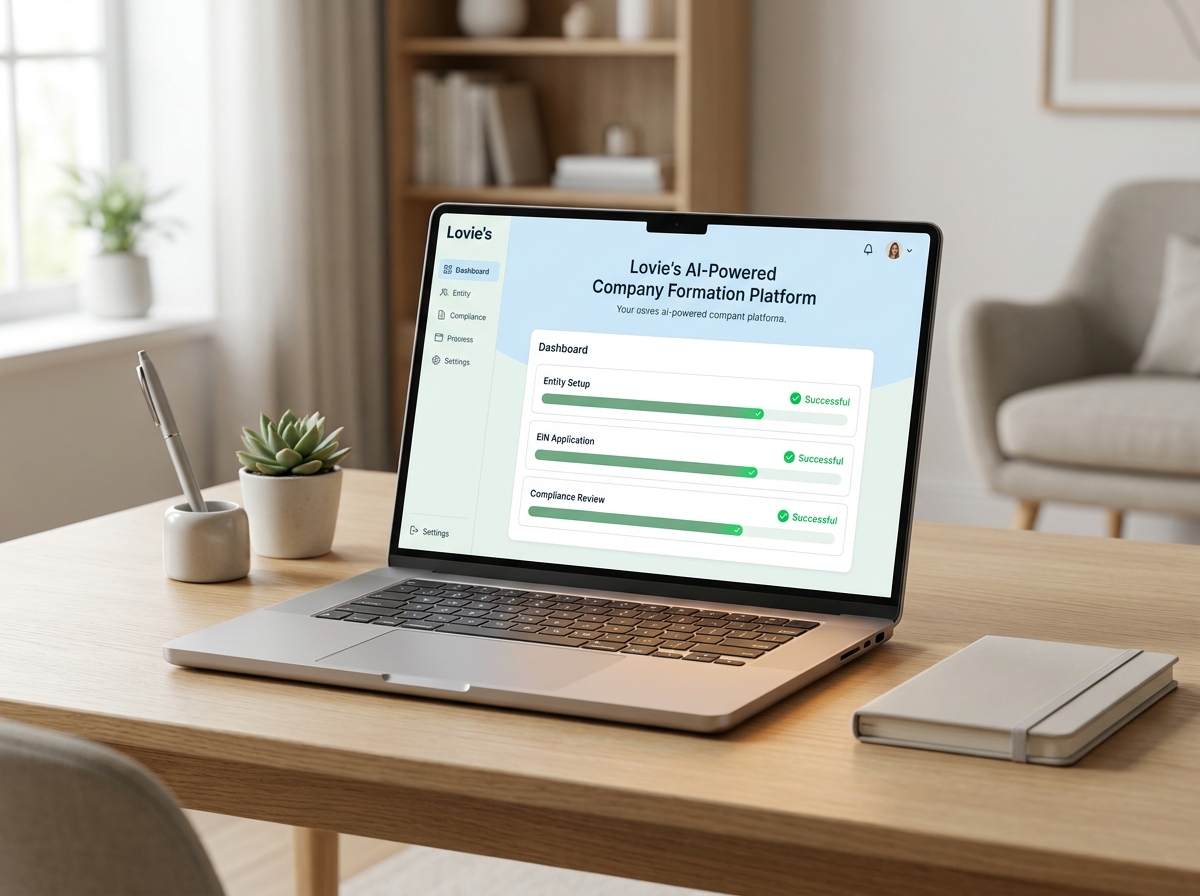
Navigating the complexities of business formation, from state filings to securing an EIN, can be daunting for even the most experienced founders. This is precisely where Lovie, the AI-powered company formation platform, differentiates itself. Lovie doesn't just prepare and submit your state formation documents; it seamlessly integrates the EIN registration process with the IRS, significantly reducing the chances of encountering issues like 'Reference Code 101' through its intelligent system.
When you form your LLC or C-Corp with Lovie, the platform guides you through each step, ensuring data consistency across your state filing and your EIN application. Our conversational UI prompts for all necessary information, cross-validating inputs to minimize common errors such as data mismatches or typos that often trigger manual reviews. Lovie's $29 one-time fee covers formation preparation and filing, with compliance reminders included; state filing fees are paid directly to your state, and registered agent service is priced separately at $79/year ($49/year in Wyoming).
Lovie's Differentiators:
Lovie's $29 one-time fee covers formation preparation and filing, with compliance reminders included; state filing fees are paid directly to your state, and registered agent service is priced separately at $79/year ($49/year in Wyoming). This eliminates the need for you to navigate separate government portals, reducing the risk of errors and saving valuable time.
- AI-Driven Compliance: Our AI monitors your application for potential issues, providing real-time feedback and ensuring that your submission adheres to IRS guidelines. If an issue arises, Lovie's system is designed to provide clear, actionable guidance rather than ambiguous reference codes.
- Expert Support: Should any questions arise, Lovie's 24/7 support team is available to assist. Our team is well-versed in IRS procedures and can help troubleshoot specific scenarios, offering a human touch to an otherwise automated process.
For international founders, Lovie is particularly invaluable. We assist with the often-complex process of obtaining an EIN without an SSN, guiding you through the necessary steps and forms, such as Form SS-4. This makes establishing your U.S. business presence from anywhere in the world significantly more accessible. With Lovie, you're not just getting a service; you're gaining a partner that simplifies compliance and accelerates your path to launching a fully operational, federally compliant business, whether it's a fintech startup in Delaware or a real estate investment vehicle in Florida. Registered agent service is required in every state and is priced separately at $79/year ($49/year in Wyoming).
Beyond Registration: Maintaining EIN Compliance and Updates
Obtaining your EIN is a significant milestone, but it's just the beginning of your compliance journey. Maintaining proper EIN compliance involves several ongoing responsibilities. For example, if your business undergoes significant changes, such as a change in legal entity type (e.g., converting an LLC to a C-Corp), a change in the responsible party, or a change in business name, you might need to inform the IRS or, in some cases, apply for a new EIN. It's crucial to understand when a new EIN is required versus when you simply need to update your existing IRS records.
When a New EIN Might Be Needed:
- Change in Entity Type: If your sole proprietorship incorporates, or your partnership becomes an LLC, a new EIN is typically required.
- New Partnership: If a sole proprietorship takes on a partner, it becomes a partnership and needs a new EIN.
- Bankruptcy: A new EIN may be required for certain types of bankruptcies.
- Purchasing an Existing Business: If you purchase an existing business and operate it as a different legal entity, you will need a new EIN.
When to Update Existing Records (Not a New EIN):
- Change of Business Name: Inform the IRS, but generally, your existing EIN remains valid.
- Change of Business Location: Update your address with the IRS.
- Change of Responsible Party: Notify the IRS of the new individual in charge via Form 8822-B.
For instance, if you establish an LLC in Texas with Lovie and later decide to convert it to a C-Corp to attract venture capital, Lovie's platform can assist with the conversion process and guide you on the necessary steps to secure a new EIN if required. Regular review of your business structure and ensuring your IRS records are up-to-date is a non-negotiable aspect of long-term business health. The IRS relies on accurate information to process tax filings and communicate effectively with your business. Neglecting these updates can lead to penalties, processing delays for tax returns, or even legal complications down the line. Lovie's $29 one-time fee covers formation preparation and filing, with compliance reminders included; state filing fees are paid directly to your state, and registered agent service is priced separately at $79/year ($49/year in Wyoming).
Frequently asked questions
Is EIN Reference Code 101 an official IRS error?
No, EIN Reference Code 101 is not an official IRS error code. You will not find it in any IRS publications or official documentation. It is typically a reference or internal code used by third-party EIN application services or within online communities to signify an application that is pending, requires manual review, or has encountered a non-standard processing issue within a third-party system, rather than a direct rejection from the IRS itself. Official IRS errors are usually specific and provide clear instructions for resolution.
How long does it typically take to get an EIN?
If you apply for an EIN online directly through the IRS and your application passes all automated checks, you will typically receive your EIN immediately. However, if your application requires manual review due to data discrepancies, previous applications, or other flags, it can take several weeks (e.g., 2-4 weeks for fax applications, longer for mail). If you are an international applicant without an SSN, the process can also take longer, often requiring Form SS-4 to be faxed or mailed.
Can I use my Social Security Number (SSN) instead of an EIN for my business?
Only sole proprietors without employees can typically use their SSN for business tax purposes. However, most other business structures, including LLCs with multiple members, partnerships, and all corporations (C-Corps, S-Corps), are legally required to obtain an EIN. Even sole proprietors often choose to get an EIN to separate business and personal finances, enhance credibility, and simplify tax filings.
What if I need an EIN but don't have a Social Security Number (SSN)?
International founders or others who do not have an SSN can still obtain an EIN. You will need to complete IRS Form SS-4, 'Application for Employer Identification Number,' and submit it via fax or mail. The IRS processes these applications manually, so the waiting time is typically longer than online applications. Lovie can assist international founders in preparing and submitting Form SS-4 to streamline this process.
What is the 'responsible party' on an EIN application?
The 'responsible party' is the individual who ultimately owns or controls the entity or who exercises ultimate effective control over the entity. This individual must be an actual person with a valid SSN or ITIN. For corporations, this is typically the CEO or President. For an LLC, it might be a managing member. The IRS uses this person's information to verify the application and ensure accountability.
Do I need a new EIN if I change my business name or address?
Generally, no. If your business entity type remains the same (e.g., an LLC remains an LLC), you typically do not need a new EIN for a name or address change. You simply need to notify the IRS of the change. For a name change, you'd typically update this when filing your tax returns. For an address change, you can use Form 8822-B, 'Change of Address or Responsible Party - Business.' A new EIN is usually only required when the legal structure or ownership of the business fundamentally changes.
Can Lovie guarantee I will get an EIN instantly?
Lovie prepares and submits your EIN application to the IRS on your behalf, designed to maximize efficiency and minimize errors. While the IRS typically issues EINs instantly for online applications without issues, Lovie cannot guarantee instant issuance as the final decision and processing time rests solely with the IRS. Factors like prior applications, data discrepancies, or IRS system maintenance can affect processing times. Lovie's role is to ensure your application is accurate and properly submitted, and to assist you if any issues arise.
Key Concepts: Business Formation
US Business Formation guides entrepreneurs through the business formation process with actionable steps. Key components include LLC formation, entity registration, and state filing, each playing a critical role in the business formation process. Understanding liability protection and tax optimization is essential, as these factors directly impact legal compliance.
When evaluating business formation options, factors such as business entity types and formation process should inform your decision-making process.
Entity Relationships
- Business Formation requires LLC formation
- Business Formation includes entity registration
- Business Formation establishes state filing
- Business Formation defines business structure selection
Quick answers
What do I need to know about Ein Number Usa for my business?
Understanding Ein Number Usa is essential for business compliance and operational success. The specific requirements vary by state and industry.
How does Ein Number Usa affect my business formation?
This aspect of business formation directly impacts your legal standing, tax obligations, and operational flexibility.
Explore Formation Guides
State-specific formation guides, cost breakdowns, compliance checklists, and expert comparisons — updated for 2026.
LLC Formation Guides
- How to Form an LLC for Virtual Assistant Hawaii
- How to Form an LLC for Web Developer West Virginia
- How to Form an LLC for Drone Services Wyoming
- How to Form an LLC for Freelancing California
Popular Guides
Cost by Entity & State
- Sole Proprietorship Cost Alabama Formation Costs
- Nonprofit Cost Michigan Formation Costs (2026) | Lovie
- C Corp Cost South Carolina Formation Costs (2026) | Lovie

Lovie is not a government agency, law firm, or professional advisory organization. Lovie is a private business-formation service that prepares and submits filings to the appropriate state agencies on your behalf — we do not issue government documents, and state approval times are not controlled by Lovie. Information on this page is general and not legal, tax, or financial advice.