On this page · 7 sections
Understanding LLC Dissolution in Maryland
Dissolving a Limited Liability Company (LLC) in Maryland is a formal legal process that officially terminates your business entity's existence. It's more than just ceasing operations; it involves a series of mandatory steps to ensure all legal, financial, and tax obligations are met. Failing to properly dissolve an LLC can lead to lingering liabilities, penalties, and ongoing administrative burdens, even if the business is no longer active. The Maryland Department of Assessments and Taxation (SDAT) is the primary state agency overseeing this process, requiring specific filings to acknowledge the termination. This guide will walk you through each critical phase, from internal member decisions to final state filings and post-dissolution considerations. For related guidance, see our article on setting up your Maryland LLC. Understanding Maryland's specific requirements, outlined primarily in the Maryland Limited Liability Company Act, is crucial for a clean exit. The process ensures that all creditors are paid, assets are distributed correctly, and the entity's legal standing is formally concluded. This prevents situations where the state might still consider your LLC active, leading to delinquent annual reports or franchise taxes.
Internal Decision-Making and Member Voting
Before any external filings can occur, the decision to dissolve your Maryland LLC must be made internally by its members. This process is governed by your LLC's Operating Agreement. The Operating Agreement is the foundational document that outlines how major decisions, including dissolution, are made. Typically, it specifies the voting threshold required for such a significant action. This could be a simple majority, a supermajority (e.g., two-thirds or three-quarters), or even unanimous consent, depending on how your agreement was drafted. If your Operating Agreement does not explicitly cover dissolution, Maryland law dictates that the consent of all members is required to dissolve the LLC. For more details, see our guide on how to register an LLC in Maryland. Once the decision is made, it's prudent to document it formally through a written resolution or meeting minutes, signed by all consenting members. This internal record serves as crucial evidence of the decision, especially if questions arise later. This step is often overlooked, but it is foundational for a legally sound dissolution. Without proper internal authorization, any subsequent filings with the state could be challenged or deemed invalid. This internal resolution also typically outlines the plan for winding up the LLC's affairs, which includes liquidating assets, paying debts, and distributing remaining funds.
Winding Up Affairs and Settling Debts
Once the decision to dissolve is formally made, the LLC enters a 'winding up' phase. During this period, the LLC remains a legal entity but its activities are restricted to those necessary for liquidation. This involves several critical actions: 1. Notifying Creditors: The LLC must notify all known creditors of its intent to dissolve. Maryland law does not specify a mandatory notification method, but sending written notices via certified mail with return receipt requested is a best practice. This notice should include a deadline for submitting claims, typically 120 days from the notice date. 2. Collecting Assets: All outstanding accounts receivable and other assets of the LLC must be collected. 3. Paying Debts and Liabilities: This is a crucial step. You can learn more about forming an LLC in Maryland to understand the full picture. All debts, obligations, and liabilities of the LLC must be paid or adequately provided for. This includes loans, vendor invoices, lease agreements, and any pending legal judgments. Maryland law prioritizes payments: first to creditors (including members who are creditors), then to members for capital contributions, and finally, any remaining assets are distributed among members according to their shares. 4. Liquidating Assets: Any remaining assets not used to pay debts should be liquidated. This might involve selling property, equipment, or intellectual property. The proceeds are then used to satisfy remaining obligations or are distributed to members. Properly managing this phase prevents future claims against members personally. It’s also vital to cancel any business licenses or permits and close business bank accounts after all financial obligations are cleared.
Filing Articles of Cancellation with SDAT
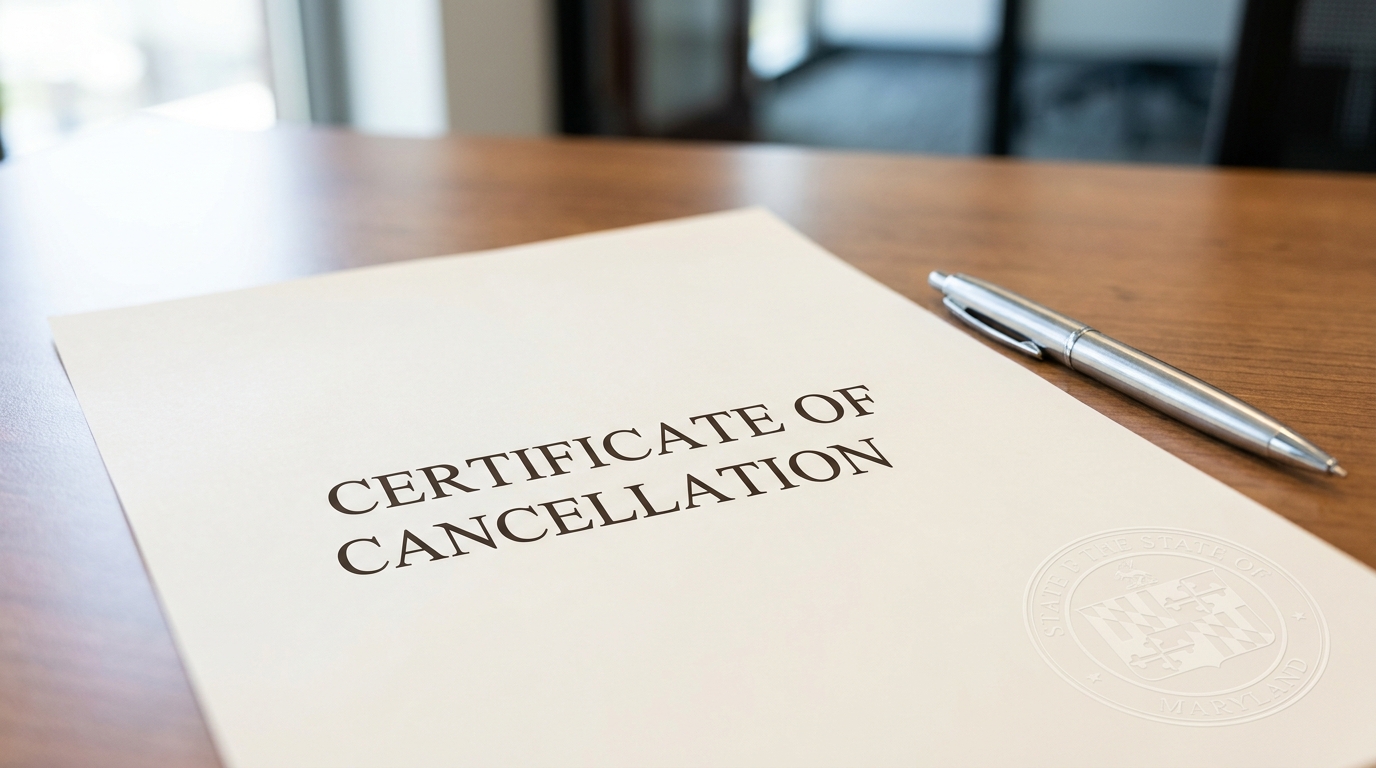
The formal legal termination of your Maryland LLC is achieved by filing Articles of Cancellation with the Maryland Department of Assessments and Taxation (SDAT). This document officially informs the state that your LLC is ceasing its existence. The form required is typically the 'Articles of Cancellation' (Form SDAT C-085). You can find this form on the SDAT website. When completing the Articles, you will need to provide basic information about your LLC, including its legal name, Department ID number, and the date the dissolution was authorized by the members. It's crucial that the information provided is accurate and consistent with your internal records. The filing fee for Articles of Cancellation in Maryland is $100 as of 2026. This fee must accompany your filing. You can submit the Articles online through the SDAT website, by mail, or in person. Online filing is often the quickest method. Ensure that all necessary attachments, if any, are included. Once filed and approved, SDAT will issue a confirmation, at which point your LLC is legally dissolved in Maryland. It's important to note that the LLC must be in 'good standing' with SDAT to file Articles of Cancellation. This means all annual reports and any associated late fees must be current. If your LLC is not in good standing, you will need to resolve any outstanding issues before the Articles of Cancellation can be accepted. Lovie can assist founders in navigating state-specific forms and ensuring all details are correctly prepared for submission, streamlining this final step.
Tax Obligations and IRS Notification
Dissolving an LLC has significant tax implications at both the federal and state levels. It's crucial to address these to avoid future tax liabilities. ## Federal Tax Obligations At the federal level, you must notify the IRS of the LLC's dissolution. The specific forms required depend on how your LLC was taxed: - Single-member LLC (Disregarded Entity): If you reported income and expenses on your personal Form 1040 (Schedule C, E, or F), you'll simply mark the 'final return' box on your last Schedule C (or other relevant schedule). - Partnership: File a final Form 1065, U.S. Return of Partnership Income. Mark the 'final return' box. - S-Corp: File a final Form 1120-S, U.S. Income Tax Return for an S Corporation. Mark the 'final return' box. - C-Corp: File a final Form 1120, U.S. Corporation Income Tax Return. Mark the 'final return' box. Additionally, you will need to cancel your Employer Identification Number (EIN) if your LLC has one and will no longer have employees or operate. You don't formally 'cancel' an EIN online; instead, you send a letter to the IRS stating that you want to close your business account and include the LLC's legal name, EIN, and the reason for closing. ## Maryland State Tax Obligations For Maryland, you must file any outstanding state income tax returns, sales and use tax returns, and employer withholding tax returns. Ensure all state tax accounts are closed. The Comptroller of Maryland is the primary agency for state tax matters. It's highly recommended to consult with a qualified tax professional to ensure all federal and state tax obligations are met and to understand any potential tax consequences of asset distribution to members. Proper tax clearance is paramount to a clean exit.
Post-Dissolution Best Practices
Even after your Maryland LLC is officially dissolved with SDAT and all tax obligations are addressed, there are several post-dissolution best practices to follow to ensure a complete and clean break. These steps help prevent unforeseen issues down the line. First, maintain detailed records. Keep all dissolution documents, including the approved Articles of Cancellation, internal resolutions, creditor notices, tax filings, and any agreements related to asset distribution, for at least seven years. These records are vital for proving the LLC's dissolution if future questions arise from creditors, former members, or government agencies. Second, close all business accounts and cancel services. This includes closing bank accounts, credit lines, and merchant accounts. Ensure all utility services, business insurance policies, and subscription services tied to the LLC are formally canceled. Update any online directories or professional listings that might still show your LLC as active. Third, distribute remaining assets. After all debts and liabilities are paid, any residual assets must be distributed to the members according to the terms of the Operating Agreement. Document these distributions carefully. Fourth, consider professional liability. Even after dissolution, members may still face liability for actions taken during the LLC's operational period. Discuss with your legal counsel if any professional liability insurance or tail coverage is advisable, especially for certain regulated professions. By diligently following these post-dissolution steps, you minimize the risk of lingering issues and ensure a definitive conclusion to your Maryland LLC's existence.
Reinstating a Dissolved Maryland LLC
There might be situations where you need to reinstate a Maryland LLC that was previously dissolved, either voluntarily or administratively. If your LLC was administratively dissolved by SDAT for reasons such as failure to file annual reports or maintain a registered agent, reinstatement is generally straightforward. You would typically need to file all delinquent annual reports, pay any outstanding fees and penalties, and ensure you have a valid registered agent. The specific form for this is usually the 'Application for Reinstatement' (Form SDAT 1-05). As of 2026, the filing fee for reinstatement is $100, in addition to any past due annual report fees and penalties. If your LLC was voluntarily dissolved by filing Articles of Cancellation, reinstatement is more complex and might not always be possible or practical. Maryland law allows for the reinstatement of an LLC that was voluntarily dissolved, but generally within a limited timeframe (e.g., three years from the date of cancellation). The process involves filing Articles of Revival with SDAT. This form requires specific information and might necessitate a new internal resolution from members to revive the entity. It's crucial to consult with legal counsel if you are considering reinstating a voluntarily dissolved LLC, as the implications can be significant. Reinstating an LLC means it resumes its legal existence as if it had never been dissolved, making it responsible for all obligations incurred during the period of dissolution. This process is distinct from forming a brand new LLC, which Lovie can simplify for you in Maryland or any other state.
Frequently asked questions
What is the difference between dissolving and administratively forfeiting an LLC in Maryland?
Dissolving an LLC is a voluntary process initiated by the LLC members to formally terminate the business entity's legal existence. It involves internal decisions and filing Articles of Cancellation with SDAT. Administrative forfeiture, on the other hand, occurs when the state (SDAT) terminates an LLC's good standing due to non-compliance, such as failing to file annual reports or maintain a registered agent. While forfeiture means the LLC loses its legal standing, it doesn't always automatically dissolve it, leaving potential liabilities. Proper dissolution is a clean, intentional exit.
Do I need a lawyer to dissolve my Maryland LLC?
While it is not legally mandated to hire a lawyer to dissolve your Maryland LLC, it is highly recommended, especially for complex situations involving multiple members, significant assets, or outstanding debts. A lawyer can ensure all legal requirements are met, liabilities are properly managed, and the dissolution process complies with your Operating Agreement and state law. For simple, single-member LLCs with no debts, you might be able to manage the process yourself, but professional guidance minimizes risk.
What happens if I don't formally dissolve my Maryland LLC?
If you simply cease operations without formally dissolving your Maryland LLC, the entity will remain legally active in the state's records. This can lead to ongoing obligations such as filing annual reports and potentially incurring late fees or penalties for non-compliance. You could also remain liable for state franchise taxes. Furthermore, without proper dissolution, your personal assets may not be fully protected from future business debts or legal actions, undermining the very purpose of an LLC. A formal dissolution is crucial for a clean legal break.
Can I transfer my Maryland LLC to another state instead of dissolving it?
Yes, it is possible to transfer your Maryland LLC to another state through a process called 'domestication' or 'conversion.' This involves filing specific documents with both the Maryland SDAT (often Articles of Conversion or Dissolution/Withdrawal) and the new state's filing office (Articles of Domestication/Conversion or new Articles of Organization). This process allows the LLC to maintain its continuity while changing its state of domicile. It is a complex procedure that requires careful planning and adherence to both states' laws, and often involves legal and tax advice.
What if my LLC has existing contracts or leases?
If your LLC has existing contracts, leases, or other ongoing agreements, these must be addressed during the winding-up phase. You generally have a few options: assign the contracts to another entity or individual (if the contract allows it), negotiate an early termination with the other party, or fulfill the terms of the agreement until its natural conclusion. Failing to properly manage existing contracts can lead to breach of contract claims against the LLC or its members. Legal review of all active agreements is highly advisable before dissolution.
Quick answers
What do I need to know about How To Change Ownership Of An Llc In for my business?
Understanding How To Change Ownership Of An Llc In is essential for business compliance and operational success. The specific requirements vary by state and industry.
How does How To Change Ownership Of An Llc In affect my business formation?
This aspect of business formation directly impacts your legal standing, tax obligations, and operational flexibility.
Explore Formation Guides
State-specific formation guides, cost breakdowns, compliance checklists, and expert comparisons — updated for 2026.
Popular Guides
- How to Close an LLC in Nc | Lovie — US Company Formation
- How To Close An LLC IN North Carolina — US Company Formation
- How to Close an LLC in Texas | Lovie — US Company Formation
- How to Close an LLC | Lovie — US Company Formation
- How To Close Business IN Washington State — US Company
- How to Close Down an LLC | Lovie — US Company Formation
- How To Close LLC IN California — US Company Formation Guide
- How to Close LLC in Maryland | Lovie — US Company Formation
- How to Close LLC in Michigan | Lovie — US Company Formation
- How to Close LLC in Pa | Lovie — US Company Formation
- How To Close LLC IN Washington State — US Company Formation
- How to Close LLC: A Step-by-Step Guide | Lovie
- How to Close Your LLC: A Step-by-Step Guide | Lovie
- How To Convert A DBA To An LLC — US Company Formation Guide
- How To Convert A Sole Proprietorship Into An LLC — US

Lovie is not a government agency, law firm, or professional advisory organization. Lovie is a private business-formation service that prepares and submits filings to the appropriate state agencies on your behalf — we do not issue government documents, and state approval times are not controlled by Lovie. Information on this page is general and not legal, tax, or financial advice.