
On this page · 8 sections
Understanding LLC Dissolution in Michigan
Closing a Limited Liability Company (LLC) in Michigan, commonly referred to as dissolution, is a structured legal process. It's more than simply ceasing operations; it involves formally terminating the business entity with the state. This critical step ensures that the LLC's legal existence is officially ended, protecting its members from potential future liabilities and obligations. Michigan's Limited Liability Company Act, specifically MCL 450.4801 through 450.4808, outlines the statutory requirements for dissolution. Understanding these provisions is fundamental to a smooth and compliant closure. The reasons for dissolution are varied: an LLC might have reached the end of its intended operational period, its purpose may have been fulfilled, or the members might simply decide to pursue different ventures. Regardless of the motivation, neglecting the formal dissolution process can lead to significant problems. An LLC that fails to properly dissolve remains on the state's active records, potentially incurring ongoing annual statement filing requirements, registered agent fees, and even penalties for non-compliance. We cover this in depth in our resource on LLC registration in Michigan. Moreover, without formal dissolution, the personal liability protection afforded by the LLC structure could be compromised, leaving members vulnerable to business debts or legal actions long after they believed the business was closed. Michigan law distinguishes between administrative dissolution and voluntary dissolution. Administrative dissolution occurs when an LLC fails to comply with state requirements, such as neglecting to file its annual statement. While this terminates the LLC's good standing, it does not absolve members of all liabilities and often requires reinstatement to formally dissolve. Voluntary dissolution, which this guide focuses on, is a proactive process initiated by the LLC members to legally close the entity. This active approach is crucial for founders looking to move on cleanly and without lingering legal or financial ties to a defunct business.
Pre-Dissolution Checklist for Michigan LLCs
Before initiating the formal dissolution process, a thorough internal review is essential. This preliminary checklist helps ensure that your Michigan LLC is in a position to dissolve smoothly and that all critical internal matters are addressed. Skipping these foundational steps can lead to complications, delays, or even unintended liabilities later in the process. First, review your LLC's Operating Agreement. This foundational document often contains specific provisions regarding dissolution, including voting requirements for members, procedures for asset distribution, and timelines. Adhering to these internal rules is paramount, as they govern the members' rights and responsibilities during closure. If your Operating Agreement is silent on dissolution, Michigan's default statutory rules will apply. Next, ensure all outstanding contracts and agreements are either fulfilled, terminated, or assigned. This includes vendor contracts, lease agreements, service contracts, and any other ongoing commitments. Check out our guide on setting up your Michigan LLC for step-by-step instructions. Liquidating inventory, collecting final accounts receivable, and settling any immediate payables are also critical. Reconcile all bank accounts and financial records to ensure a clear picture of the LLC's financial standing. This includes preparing final financial statements and reviewing tax liabilities. Finally, verify that your LLC is in good standing with the Michigan Department of Licensing and Regulatory Affairs (LARA). You can check your LLC's status on the LARA website. If your LLC is not in good standing due to unfiled annual statements or other issues, you may need to resolve these first before LARA will accept your dissolution filings. Addressing these internal and compliance matters upfront streamlines the entire dissolution journey, allowing you to proceed with confidence. Lovie's $29 one-time fee covers formation preparation and filing, with compliance reminders included; state filing fees are paid directly to your state, and registered agent service is priced separately at $79/year ($49/year in Wyoming).
Member Approval and Dissolution Plan
The formal decision to dissolve an LLC in Michigan typically requires a vote or written consent from its members. The specific voting threshold is determined by your LLC's Operating Agreement. Many agreements stipulate a supermajority vote (e.g., two-thirds or three-quarters of members) for significant actions like dissolution, while others might require a simple majority. If the Operating Agreement does not specify, Michigan's default rule, MCL 450.4801(1), states that dissolution requires the unanimous consent of all members unless the operating agreement provides otherwise. Documenting this decision is crucial; prepare a formal resolution or minutes of the meeting where the dissolution was approved, signed by all consenting members. This document serves as internal proof of the decision and should be kept with the LLC's records. Once the decision to dissolve is made, the next step is to develop a comprehensive dissolution plan. This plan outlines the practical steps required to wind down the business. It should cover:
- Liquidation of Assets: How will the LLC's property and assets be sold or disposed of? 2. Our resource on how to register an LLC in Michigan breaks this down further. Settlement of Debts: A clear strategy for paying off all creditors, including secured and unsecured debts. 3. Distribution to Members: After all debts are paid, how will any remaining assets be distributed among the members according to their capital contributions and the Operating Agreement? 4. Tax Obligations: A plan for filing final tax returns and obtaining necessary tax clearances. 5. Employee Matters: If applicable, addressing employee terminations, final paychecks, and benefits. Assigning specific individuals or a designated member to oversee various aspects of the winding-up process can significantly improve efficiency. This structured approach minimizes confusion and ensures that all necessary actions are systematically addressed. A well-defined plan, approved by the members, acts as a roadmap for the entire dissolution journey, providing clarity and accountability during a complex period.
Filing Articles of Dissolution with LARA
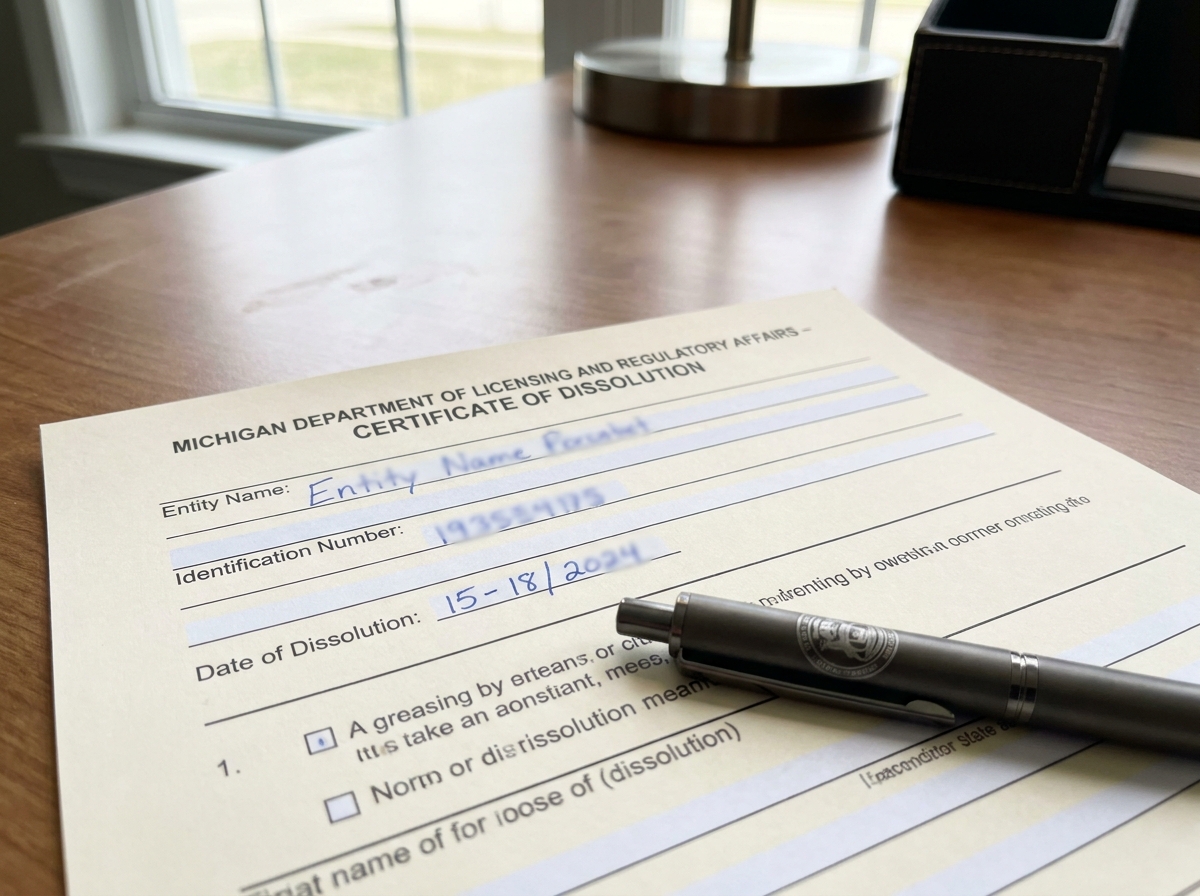
The official notification to the state that your Michigan LLC is dissolving is accomplished by filing the Articles of Dissolution with the Michigan Department of Licensing and Regulatory Affairs (LARA). This is a mandatory legal step that formally begins the winding-up period and informs the public and creditors of your intent to cease business operations.
The specific form required is the Certificate of Dissolution for a Limited Liability Company (Form CSCL/CD-700). This form is relatively straightforward and requires basic information about your LLC, including its name, the date its Articles of Organization were filed, and a statement that the LLC is dissolving in accordance with Michigan law. You will also need to affirm that the dissolution has been approved by the members as required by the Operating Agreement or statute.
Submission and Fees
The Articles of Dissolution can be filed online through the LARA Corporations Online Filing System or by mail. As of 2026, the filing fee for the Certificate of Dissolution is $10. While this fee is minimal, ensure your payment method is valid and that the form is completed accurately to avoid rejection. LARA typically processes filings within 3-5 business days for online submissions, though mail processing can take longer. For expedited services, LARA offers 24-hour, same-day, and two-hour processing for additional fees, which may be beneficial if you are under a tight deadline.
Once accepted, LARA will provide a filed-stamped copy of the Articles of Dissolution, which serves as official proof of your LLC's formal dissolution with the state. This document is critical and should be kept with your LLC's permanent records. Filing the Articles of Dissolution formally marks the end of your LLC's active legal status and transitions it into a winding-up phase, during which you will settle its affairs. Lovie can assist founders by preparing and submitting these critical filings on your behalf, ensuring accuracy and compliance with state requirements.
Winding Up Business Operations
After filing the Articles of Dissolution, your Michigan LLC enters the 'winding up' phase. This period is dedicated to systematically closing out all business activities in an orderly manner. It's a critical stage where you finalize all operational aspects, fulfill remaining obligations, and prepare the LLC for its ultimate termination. Neglecting this phase can lead to lingering issues, even after the state has acknowledged your dissolution.
The first priority is to cease all new business activities. This means no new contracts, no new sales, and no new projects. Your focus should shift entirely to fulfilling existing commitments and liquidating assets. This includes selling off inventory, equipment, and any other property owned by the LLC. Ensure that these sales are conducted fairly and transparently, especially if there are multiple members with differing interests. Maintain meticulous records of all sales and liquidations, as these will be important for final financial reporting and asset distribution.
Next, cancel all business licenses, permits, and registrations. This includes local city and county permits, professional licenses, and any industry-specific registrations. Failure to cancel these can result in ongoing fees or compliance requirements. Notify utility companies, landlords, and other service providers of the LLC's impending closure. For example, if you have a business lease, work with your landlord to terminate it early or assign it, ensuring all terms are met. Close all business bank accounts only after all checks have cleared and all final transactions, including tax payments, have been completed. It's often advisable to keep a separate account open for a short period to handle any unexpected final expenses or refunds.
Finally, secure all business records. Michigan law requires businesses to retain certain records for a specified period, typically seven years for tax-related documents. This includes financial statements, tax returns, contracts, and legal documents. Store these records in a safe, accessible location, as they may be needed for future audits or legal inquiries. Designate a custodian for these records, often one of the former members or a trusted third party, to ensure their availability. Proper winding up is essential for a clean break from your business operations.
Tax Obligations and Clearance
One of the most critical aspects of dissolving your Michigan LLC is ensuring all tax obligations are met at both federal and state levels. Failure to properly address these can lead to significant penalties, liens, and personal liability for the LLC's members, even after the business has formally dissolved. This phase requires careful attention to detail and, often, consultation with a tax professional.
Federal Tax Requirements
For federal taxes, you must file a final income tax return with the IRS for the period covering the beginning of your tax year up to the date of dissolution. The type of return depends on how your LLC was classified for tax purposes (e.g., Form 1065 for partnerships, Form 1120 for corporations, or Schedule C for sole proprietorships). You will also need to indicate on the return that it is a final return by checking the appropriate box. If your LLC has an Employer Identification Number (EIN), you do not need to cancel it directly with the IRS; it will become inactive once the final tax return is processed. However, ensure all payroll taxes, if applicable, are paid and final Forms W-2 and W-3 for employees, and Forms 1099 for contractors, are issued.
Michigan State Tax Requirements
At the state level, your Michigan LLC must file a final Michigan Annual Statement (Form 700) with LARA. This statement covers the period up to the dissolution date and ensures your compliance with state reporting requirements. Additionally, you must address any outstanding Michigan business taxes. This includes the Michigan Income Tax (if your LLC elected corporate taxation), Michigan Sales, Use, and Withholding Taxes (if you collected these), and any local taxes. It's crucial to file all necessary final returns with the Michigan Department of Treasury. For sales and use tax, you typically need to file a final return and pay any outstanding balances.
While Michigan does not typically require a formal 'tax clearance certificate' from the Department of Treasury for LLC dissolution, it is imperative to settle all tax debts before distributing assets to members. The IRS and the Michigan Department of Treasury have the authority to pursue unpaid taxes from the LLC, and in certain circumstances, from the members personally, even after dissolution. Keep detailed records of all tax filings and payments for at least seven years. Consulting with a tax advisor specializing in business dissolution is highly recommended to ensure all federal and state tax obligations are accurately identified and fulfilled, providing peace of mind as you close your LLC.
Notifying Creditors and Claimants
A crucial step in the dissolution of your Michigan LLC is properly notifying all known and reasonably ascertainable creditors and claimants. This action is not merely a courtesy; it's a legal requirement designed to protect both the LLC's members and its creditors. Michigan law, specifically MCL 450.4804, outlines the procedures for providing notice and handling claims during dissolution. Failing to adequately notify creditors can expose the LLC's members to personal liability for unpaid debts, even after the business has formally ceased to exist.
Providing Direct Notice
The most effective way to notify known creditors is through direct written communication. Send a formal letter to each creditor, informing them of the LLC's dissolution and providing clear instructions on how and where to submit their claims. The notice should specify a deadline for submitting claims, which, under Michigan law, cannot be less than six months from the date of the notice. Include details such as the LLC's name, its EIN, and the effective date of dissolution. It's advisable to send these notices via certified mail with a return receipt requested, creating a verifiable record of delivery.
Publishing Notice of Dissolution
In addition to direct notice, Michigan law allows, but does not strictly require, the publication of a notice of dissolution. While not mandatory, publishing a notice in a newspaper of general circulation in the county where the LLC's principal office is located can help provide notice to unknown or contingent creditors. This public notice can offer an added layer of protection against future claims, as it establishes a reasonable attempt to inform all potential claimants. The publication should include similar information as the direct notice, including the LLC's name, the fact of its dissolution, and the claim submission process and deadline.
Carefully review all claims received by the specified deadline. Valid claims should be paid in full according to the priority established by Michigan law. If there are insufficient assets to cover all debts, the LLC's assets must be distributed according to a specific order of priority: first to secured creditors, then to unsecured creditors, and finally to members. Documenting every claim received, its validity, and its resolution is essential for maintaining a clear audit trail and demonstrating compliance with state statutes. This meticulous approach to creditor notification and claims resolution is vital for a complete and legally sound dissolution.
Distributing Assets and Final Steps
Once all debts, liabilities, and tax obligations of the Michigan LLC have been settled, the remaining assets, if any, can be distributed to the members. This is the final financial step in the dissolution process and must be conducted strictly according to the LLC's Operating Agreement and Michigan law. Mismanagement of asset distribution can lead to disputes among members or issues with creditors who may still hold claims.
Order of Distribution
Michigan's Limited Liability Company Act, specifically MCL 450.4808, outlines a clear order for the distribution of assets during dissolution. Generally, the priority is as follows:
- Creditors: All debts and liabilities of the LLC, including those to members who are also creditors, must be paid first. This includes taxes, loans, and any outstanding invoices.
- Members for Capital Contributions: After creditors are satisfied, any remaining assets are typically distributed to members to repay their capital contributions.
- Members for Profits/Distributions: Finally, any residual assets are distributed among the members in proportion to their rights to share in distributions, as specified in the Operating Agreement. If the Operating Agreement is silent, Michigan law often defaults to equal distribution among members.
It is imperative to document every distribution made to members, including the date, amount, and the basis for the distribution. This ensures transparency and provides a clear record for tax purposes and potential future inquiries. If there are no remaining assets after paying creditors, the distribution step is simply noted as complete with zero assets remaining.
Canceling Registrations and Closing Accounts
After asset distribution, the final administrative steps involve formally closing all remaining accounts and canceling any lingering registrations. This includes:
- Closing all bank accounts: Ensure all checks have cleared and no outstanding transactions remain.
- Canceling business insurance policies: Notify your insurance provider of the LLC's dissolution to avoid future premiums.
- Notifying relevant parties: Inform any remaining stakeholders, such as suppliers or former clients, of the LLC's permanent closure.
While LARA processes the dissolution, there is no official 'closure' document beyond the filed Articles of Dissolution. The meticulous completion of all winding-up activities, from tax clearance to asset distribution and final notifications, ensures a complete and legally compliant end to your Michigan LLC. This thoroughness provides finality and protects you from any future claims or obligations associated with the dissolved entity.
Frequently asked questions
What is the difference between administrative dissolution and voluntary dissolution in Michigan?
Administrative dissolution occurs when the state (LARA) dissolves an LLC for failing to meet certain requirements, such as not filing annual statements. This happens without the members' active participation. Voluntary dissolution is initiated by the LLC members who decide to close the business, following a formal process of voting, winding up affairs, and filing Articles of Dissolution with LARA. Voluntary dissolution provides a cleaner, more controlled closure, protecting members from lingering liabilities that can arise from administrative dissolution.
How long does it take to dissolve an LLC in Michigan?
The official filing of the Articles of Dissolution with LARA can be processed in 3-5 business days for online submissions, or faster with expedited services. However, the entire dissolution process, including winding up operations, settling debts, notifying creditors, and addressing tax obligations, can take several months to over a year, depending on the complexity of the LLC's affairs and the volume of its liabilities. It's not a quick process if done thoroughly.
Do I need to notify the IRS when I dissolve my Michigan LLC?
You do not directly notify the IRS to 'cancel' your EIN. Instead, you indicate that your final tax return is being filed by checking the 'final return' box on your last federal income tax form (e.g., Form 1065, Form 1120, or Schedule C). The IRS will then consider your EIN inactive. Ensure all federal tax obligations, including payroll and information returns, are completed before filing your final income tax return.
What happens if I don't properly dissolve my Michigan LLC?
If you don't properly dissolve your Michigan LLC, it will remain an active entity on state records. This can lead to ongoing obligations such as annual statement filings, registered agent fees, and potential penalties for non-compliance. Crucially, without formal dissolution, the limited liability protection for members can be compromised, potentially leaving them personally liable for the LLC's debts or future legal actions, even if the business has ceased operations. It's essential for a clean break.
Can I reopen an administratively dissolved LLC in Michigan?
Yes, an administratively dissolved LLC in Michigan can often be reinstated. This typically involves filing an Application for Reinstatement (Form CSCL/CD-720) with LARA, paying any outstanding annual statement fees and penalties, and filing any delinquent annual statements. Once reinstated, you could then proceed with a voluntary dissolution if you still intend to close the business. The reinstatement process aims to restore the LLC to good standing.
What records should I keep after dissolving my Michigan LLC?
After dissolving your Michigan LLC, you should retain all critical business records for at least seven years. This includes financial statements, federal and state tax returns, bank statements, contracts, operating agreements, minutes of dissolution, and any legal correspondence. These records may be necessary for future audits, legal inquiries, or to respond to any claims that may arise even after dissolution. Designate a responsible party for their safekeeping.
Michigan Formation Data Insights
| State Filing Fee | $50 |
| Annual Fee | $25 |
| First Year Total | $75 |
| Processing Time | 8.4 days avg (official: 7-10 days) |
| Corporate Tax Rate | 6% |
Key Insights
- Michigan'de LLC kurulum maliyeti ulusal ortalamanın $149 altında — toplam ilk yıl maliyeti $75.
- Lovie platformu üzerinden Michigan LLC başvuruları ortalama 8.4 iş gününde onaylanmaktadır (eyalet resmi süresi: 7-10 gün).
- Michigan merkezli işletmeler için EIN onay süresi ortalama 4.0 gündür.
- Michigan kurumlar vergisi oranı %6.0'dir (ulusal ortalama: %6.57).
Data sources: State Secretary of State offices, IRS, Tax Foundation (2026). Platform metrics based on anonymized Lovie user data.
Key Concepts: Business Formation
US Business Formation guides entrepreneurs through the business formation process with actionable steps. Key components include LLC formation, entity registration, and state filing, each playing a critical role in the business formation process. Understanding liability protection and tax optimization is essential, as these factors directly impact legal compliance.
When evaluating business formation options, factors such as business entity types and formation process should inform your decision-making process.
Entity Relationships
- Business Formation requires LLC formation
- Business Formation includes entity registration
- Business Formation establishes state filing
- Business Formation defines business structure selection
Quick answers
What do I need to know about How To Close Llc In for my business?
Understanding How To Close Llc In is essential for business compliance and operational success. The specific requirements vary by state and industry.
How does How To Close Llc In affect my business formation?
This aspect of business formation directly impacts your legal standing, tax obligations, and operational flexibility.
Explore Formation Guides
State-specific formation guides, cost breakdowns, compliance checklists, and expert comparisons — updated for 2026.
LLC Formation Guides
- How to Form an LLC for Virtual Assistant Hawaii
- How to Form an LLC for Web Developer West Virginia
- How to Form an LLC for Drone Services Wyoming
- How to Form an LLC for Freelancing California
Popular Guides
Cost by Entity & State
- Sole Proprietorship Cost Alabama Formation Costs
- Nonprofit Cost Michigan Formation Costs (2026) | Lovie
- C Corp Cost South Carolina Formation Costs (2026) | Lovie

Lovie is not a government agency, law firm, or professional advisory organization. Lovie is a private business-formation service that prepares and submits filings to the appropriate state agencies on your behalf — we do not issue government documents, and state approval times are not controlled by Lovie. Information on this page is general and not legal, tax, or financial advice.