On this page · 7 sections
Start with the 2026 rule change
House Bill 2844 changed the health-licensing path for food trucks. Since July 1, 2026, a person operating a mobile food vendor must hold a license from the Texas Department of State Health Services (DSHS). DSHS now uses the terms mobile food vendor (MFV) and food vending vehicle (FVV), replacing the older MFU label. DSHS's current mobile food vendor page is the starting point, not an old city health-permit checklist.
DSHS handles the statewide health license. A city, county, fire authority, property owner, or event organizer can still control the particular place where you plan to serve.
What permits does a food truck need in Texas?
Since July 1, 2026, Texas requires a DSHS mobile food vendor license for every food vending vehicle. New operators must pass a pre-licensing inspection before selling. The appropriate license type, documents, and equipment depend on the menu and food-handling process, not merely the vehicle.
- Choose the type that matches the menu and food-handling process.
- Apply through DSHS Online Licensing Services and prepare for inspection.
- Do not open a new vehicle before it has passed inspection.
The Texas mobile food vendor license is issued in three risk-based types. Type I covers low-risk or prepackaged food; Type II covers limited handling or food prepared to order; and Type III covers cooking and serving from the vehicle. TCS means time/temperature control for safety.
| DSHS type | Practical example from DSHS | Fees due when applying |
|---|---|---|
| I | Prepackaged snacks or ice cream | $309 application fee; no pre-licensing inspection fee |
| II | Coffee, snow-cone, or hot-dog vendor | $618 application fee plus $400 pre-licensing inspection fee |
| III | Burger, barbecue, or taco truck | $876 application fee plus $500 pre-licensing inspection fee |
This is the current Texas food truck license cost schedule published by DSHS. Confirm the amount in the application system before payment because agency fee schedules can change.
A state inspector may conduct the inspection, or DSHS may use a local agency under a collaborative agreement. DSHS says, "The same rules apply for all inspections statewide." DSHS, Local Agencies Helping Conduct Inspections of MFVs.
Current DSHS licensing and fee schedule.
Make the truck inspection-ready before you schedule
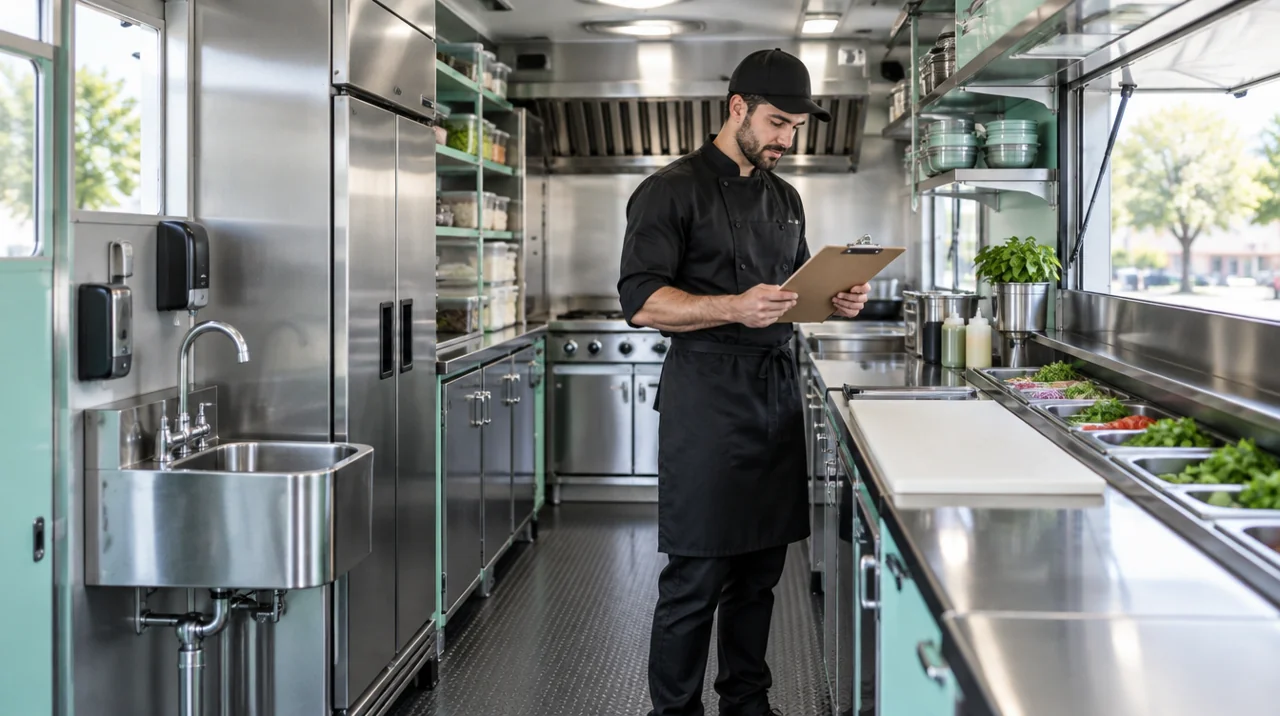
The DSHS guide is more useful than a generic equipment list because physical requirements depend on type. All FVVs must remain readily movable. DSHS describes type-specific water, sink, temperature-control, and documentation rules.
Use this original food vending vehicle inspection readiness record before scheduling:
| Decision or document | Record before inspection | Why it changes the build |
|---|---|---|
| Menu and process | List every item, source, packaging, cooking, cooling, reheating, and holding step | DSHS type and equipment needs follow the process |
| Water and waste | Tank labels, capacities, hose setup, and servicing method, if applicable | DSHS requires the wastewater tank to be at least 15% larger than the potable-water tank where those tank requirements apply |
| Food safety | Food-manager and food-handler credentials when required, plus an employee illness policy | The inspector asks how the operation controls food safety |
| Base facility | Current inspection report and signed authorization if using a CPF or servicing area you do not own | The truck needs a documented place for supplies, cleaning, and servicing unless exempt |
| Vehicle file | Driver license or CDL, insurance, Texas Department of Transportation weight record, itinerary, allergen poster, and restroom plan | DSHS lists these for the pre-license inspection |
The DSHS guide says a truck that does not meet the commissary exemption must operate from a central preparation facility (CPF) or another fixed establishment for supplies, cleaning, and servicing. A private residence cannot be the CPF or servicing area. The food truck commissary requirements in Texas are therefore a design decision: document an approved base facility, or demonstrate that the vehicle meets the exemption checklist. Read the May 2026 DSHS Mobile Food Vendor Guide before building or buying.
Can a food truck operate statewide in Texas?
A DSHS license replaces the former stack of local health permits, but it does not reserve a curb, override zoning, or grant entry to a park or special event. Check city, county, property-owner, fire-authority, and organizer requirements for each place where you intend to serve.
- Ask the local government about zoning, parking, right-of-way, and special-event rules.
- Ask the fire authority what inspection or permit applies to the vehicle and fuel setup.
- Obtain the property owner's or event organizer's written approval where their rules require it.
A DSHS license is statewide for food-health licensing; it is not one permit that authorizes every place you might park or serve. The DSHS announcement states:
"MFVs must also continue to comply with all applicable state and local laws."
DSHS news release, June 4, 2026.
Local rules are site-specific. For example, the City of Denison says it still regulates zoning, approved operating locations, fire and life safety, traffic, noise, public safety, and special-event permits. Denison's HB 2844 implementation page. In San Antonio, an FVV using propane, a generator, or a gas, charcoal, or wood-burning grill needs a fire inspection; its downtown business district and city parks also have separate approval paths. San Antonio's mobile food vending page. These examples are not statewide location rules.
Before committing to a weekly site, create a one-page Texas food truck permit record with the address, governing city and county, owner contact, fire contact, required approvals, and expiration dates. Repeat it for each stop.
Do food trucks charge sales tax in Texas?
Most food trucks selling prepared meals in Texas need a Comptroller sales tax permit because they sell taxable tangible personal property. It does not replace the DSHS license, inspection, or site approvals. The business must calculate, collect, report, and retain records for tax on its taxable sales.
- Register through the Comptroller's online sales-tax system when the business will make taxable sales.
- Set the point-of-sale system to use the rate for the sale's applicable location.
- File returns and keep records even for a reporting period with no taxable sales.
The Texas sales tax permit itself has no fee; a security bond may be required. Permit holders must collect tax on taxable sales, report and pay it on time, and keep adequate records. The Comptroller also says ready-to-eat food is typically taxable even when sold to go, with stated exceptions such as bakery items sold without plates or eating utensils. Comptroller permit FAQ Comptroller restaurant guidance.
Texas state sales tax is 6.25%, and local sales and use tax cannot exceed 2%, for a maximum combined rate of 8.25%. Mobile operators should not hard-code one city rate into every sale. The Comptroller's Sales Tax Rate Locator and local-tax guide explain that sales at temporary places of business use the same local-tax framework as other places of business.
Form the business, then launch from written decisions
An LLC is not a food-truck permit, and Texas does not require every operator to use one. The Texas Secretary of State says an LLC is created by filing a certificate of formation. Texas Secretary of State business-structure guidance If you want help understanding formation options, visit Lovie Formation or browse formation resources.
For a hypothetical taco truck planning a weekday brewery stop and a Saturday city festival, the launch file should have two location records. Put the state license status, inspection date, tax account, menu/type decision, CPF or exemption proof, fire clearance, property or organizer approval, and site dates in one shared folder.
A practical answer to how to start a food truck business in Texas is a launch record you can update at each new stop, not one permit receipt. Confirm the licensing status and location permissions before accepting the next booking.
Frequently asked questions
Do I need a different DSHS license for a second truck?
Yes. DSHS states that each food vending vehicle needs its own mobile food vendor license, even if the vehicles share an owner or menu.
Does every food truck need a commissary?
No. A vehicle that meets DSHS's CPF or commissary exemption checklist may not need one. Otherwise, it must operate from an approved central preparation facility or fixed establishment.
Who conducts the food-safety inspection?
DSHS is responsible for licensing and may have a state inspector or a local agency working under a DSHS collaborative agreement conduct the inspection under statewide rules.
Do I need a city fire inspection after getting the DSHS license?
Possibly. The answer depends on the local fire authority and the vehicle setup. Check before serving, especially if using propane, generators, or open-flame equipment.
What rate should I charge at a pop-up?
Use the Comptroller's guidance and Sales Tax Rate Locator for the sale location. Do not assume the rate at your home base applies to every temporary stop.
Explore Formation Guides
State-specific formation guides, cost breakdowns, compliance checklists, and expert comparisons — updated for 2026.
Popular Guides
- How to Start a Holding Company With No Money: Costs
- How to Start a Property Management Company in Florida
- How to Write a Resolution for a Board Meeting
- How Old Do You Have to Be to Sell on eBay? | Lovie
- How to Start Your Own Travel Agency: Founder Guide
- $1 LLC Colorado | Lovie — US Company Formation
- 101 EIN Error | Lovie — US Company Formation
- 101 Error Code IRS — US Company Formation Guide
- 1099 Contractor Vs LLC — US Company Formation Guide
- 1099 Employee Vs LLC — US Company Formation Guide
- 1099 for LLC | Lovie — US Company Formation Services
- 1099 Individual Vs LLC — US Company Formation Guide
- 1099 LLC — US Company Formation Guide (2026) | Lovie
- 1099 vs LLC Taxes | Lovie — US Company Formation
- 1099 Vs LLC — US Company Formation Guide (2026) | Lovie
Plan your next steps
Use Lovie AI to organize your questions, then check important decisions against the primary sources. Explore formation options.
Lovie is not a government agency, law firm, or professional advisory organization. Lovie is a private business-formation service that prepares and submits filings to the appropriate state agencies on your behalf — we do not issue government documents, and state approval times are not controlled by Lovie. Information on this page is general and not legal, tax, or financial advice.