
On this page · 8 sections
- Understand PA Nonprofit Basics
- Choose a Name and Registered Agent
- Draft Your Bylaws and Organizational Documents
- File Articles of Incorporation with the PA DOS
- Obtain an Employer Identification Number (EIN)
- Apply for 501(c)(3) Tax-Exempt Status
- Fulfill State Charitable Registration
- Maintain Ongoing Compliance
Understand Pennsylvania Nonprofit Basics and Mission
Before embarking on the formal process of starting a nonprofit in Pennsylvania, it's crucial to solidify your organization's mission and understand the foundational legal framework. A clear mission statement will guide all your future decisions, from program development to fundraising efforts. This statement should articulate your purpose, the community you serve, and the change you aim to effect. For instance, a mission might be 'To provide educational resources and mentorship for underserved youth in Philadelphia.' This clarity is not just for internal guidance; it’s a requirement for your IRS 501(c)(3) application. Pennsylvania law governs the incorporation of nonprofits under Title 15, Corporations and Unincorporated Associations. Key to this is understanding that a nonprofit corporation, while not distributing profits to members or shareholders, must still generate revenue to cover its operational costs and achieve its mission. For more details, see our guide on setting up your Arkansas LLC. The primary distinction from a for-profit entity is the use of surplus funds: all profits must be reinvested into the organization's mission. The initial planning phase should also involve identifying your target beneficiaries, outlining your proposed programs and services, and conducting preliminary research into funding sources. A well-defined program plan strengthens your application and demonstrates viability to potential donors and regulatory bodies. This early groundwork sets the stage for a smoother formation process and a more impactful organization. Consider the long-term vision and how your nonprofit will sustain its operations, as this foresight is invaluable.
Choose a Name and Designate a Registered Agent
Selecting a suitable name for your Pennsylvania nonprofit is more than just a branding exercise; it involves legal compliance. Your chosen name must be distinguishable from other registered entities in Pennsylvania. The Pennsylvania Department of State (PA DOS) maintains a corporate database where you can check for name availability. It's advisable to have several alternatives ready, as popular names might already be taken. The name must also clearly indicate that it is a corporation, typically by including identifiers such as 'Corporation,' 'Incorporated,' 'Company,' 'Limited,' or an abbreviation thereof, though 'Association' or 'Foundation' are also common for nonprofits. Pennsylvania law generally permits a nonprofit name to omit these designators if its nature is clearly understood. Simultaneously, you must designate a Registered Agent in Pennsylvania. This agent is an individual or a business entity with a physical street address (not a P.O. You can learn more about setting up your California LLC to understand the full picture. Box) in Pennsylvania, responsible for receiving legal documents, service of process, and official state correspondence on behalf of your nonprofit. The Registered Agent's role is critical for ensuring your organization remains in good standing with the state. Failing to maintain a valid Registered Agent can lead to serious compliance issues, including administrative dissolution. Many founders opt for a professional registered agent service, which provides reliability, privacy, and ensures that critical documents are never missed. This service is particularly beneficial for organizations without a permanent physical office or for founders who prefer to keep their home address private. Registered agent service is required in every state and is priced separately at $79/year ($49/year in Wyoming).
Draft Your Bylaws and Organizational Documents
Before filing with the state, your nonprofit needs foundational internal documents, primarily the Bylaws. Bylaws are the operational manual for your organization, outlining the rules and procedures for its internal governance. They define the roles and responsibilities of the board of directors, meeting protocols, voting procedures, membership rights (if applicable), and financial management policies. Crucially, the IRS will review your Bylaws as part of your 501(c)(3) application to ensure they comply with tax-exempt requirements, particularly regarding dissolution clauses and non-distribution of assets. Key elements to include in your Bylaws are: the name and purpose of the corporation; provisions for the board of directors, including number of directors, terms, election, removal, and meetings; officer positions and their duties; procedures for amending the Bylaws; and a clear statement on the distribution of assets upon dissolution, ensuring they are distributed to another 501(c)(3) organization. We cover this in depth in our resource on forming an LLC in Colorado. You will also need to hold an initial organizational meeting of your board of directors. At this meeting, the board formally adopts the Bylaws, elects officers, establishes initial bank accounts, and approves other foundational matters. While Bylaws are not filed with the state, they are essential for establishing the legal framework and operational integrity of your nonprofit. Lovie provides templates for organizational documents, which can be customized for your Pennsylvania nonprofit, helping you create robust and compliant Bylaws.
File Articles of Incorporation with the PA DOS
The next critical step is to officially incorporate your nonprofit with the Pennsylvania Department of State (PA DOS) by filing the Articles of Incorporation. This document legally creates your nonprofit corporation as a distinct legal entity. The Articles of Incorporation must include specific information as required by Pennsylvania law, including the exact name of the corporation, the address of its registered office in Pennsylvania, the name and address of its registered agent, and a statement that the corporation is organized on a non-stock basis and does not contemplate pecuniary gain or profit.
You will need to submit Form DSCB:15-5302/7302 (Articles of Incorporation - Nonprofit Corporation) to the PA DOS. As of 2026, the filing fee for these Articles of Incorporation is $125. You can file these documents online through the PA DOS website or by mail. While the state generally processes filings within 10-15 business days, expedited services are often available for an additional fee if you need faster processing. Once the Articles are approved, the PA DOS will issue a Certificate of Incorporation, formally recognizing your nonprofit as a legal entity in Pennsylvania. This certificate is a vital document, confirming your organization's legal existence and paving the way for subsequent steps, such as obtaining an EIN and applying for federal tax-exempt status. Ensuring accuracy and completeness in this filing is paramount to avoid delays and potential rejection. Lovie assists with the preparation and submission of these crucial state filings, streamlining the incorporation process.
Obtain an Employer Identification Number (EIN)
After your Articles of Incorporation have been approved by the Pennsylvania Department of State, your nonprofit will need to obtain an Employer Identification Number (EIN) from the Internal Revenue Service (IRS). An EIN is a nine-digit number assigned to employers, trusts, and other entities for tax identification purposes. Even if your nonprofit does not plan to have employees immediately, an EIN is essential for several reasons: it's required to open a bank account in the nonprofit's name, to file federal and state tax returns, and to apply for 501(c)(3) tax-exempt status.
You can apply for an EIN online directly through the IRS website. The application, Form SS-4, is straightforward and typically takes only a few minutes to complete. It requires information such as the legal name of your organization, the mailing address, the type of entity (nonprofit), and the reason for applying (e.g., 'Started a New Business'). It is crucial that the name on the EIN application exactly matches the name on your approved Articles of Incorporation to avoid discrepancies that could delay your 501(c)(3) application. Once submitted online, the EIN is usually issued immediately. This number becomes the federal tax ID for your nonprofit and is a prerequisite for nearly all subsequent financial and regulatory steps. Having your EIN quickly allows you to proceed with setting up your financial infrastructure, which is a key milestone for any newly formed organization. Lovie assists with EIN registration with the IRS, ensuring this step is handled efficiently as part of your formation package.
Apply for 501(c)(3) Tax-Exempt Status with the IRS
Achieving 501(c)(3) tax-exempt status is often the most critical objective for a nonprofit, as it allows your organization to receive tax-deductible donations and exempts it from federal income tax. This status is granted by the IRS, not the state, and requires a separate application process after your nonprofit has been incorporated by the PA DOS and has obtained an EIN.
The primary application form is Form 1023, Application for Recognition of Exemption Under Section 501(c)(3) of the Internal Revenue Code. This is a comprehensive document that requires detailed information about your organization's purpose, activities, financial data (actual and projected), governance structure, and compensation policies. It also requires attachments like your Articles of Incorporation, Bylaws, and conflict of interest policy. The filing fee for Form 1023 varies based on your organization's gross receipts; for organizations with average annual gross receipts normally not more than $10,000, the fee is $275. For organizations with average annual gross receipts normally more than $10,000, the fee is $600 (as of 2026). Small nonprofits may be eligible to file Form 1023-EZ, a streamlined application, if they meet specific criteria, such as projected gross receipts of less than $50,000 and total assets of less than $250,000.
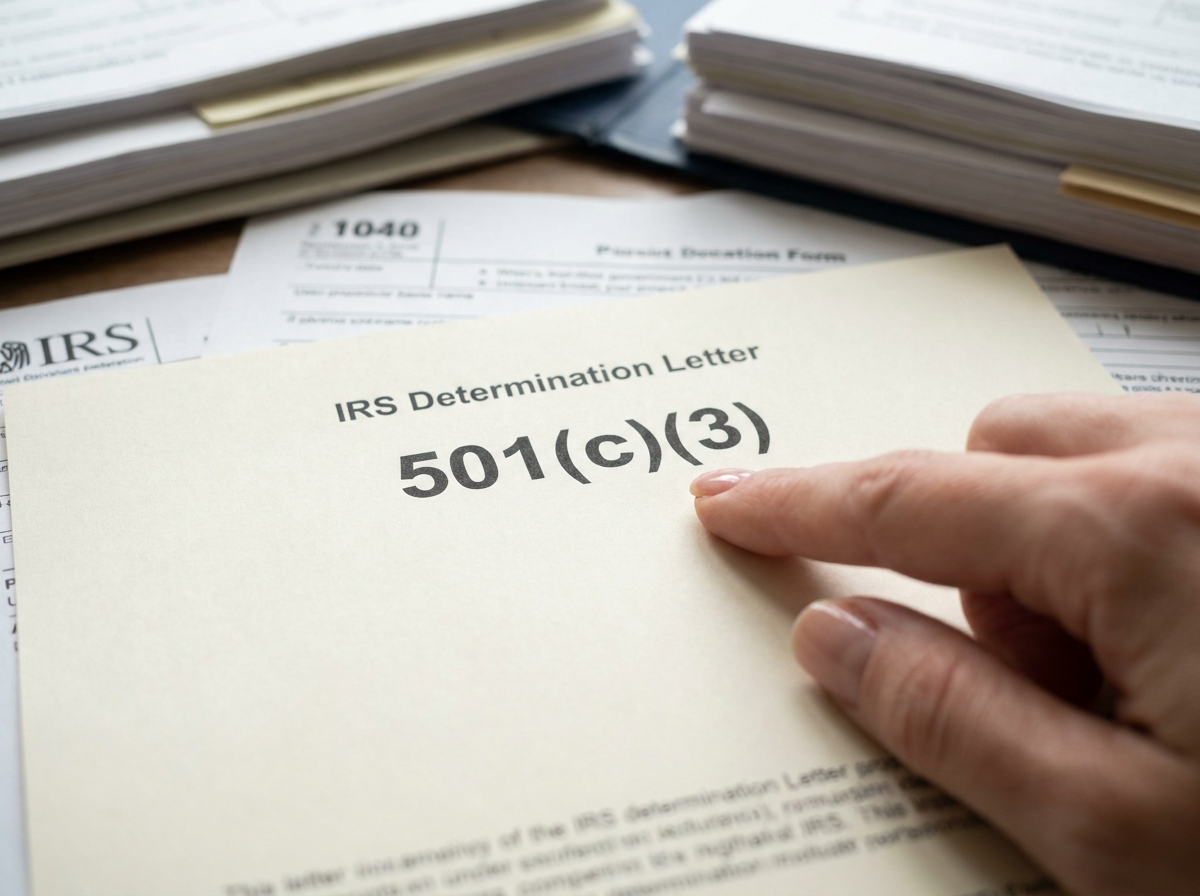
The IRS review process can take several months, and it's common for the IRS to request additional information. Therefore, ensuring your application is meticulously prepared and includes all necessary supporting documentation is vital. Once approved, the IRS will issue a Determination Letter, officially recognizing your organization as a 501(c)(3) tax-exempt entity. This letter is crucial for fundraising and maintaining public trust. Lovie provides guidance on the 501(c)(3) application process, helping you prepare the necessary forms and documentation to increase your chances of a successful outcome.
Fulfill State Charitable Registration Requirements
Even after securing federal 501(c)(3) status, most nonprofits that intend to solicit charitable contributions in Pennsylvania must register with the Pennsylvania Department of State's Bureau of Charitable Organizations. This is a distinct requirement from the initial corporate incorporation and the federal tax-exempt status. The purpose of charitable registration is to ensure transparency and accountability in fundraising activities.
The primary form for this registration is the 'Charitable Organization Registration Statement' (Form BCO-100). This form requires detailed information about your organization, its programs, financial activities, and board members. You will also need to submit a copy of your IRS 501(c)(3) Determination Letter, your Articles of Incorporation, and your Bylaws. The initial registration fee is $75 for organizations with gross contributions under $500,000 and increases for larger organizations (as of 2026). Subsequent annual renewals are also required.
It's important to note that specific exemptions from charitable registration may exist for certain types of organizations, such as religious institutions or those that solicit only from a small number of members. However, most public charities will need to complete this step. Failure to register can lead to penalties, including fines and prohibitions on soliciting funds in Pennsylvania. This registration ensures that your nonprofit can legally engage in fundraising activities within the state, a critical component for sustaining your mission. Some organizations may also need to consider registering in other states if they plan to solicit donations nationally, as each state has its own unique charitable solicitation laws. Researching these requirements early can prevent compliance headaches down the line.
Maintain Ongoing Compliance and Governance
Once your Pennsylvania nonprofit is fully formed and has obtained its tax-exempt status, the journey shifts to maintaining ongoing compliance and robust governance. This isn't a one-time task but a continuous commitment to legal and ethical operations. Key ongoing federal requirements include filing annual information returns with the IRS. Most 501(c)(3) organizations are required to file Form 990, 990-EZ, or 990-PF, depending on their gross receipts and assets. Small organizations with gross receipts normally $50,000 or less may be eligible to file the electronic Form 990-N (e-Postcard). These filings are due by the 15th day of the 5th month after your organization's fiscal year ends.
At the state level, your nonprofit must file an annual registration statement with the Pennsylvania Department of State to maintain its corporate good standing. This is typically Form DSCB:15-1341 (Statement of Election of a Registered Office) or a similar annual report, usually due by April 15th each year. Additionally, if your nonprofit is registered with the Bureau of Charitable Organizations, you will need to renew your charitable registration annually, typically by filing Form BCO-100R (Annual Registration Renewal). There are also specific requirements for sales tax exemption (Form REV-72) and potentially property tax exemptions, which are typically handled at the county or local level.
Beyond these filings, strong governance practices are essential. This includes holding regular board meetings, keeping accurate minutes, maintaining transparent financial records, and periodically reviewing your Bylaws and policies. A robust conflict of interest policy is also vital to prevent situations where board members or staff could benefit personally from their positions. Ongoing compliance ensures your nonprofit retains its legal status, protects its tax-exempt privileges, and maintains public trust. Lovie's $29 one-time fee covers formation preparation and filing, with compliance reminders included; state filing fees are paid directly to your state, and registered agent service is priced separately at $79/year ($49/year in Wyoming).
Frequently asked questions
How long does it take to start a nonprofit in Pennsylvania?
The timeline can vary significantly. Filing Articles of Incorporation with the PA DOS typically takes 10-15 business days, though expedited options are available. Obtaining an EIN from the IRS is usually instant. The longest phase is the 501(c)(3) application with the IRS, which can take anywhere from 3 to 12 months, depending on the complexity of your application and current IRS backlog. State charitable registration can add another few weeks. Overall, expect the entire process to range from 4 to 14 months to be fully operational and tax-exempt.
What is the difference between a nonprofit and a 501(c)(3)?
A 'nonprofit' is a general term for an organization that does not distribute its surplus revenues to members, directors, or officers. It is primarily a state-level designation for its corporate structure. A '501(c)(3)' refers specifically to a section of the Internal Revenue Code that grants federal tax-exempt status to certain types of nonprofit organizations, primarily those organized for charitable, educational, religious, or scientific purposes. All 501(c)(3) organizations are nonprofits, but not all nonprofits are 501(c)(3)s (e.g., 501(c)(4) social welfare organizations are nonprofits but not 501(c)(3)).
Can I start a nonprofit by myself in Pennsylvania?
While you can initiate the administrative steps, Pennsylvania law generally requires a nonprofit corporation to have at least three directors on its board. While one person can serve as the incorporator and handle the initial filings, a functional and legally compliant nonprofit needs a governing board. Therefore, you cannot truly operate a nonprofit 'by yourself' in terms of governance and decision-making.
What are the annual filing requirements for a PA nonprofit?
Pennsylvania nonprofits have several annual filing requirements. Federally, most must file an annual Form 990 series return (990, 990-EZ, or 990-N) with the IRS. At the state level, you must file an annual registration statement with the PA Department of State to maintain corporate good standing. If you solicit charitable contributions, you'll also need to renew your registration with the PA Bureau of Charitable Organizations annually. Additionally, if sales or property tax exemptions were granted, specific local renewals may be necessary.
How much does it cost to start a nonprofit in Pennsylvania?
The direct costs include the PA Department of State filing fee for Articles of Incorporation ($125 as of 2026) and the IRS 501(c)(3) application fee ($275 or $600 for Form 1023, or $275 for Form 1023-EZ as of 2026). There's also an initial state charitable registration fee ($75 for smaller organizations). Additional costs may include registered agent services, legal counsel, and accounting services. Expect a minimum of $500-$1,000 in direct government fees, not including professional services.
Do I need a lawyer to start a nonprofit in PA?
While it's not legally mandated, engaging a lawyer experienced in nonprofit law can be highly beneficial, especially for complex organizations or those seeking specific legal advice on governance, fundraising, or tax matters. A lawyer can ensure your Articles of Incorporation and Bylaws are robust and compliant, and they can review your 501(c)(3) application. For simpler structures, resources like Lovie can assist with the core filing processes, but legal counsel remains valuable for tailored advice.
Lovie Data Insights
Creative & Media — Formation Context
Recommended Entity: LLC
Key Tax Benefit: Home office, equipment, software subscriptions
Compliance Priority: Copyright/IP protection, contract terms
Data sources: State Secretary of State offices, IRS, Tax Foundation (2026). Platform metrics based on anonymized Lovie user data.
Key Concepts: Business Formation
US Business Formation guides entrepreneurs through the business formation process with actionable steps. Key components include LLC formation, entity registration, and state filing, each playing a critical role in the business formation process. Understanding liability protection and tax optimization is essential, as these factors directly impact legal compliance.
When evaluating business formation options, factors such as business entity types and formation process should inform your decision-making process.
Entity Relationships
- Business Formation requires LLC formation
- Business Formation includes entity registration
- Business Formation establishes state filing
- Business Formation defines business structure selection
Quick answers
What do I need to know about How To Start A Nonprofit In Pa for my business?
Understanding How To Start A Nonprofit In Pa is essential for business compliance and operational success. The specific requirements vary by state and industry.
How does How To Start A Nonprofit In Pa affect my business formation?
This aspect of business formation directly impacts your legal standing, tax obligations, and operational flexibility.
Explore Formation Guides
State-specific formation guides, cost breakdowns, compliance checklists, and expert comparisons — updated for 2026.
LLC Formation Guides
- How to Form an LLC for Virtual Assistant Hawaii
- How to Form an LLC for Web Developer West Virginia
- How to Form an LLC for Drone Services Wyoming
- How to Form an LLC for Freelancing California
Popular Guides
Cost by Entity & State
- Sole Proprietorship Cost Alabama Formation Costs
- Nonprofit Cost Michigan Formation Costs (2026) | Lovie
- C Corp Cost South Carolina Formation Costs (2026) | Lovie

Lovie is not a government agency, law firm, or professional advisory organization. Lovie is a private business-formation service that prepares and submits filings to the appropriate state agencies on your behalf — we do not issue government documents, and state approval times are not controlled by Lovie. Information on this page is general and not legal, tax, or financial advice.