
On this page · 8 sections
- Understanding New York Certificates
- Certificate of Incorporation for Corporations
- Certificate of Formation for LLCs
- Business Certificate for Sole Proprietors & Partnerships
- Certificate of Authority for Foreign Entities
- Certificate of Assumed Name (DBA)
- Operational Permits and Licenses
- Navigating the Filing Process
Understanding New York Certificates: Your Business Foundation
Starting a business in New York involves more than just a great idea; it requires a precise understanding of the state's regulatory landscape, particularly concerning various business certificates. These documents are not merely bureaucratic hurdles; they are the legal bedrock upon which your enterprise is built. Each certificate serves a distinct purpose, from officially recognizing your business entity to authorizing its operations under a specific name or in a particular industry. Missing a crucial certificate can lead to significant penalties, legal complications, and even the inability to conduct business legally within the state. New York, like many states, uses the term "certificate" broadly, which can sometimes cause confusion for new founders. It can refer to the core document that establishes your legal entity, such as a Certificate of Incorporation for a corporation or a Certificate of Formation for an LLC. Our resource on how to register an LLC in New York breaks this down further. It can also refer to registrations for operating under a different name (DBA), or even specific licenses and permits required to perform certain business activities. Our goal here is to demystify these terms and provide a clear roadmap for what you'll need. Understanding these foundational documents is the first step towards ensuring your business is compliant and poised for growth in the Empire State. Lovie assists founders by streamlining the preparation and submission of these critical filings, ensuring accuracy and helping you navigate the Department of State's requirements efficiently.
Certificate of Incorporation: The Cornerstone for New York Corporations
For founders establishing a C-Corporation or S-Corporation in New York, the Certificate of Incorporation is the foundational legal document. This certificate is filed with the New York Department of State (NYDOS) and officially brings your corporate entity into existence. It's essentially the birth certificate of your corporation, formally establishing its name, purpose, and the number of shares it is authorized to issue. Without an approved Certificate of Incorporation, your business cannot legally operate as a corporation in New York. The process for filing this certificate involves several key details. You'll need to specify the corporate name, which must comply with New York's naming conventions (e.g., including "Corporation," "Inc.," or "Limited"). If you're exploring this further, our guide on forming an LLC in New York is a helpful next step. The certificate also requires the designation of a registered agent, who will receive legal documents on behalf of the corporation, and the county within New York where the corporation's office will be located. Furthermore, you'll state the total number of shares of stock the corporation is authorized to issue and the par value, if any. The filing fee for a Certificate of Incorporation in New York is currently $125. Once accepted by the NYDOS, your corporation officially exists, and you can then proceed with other essential steps like obtaining an EIN from the IRS and drafting corporate bylaws. Lovie specializes in preparing and submitting these intricate documents, ensuring all statutory requirements are met, so you can focus on building your business.
Certificate of Formation: Establishing Your New York LLC
The Limited Liability Company (LLC) is a popular business structure in New York, offering liability protection to its owners while providing flexible management. To form an LLC in New York, you must file a Certificate of Formation with the New York Department of State. This document is equivalent to a Certificate of Incorporation for corporations and serves to officially create your LLC as a legal entity. Key information required on the Certificate of Formation includes the LLC's name, which must adhere to New York's naming rules (e.g., include "Limited Liability Company" or "LLC"). You'll also need to designate a registered agent within New York, who will receive legal and official correspondence. Unlike some states, New York's Certificate of Formation is relatively concise, primarily requiring the LLC's name, county of principal office, and a statement that the LLC is formed for any lawful business purpose. For a deeper dive, see our resource on setting up your New York LLC. The current filing fee for a Certificate of Formation in New York is $200. After filing, New York has a unique publication requirement: within 120 days of its effective date, an LLC must publish a notice of its formation in two newspapers (one daily, one weekly) designated by the county clerk of the county in which the LLC's office is located. Failure to comply with this publication requirement can result in the suspension of the LLC's authority to carry on, conduct, or transact business. Lovie assists founders by ensuring the Certificate of Formation is correctly prepared and submitted, and can provide guidance on the subsequent publication requirements, which are often a point of confusion for new LLCs.
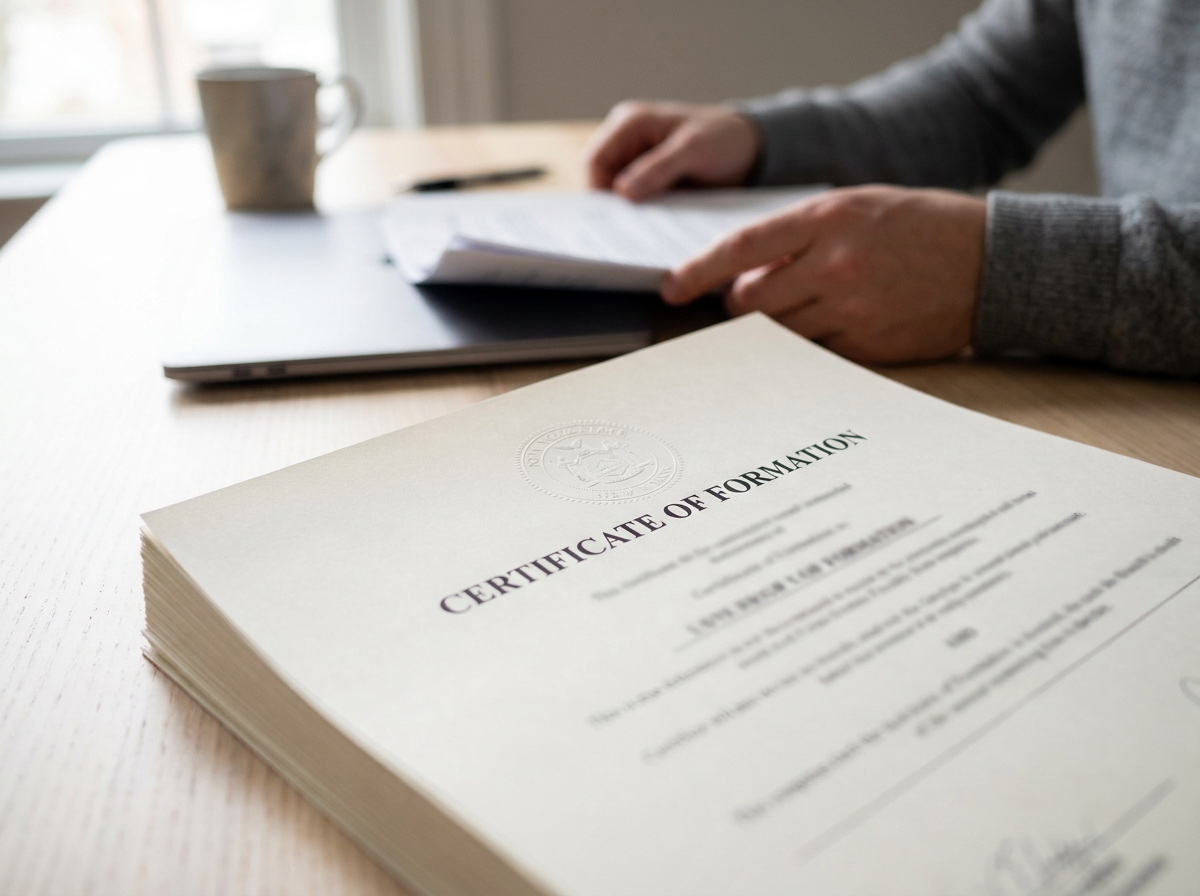
New York Certificate of Formation document on a light wooden table, with other blurred business papers in the background.
New York Certificate of Formation document on a light wooden table, with other blurred business papers in the background.
Business Certificate: For Sole Proprietors and General Partnerships
While LLCs and corporations file with the New York Department of State, sole proprietorships and general partnerships operate under a different set of rules regarding their foundational documentation. These unincorporated business structures do not file a Certificate of Formation or Incorporation with the state. Instead, if they operate under a name other than the owner's legal name (for a sole proprietorship) or the partners' legal names (for a general partnership), they typically need to file a "Business Certificate" or "Assumed Name Certificate" at the county level.
This is often referred to as a "Doing Business As" (DBA) filing. For sole proprietorships and general partnerships, this certificate is filed with the County Clerk in the county where the business will primarily operate. The purpose of this filing is to inform the public about the true owners of a business operating under a fictitious name. It provides transparency and allows consumers to know who they are dealing with. The fees for filing a Business Certificate vary by county, but generally range from $25 to $100. It's crucial for these business types to comply with this county-level registration to avoid potential legal issues and ensure they can legally open bank accounts or enter into contracts under their chosen business name. Lovie primarily focuses on LLC and C-Corp formation, but understanding the requirements for all business types is part of a comprehensive approach to New York business compliance.
Certificate of Assumed Name (DBA): Operating Under a Different Brand
The Certificate of Assumed Name, commonly known as a Doing Business As (DBA) filing, allows an existing legal entity (like an LLC or corporation) to operate under a name different from its official, registered name. This is distinct from the Business Certificate required for sole proprietorships and general partnerships, although both serve the purpose of public disclosure for a trade name. For an LLC or corporation, filing a DBA with the New York Department of State (NYDOS) means your formal entity, say "Empire State Holdings LLC," can market itself as "NYC Tech Solutions."
Filing a Certificate of Assumed Name is crucial for branding flexibility and legal transparency. It enables your business to maintain its core legal structure while projecting a different brand identity to customers. The filing requires the official name of your LLC or corporation, the assumed name you wish to use, and the county or counties where the business will operate under this name. The filing fee for a Certificate of Assumed Name with the NYDOS is $25, plus an additional $25 for each county you specify. It's important to remember that a DBA is merely a name registration; it doesn't create a new legal entity or offer additional liability protection. It simply links a trade name to your legally formed business. Many businesses use DBAs to launch new product lines, target specific markets, or simplify their brand name without undergoing a full legal name change for the entity itself. Lovie helps founders determine if a DBA is appropriate for their strategy and assists with the necessary filings.
Beyond Formation: Operational Permits and Licenses in New York
While Certificates of Formation or Incorporation establish your legal entity, they are often just the first step. Most businesses in New York will also need to secure various operational permits and licenses to legally conduct their specific activities. These requirements are typically industry-specific and can originate from state, county, or municipal authorities. For example, a restaurant will need health permits, a liquor license, and potentially zoning permits, while a construction company might need specific contractor licenses and building permits.
State-Level Licenses and Permits
New York State regulates numerous professions and industries. The New York State Department of State's Division of Licensing Services oversees many professional licenses, including those for real estate brokers, barbers, and security guards. Other state agencies, such as the Department of Health or the Department of Environmental Conservation, issue permits relevant to their respective domains. It's vital to research the specific licensing requirements for your industry and location early in your planning process.
Local-Level Licenses and Permits
Beyond state requirements, cities and counties in New York often have their own sets of licenses and permits. For instance, New York City has extensive licensing requirements managed by the Department of Consumer and Worker Protection (DCWP) for a wide range of businesses, from retail stores to street vendors. These local requirements can vary significantly even within different parts of the same county. Neglecting these permits can lead to fines, operational shutdowns, and reputational damage. While Lovie focuses on the core entity formation documents, we emphasize the importance of identifying and securing all necessary operational licenses to ensure full compliance. Resources like the New York State Business Express portal can be a valuable starting point for researching these diverse requirements.
Frequently asked questions
What is the difference between a Certificate of Formation and a Certificate of Incorporation in New York?
A Certificate of Formation is the document filed with the New York Department of State to create a Limited Liability Company (LLC). A Certificate of Incorporation, on the other hand, is the document filed with the same department to create a C-Corporation or S-Corporation. Both serve as the foundational legal document for their respective entity types, officially bringing the business into existence in New York.
Do I need a New York Business Certificate if I'm a sole proprietor?
If you are a sole proprietor in New York and plan to operate your business under a name different from your own legal name, you generally need to file a "Business Certificate" (often called an Assumed Name Certificate or DBA) with the County Clerk in the county where you conduct business. If you operate under your personal legal name, this county-level filing is usually not required.
How long does it take to get a business certificate approved in New York?
Approval times for New York business certificates, such as the Certificate of Formation or Incorporation, vary depending on the Department of State's current workload and whether you choose expedited processing. Standard processing can take several weeks (e.g., 3-4 weeks), while expedited services (for an additional fee) can reduce this to a few days or even same-day processing. Lovie tracks filing statuses to keep you informed.
Explore Formation Guides
State-specific formation guides, cost breakdowns, compliance checklists, and expert comparisons — updated for 2026.
Popular Guides
- New York Company Registry | Lovie — US Company Formation
- New York Company Search | Lovie — US Company Formation
- New York Corp | Lovie — US Company Formation
- New York Corporate Lookup | Lovie — US Company Formation
- New York Corporate Search | Lovie — US Company Formation
- New York Corporation And Business Entity Database — US
- New York Corporation Search | Lovie — US Company Formation
- New York Department Of Corporations Search — US Company
- New York Department Of State Corporation Search — US Company
- New York Entity Search | Lovie — US Company Formation
- New York Foreign LLC Registration — US Company Formation
- New York Foreign LLC — US Company Formation Guide
- New York LLC Annual Fee | Lovie — US Company Formation
- New York LLC Annual Filing Requirements — US Company
- New York LLC Fee | Lovie — US Company Formation

Lovie is not a government agency, law firm, or professional advisory organization. Lovie is a private business-formation service that prepares and submits filings to the appropriate state agencies on your behalf — we do not issue government documents, and state approval times are not controlled by Lovie. Information on this page is general and not legal, tax, or financial advice.