
On this page · 8 sections
Understanding the NYS Biennial Filing
Every corporation registered with the New York Department of State (NYS DOS) is mandated to file a biennial statement. This requirement, codified under Section 408 of the Business Corporation Law (BCL), serves a critical administrative purpose: to keep the state's public record of corporations current. The term "biennial" itself means "occurring every two years," which precisely defines the filing frequency. Unlike annual reports in some other states, New York's biennial statement is less about financial disclosure and more about basic corporate information. It ensures that the DOS has up-to-date contact information for the corporation's chief executive officer (CEO) and the address for service of process, which is the official address where legal documents can be served. This transparency is vital for both the state and the public, providing a clear point of contact for legal and administrative matters. If you're exploring this further, our guide on LLC registration in Arkansas is a helpful next step. Neglecting this filing can lead to severe repercussions, underscoring its importance for sustained legal operation within New York State. Founders often confuse this with tax filings; it's essential to understand that the biennial statement is a corporate governance requirement, distinct from your federal or state income tax obligations. The information provided helps the state maintain an accurate registry, which is crucial for consumer protection and regulatory oversight. This guide will clarify the nuances, helping you stay on top of your obligations. Founders who have not established the underlying corporation can set up the entity and its compliance foundation before the first biennial cycle begins.
Who Must File and Why
The biennial filing requirement applies to all corporations formed or authorized to do business in New York State. This includes both domestic corporations (those formed in New York) and foreign corporations (those formed in another state or country but registered to operate in New York). The legal basis for this is BCL §408, which specifically states that every domestic corporation and every authorized foreign corporation shall file a statement with the Department of State. The "why" behind this mandate is rooted in public transparency and regulatory efficiency. The state needs to know who is responsible for each corporation and where official communications, including legal notices, can be reliably sent. This ensures that stakeholders, from creditors to customers, can identify and contact responsible parties. For a deeper dive, see our resource on starting a business in California. Without this information, the integrity of the corporate registry would be compromised, making it difficult to enforce laws or pursue legal actions against corporations. For example, if a corporation changes its principal address or its CEO, the biennial statement is the mechanism to update the public record. Failure to provide this updated information can lead to significant administrative hurdles and legal complications down the line. It's a fundamental aspect of corporate accountability in New York, designed to protect the public interest and maintain an orderly business environment. Small businesses and large enterprises are equally subject to this requirement, highlighting its universal application within the state's corporate framework.
Filing Deadlines and Frequency
The biennial statement is due every two years, calculated from the month of your corporation's original formation or authorization in New York. For instance, if your corporation was formed in April 2023, your first biennial statement will be due in April 2025, and then every April in subsequent odd-numbered years (2027, 2029, etc.). The New York Department of State typically sends a reminder notice to the corporation's registered agent or the address on file approximately three months before the due date. However, relying solely on this reminder is a risky strategy. As a founder, it's your responsibility to track this crucial deadline proactively. Missing the notice does not absolve your corporation of its filing obligation. ## Calculating Your Due Date To determine your specific due month, simply look at the month your Certificate of Incorporation (for domestic corporations) or Application for Authority (for foreign corporations) was filed and accepted by the NYS DOS. You might also find our guide on LLC registration in Colorado useful here. The statement is due during that specific month, every other year. There is no specific day within the month; any time within the due month is acceptable. This biennial cycle differs from the annual reports required in many other states, making New York's process unique and sometimes a point of confusion for founders accustomed to yearly filings. Setting up a robust internal compliance calendar is highly recommended to avoid inadvertent non-compliance, especially for founders managing multiple entities or operating across various states. ## Reminder System The NYS DOS does offer an online search tool where you can look up your corporation's details and often see the next biennial statement due date. This can be a useful cross-reference even if you're tracking it internally.

The Filing Process: Step-by-Step
Filing the New York biennial statement is a relatively straightforward process, primarily conducted online. The New York Department of State encourages electronic filing through its online portal. Here's a breakdown of the steps:
- Access the NYS DOS Online Filing System: Navigate to the New York Department of State's Corporations and Business Entities database. You'll typically need to search for your entity by its exact name or DOS ID number.
- Locate Your Corporation: Once you find your corporation, there will be an option to file your biennial statement. You might need to verify some existing information before proceeding.
- Provide Required Information: The statement requires basic information to be updated or confirmed. This typically includes:
The name of the corporation. The date of its initial formation or authorization in New York. The address of the principal executive office. The name and business address of the chief executive officer (CEO). * The address for service of process (this is often your registered agent's address).
- Review and Verify: Carefully review all entered information for accuracy. Errors can lead to rejection or further compliance issues.
- Pay the Filing Fee: A statutory fee of $9.00 is required for each biennial statement. Payment is usually made via credit card through the online system.
- Submit the Statement: After payment, submit the filing. You will receive a confirmation, which you should retain for your records.
While the process seems simple, busy founders can easily overlook the deadline or make minor errors. This is where automated compliance systems or dedicated services become invaluable, ensuring that each step is meticulously followed and submitted on time. For example, if your corporation has undergone changes in its principal office or CEO, ensuring these updates are reflected accurately in the biennial statement is paramount. The DOS system is designed for ease of use, but attention to detail is critical.
Biennial Statement Fees and Payment
The New York Department of State charges a statutory fee for filing the biennial statement. As of 2026, the fee for corporations (both domestic and foreign) is a modest $9.00. This fee is non-negotiable and must be paid at the time of filing. Compared to annual report fees in many other states, New York's biennial fee is notably low, designed to cover the administrative costs of maintaining the state's corporate registry rather than generating significant revenue.
Payment Methods
When filing online through the NYS DOS portal, payment is typically made via credit card (Visa, MasterCard, American Express, Discover). The online system is secure and processes payments immediately, allowing for quick confirmation of your filing. If you choose to file by mail, a check or money order made payable to the "New York Department of State" would be required. However, online filing is strongly recommended due to its speed, convenience, and immediate confirmation.
No Expedited Options
Unlike some other state filings, the biennial statement does not offer expedited processing options for an additional fee. The standard processing time is usually very quick, especially for online submissions. This is partly due to the straightforward nature of the information required and the automated systems in place to handle these routine compliance documents. It's important to budget for this small fee and ensure your payment method is ready when your filing window opens. While $9.00 might seem insignificant, overlooking it can trigger significant non-compliance penalties, making timely payment just as critical as timely submission. Always ensure you receive and retain a receipt or confirmation of payment for your records.
Consequences of Non-Compliance
Failure to file the biennial statement with the New York Department of State carries serious consequences that can significantly impact your corporation's legal standing and operational capabilities. The state does not impose monetary fines for late biennial statements in the same way some other states do for annual reports. Instead, the primary penalty is the administrative "delinquency" of your corporation.
Administrative Delinquency
If your biennial statement is not filed, the NYS DOS will mark your corporation as "delinquent" on its records. While this does not immediately dissolve your corporation, it signals to the public and other state agencies that your entity is not in good standing. This can lead to a cascade of problems:
Loss of Good Standing: Your corporation will lose its "good standing" status. This can prevent you from obtaining a Certificate of Good Standing, which is often required for securing loans, entering into contracts, or registering to do business in other states. Inability to File Other Documents: The DOS may refuse to accept other corporate filings (e.g., amendments to your Certificate of Incorporation) while your biennial statement is delinquent. Potential Administrative Dissolution: Although not immediate, persistent failure to file can eventually lead to the administrative dissolution of your corporation. This means the state officially terminates your entity's legal existence, stripping it of its corporate protections. Reinstatement can be a complex and costly process. Legal and Business Implications: Delinquent status can raise red flags with banks, potential investors, and business partners, potentially hindering growth and operational stability. It can also open up personal liability for corporate debts if the corporate veil is pierced due to non-compliance. Ensuring timely filing is a fundamental aspect of maintaining the limited liability protection your corporation offers. Don't underestimate the impact of this seemingly small compliance task.
How Lovie Simplifies NYS Compliance
Navigating the New York Department of State biennial filing, alongside other critical compliance tasks, can be a significant drain on a founder's time and attention. This is precisely where Lovie steps in, offering an AI-powered platform designed to streamline and automate your corporate compliance needs, including the NYS DOS biennial statement. Lovie acts as your dedicated compliance partner, ensuring you never miss a crucial deadline.
Proactive Monitoring and Reminders
Lovie's $499 one-time fee covers the state filing fee, a year of registered agent service, your EIN application, five scanned mailpieces a year, and one domain name for a year. It is the same price in every state. Instead of relying solely on state reminders (which can be missed or misdirected), Lovie provides proactive alerts and notifications, giving you ample time to prepare and review your filing.
Seamless Filing Preparation
When your biennial statement is due, Lovie assists you by preparing the necessary forms with the information on file. Our conversational UI guides you through any required updates, making the process intuitive and quick. We ensure all required fields are accurately completed, minimizing the risk of rejection by the NYS DOS.
Submission and Record Keeping
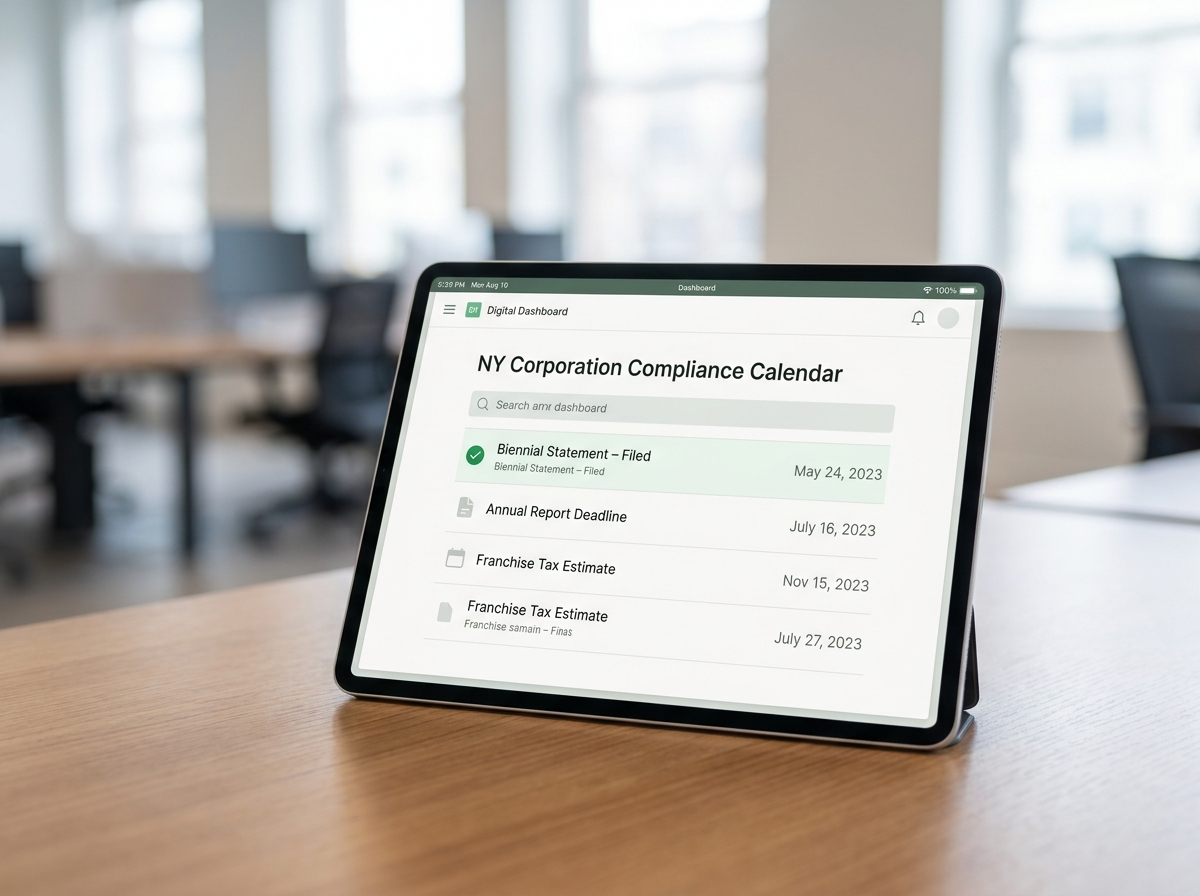
Once you review and approve, Lovie prepares and submits the biennial statement on your behalf through the appropriate state channels. We handle the interaction with the New York Department of State, and you receive instant filing-status visibility within your Lovie dashboard. All confirmations and submitted documents are securely stored in your Lovie account, creating a comprehensive digital record of your compliance history.
All-Inclusive Compliance Management
Beyond the biennial statement, Lovie's single $499 one-time fee covers a full spectrum of compliance and formation services: a year of registered agent service in every state, EIN registration, digital mail scanning, operating agreement templates, and more. This holistic approach means you have one trusted partner managing your ongoing compliance, allowing you to focus on building your business rather than administrative overhead. We simplify the entire lifecycle of your corporation, from formation to ongoing good standing, ensuring your New York entity remains compliant without constant manual oversight. Lovie is built for founders who demand efficiency and peace of mind, transforming complex state requirements into simple, automated tasks.
Maintaining Good Standing Beyond the Biennial
While the biennial statement is a critical component of maintaining good standing in New York, it's just one piece of the larger compliance puzzle. A holistic approach ensures your corporation remains fully compliant and avoids any potential disruptions to its operations.
Other Key Compliance Areas:
- Registered Agent Service: Every New York corporation must maintain a registered agent with a physical street address in New York State to accept service of process. This is a continuous requirement, and any change must be promptly filed with the DOS. Lovie includes a year of registered agent service in every state as part of its comprehensive plan.
- Annual Tax Filings: Corporations are subject to various federal and state tax obligations. This includes federal income tax (Form 1120 for C-Corps), New York State corporate franchise tax (Form CT-3 or CT-4 for S-Corps), and potentially other local taxes. These are distinct from the biennial statement and have different deadlines.
- Business Licenses and Permits: Depending on your industry and location within New York, your corporation may need specific federal, state, or local business licenses and permits. These often require periodic renewal.
- Corporate Records Maintenance: Maintaining accurate internal corporate records, such as meeting minutes, bylaws, and stock ledgers, is crucial for good corporate governance and can be required in legal or financial audits.
- Foreign Qualification: If your New York corporation expands its operations into other states, it will likely need to register as a foreign corporation in those states and comply with their specific annual report or periodic filing requirements.
By integrating these various compliance requirements into a single, managed process, founders can alleviate the administrative burden and focus on growth. Lovie's platform offers a unified solution, providing AI-driven monitoring and support across all these areas, ensuring your New York corporation not only files its biennial statement but also maintains impeccable standing across the board. This comprehensive approach minimizes risk and maximizes your ability to operate smoothly and legally within New York and beyond. Founders often underestimate the cumulative weight of these obligations, making a centralized management system invaluable. Don't let compliance become a bottleneck to your entrepreneurial journey. Proactive management of all compliance aspects ensures longevity and credibility for your corporation.
Frequently asked questions
How do I find my corporation's biennial filing due date?
Your corporation's biennial filing due date is determined by the month your Certificate of Incorporation (or Application for Authority for foreign corporations) was originally filed and accepted by the NYS DOS. The statement is due every two years in that same month. You can also search for your entity on the NYS DOS Corporations and Business Entities database, which often provides the next due date.
What information is required for the biennial statement?
The biennial statement typically requires the corporation's name, its initial formation/authorization date, the address of its principal executive office, the name and business address of its chief executive officer (CEO), and the address for service of process (usually your registered agent's address). It's primarily a confirmation and update of existing public record information.
Quick answers
What do I need to know about Nys Dos Corp Ebiennial for my business?
Understanding Nys Dos Corp Ebiennial is essential for business compliance and operational success. The specific requirements vary by state and industry.
How does Nys Dos Corp Ebiennial affect my business formation?
This aspect of business formation directly impacts your legal standing, tax obligations, and operational flexibility.
Explore Formation Guides
State-specific formation guides, cost breakdowns, compliance checklists, and expert comparisons — updated for 2026.
Popular Guides
- Nys Form LLC | Lovie — US Company Formation
- Nys LLC Certificate Of Good Standing — US Company Formation
- Nys LLC Cost | Lovie — US Company Formation
- Nys LLC Fee | Lovie — US Company Formation
- Nys LLC Fees | Lovie — US Company Formation
- Nys LLC Filing Fee | Lovie — US Company Formation
- Nys LLC Formation | Lovie — US Company Formation
- Nys LLC Lookup | Lovie — US Company Formation
- Nys LLC Publication Requirement — US Company Formation Guide
- Nys LLC Registration | Lovie — US Company Formation
- Nys LLC Search | Lovie — US Company Formation
- Nys LLC — US Company Formation Guide (2026) | Lovie
- Nys Secretary Of State Corporation Search — US Company
- Obtain DBA | Lovie — US Company Formation
- Obtain EIN Number — US Company Formation Guide

Lovie is not a government agency, law firm, or professional advisory organization. Lovie is a private business-formation service that prepares and submits filings to the appropriate state agencies on your behalf — we do not issue government documents, and state approval times are not controlled by Lovie. Information on this page is general and not legal, tax, or financial advice.