On this page · 8 sections
- Why a Separate Bank Account is Non-Negotiable for Your LLC
- Key Factors When Choosing a Business Bank for Your LLC
- Top National Banks for LLCs: Robust Features and Widespread Access
- Best Online Banks for LLCs: Low Fees and Digital Efficiency
- Credit Unions and Local Banks for LLCs: Personalized Service
- Specialized Banking for Specific LLC Needs
- How to Open a Business Bank Account for Your LLC
- Optimizing Your LLC Banking Strategy for Long-Term Growth
Why a Separate Bank Account is Non-Negotiable for Your LLC
After successfully forming your Limited Liability Company, one of the immediate and most critical steps is establishing a distinct business bank account. This isn't merely a recommendation; it's a foundational requirement for upholding the legal protections an LLC offers. The primary benefit of an LLC is the separation it creates between your personal and business liabilities, shielding your individual assets from business debts and legal claims. This protection, often referred to as the 'corporate veil,' is contingent on maintaining strict financial separation. Commingling personal and business funds — using the same account for both — can lead to a legal concept known as 'piercing the corporate veil.' If a court determines that your business is not truly separate from you personally due to shared finances, creditors or litigants could pursue your personal assets (your home, car, personal savings) to satisfy business debts. This completely negates the core purpose of forming an LLC. Therefore, a separate bank account acts as a clear, irrefutable demarcation line, demonstrating to legal and financial entities that your LLC operates as its own distinct entity. Our resource on LLC registration in Arkansas breaks this down further. It simplifies accounting, tax preparation, and financial reporting, making it easier to track income and expenses accurately. Without this clear separation, you introduce unnecessary risk and complexity into your business operations. It’s a small step with immense legal and financial implications for your LLC’s integrity and your personal peace of mind. Setting up this account early also helps establish a credit history for your business, independent of your personal credit, which is crucial for future financing and loans. It provides a professional image when dealing with vendors, clients, and investors, signaling that your business is legitimate and well-managed.
Key Factors When Choosing a Business Bank for Your LLC
Selecting the right business bank account for your LLC involves more than just picking a familiar name. It requires a strategic evaluation of your business needs against what various financial institutions offer. Here are the crucial factors to consider:
- Fees and Minimums: Scrutinize monthly maintenance fees, transaction fees (for deposits, withdrawals, transfers, or exceeding certain limits), wire transfer fees, and ATM fees. Many banks offer accounts with no monthly fees if you maintain a specific minimum daily balance. For example, some regional banks may waive fees for balances over $1,500, while larger institutions might require $5,000 or more. Understand these thresholds to avoid unexpected costs. 2. Transaction Limits: Evaluate how many transactions (deposits, checks cleared, debit card purchases) are included per month before additional fees apply. High-volume businesses need accounts with generous limits or a clear, predictable fee structure for overages. 3. Online and Mobile Banking: For modern businesses, robust digital tools are paramount. If you're exploring this further, our guide on LLC registration in California is a helpful next step. Look for intuitive online portals, mobile apps for managing accounts, remote check deposit capabilities, and seamless integration with accounting software like QuickBooks or Xero. 4. ATM and Branch Access: Consider your operational footprint. If you deal heavily in cash or require in-person services, a bank with a strong local branch presence and an extensive ATM network is essential. Online-only banks excel in digital features but lack physical branches. 5. Customer Service: Access to responsive and knowledgeable customer support is invaluable. Check for 24/7 support, dedicated business banking specialists, and positive reviews regarding issue resolution times. 6. Additional Services: Assess whether the bank offers services your LLC might need, such as merchant services for processing credit card payments, payroll services, business credit cards, lines of credit, or small business loans. Consider future growth and how the bank can scale with you.

Top National Banks for LLCs: Robust Features and Widespread Access
National banks offer extensive networks, comprehensive services, and established reputations, making them a popular choice for many LLCs, especially those with broader geographical reach or significant transaction volumes. These institutions often have the resources to invest in advanced digital platforms and a wide array of financial products. However, they may come with higher minimum balance requirements or more complex fee structures compared to smaller banks or credit unions. ## JPMorgan Chase Bank Chase is a dominant player in business banking, offering multiple checking account options tailored to different business sizes, from startups to large enterprises. Their Basic Business Checking account is popular for new LLCs, often waiving monthly fees with a modest minimum balance or certain transaction activities. Chase boasts an immense ATM network and thousands of branches nationwide, providing excellent accessibility. Their online and mobile banking platforms are robust, featuring remote deposit, bill pay, and integration with accounting software. They also offer a full suite of services including merchant services, business credit cards, and lines of credit, making them a one-stop shop for many growing LLCs. ## Bank of America Bank of America provides a competitive range of business checking accounts, including their Business Advantage Fundamentals and Relationship Banking accounts. The Fundamentals account is suitable for smaller LLCs, with fee waivers possible through qualifying balances or spending. Bank of America has a vast ATM and branch presence, and their digital tools are highly rated, offering strong mobile banking capabilities and cash flow management insights. They are well-regarded for their business lending options and merchant services, catering to LLCs looking for integrated financial solutions. For a deeper dive, see our resource on starting a business in Colorado. Their preferred rewards program can also benefit businesses that utilize multiple Bank of America products. They consistently rank high in customer satisfaction for their digital offerings, making them a strong contender for tech-savvy founders. ## Wells Fargo Wells Fargo offers diverse business checking accounts, such as Simple Business Checking and Business Choice Checking, designed to accommodate various business needs. They have one of the largest branch and ATM networks in the U.S., which is a significant advantage for LLCs requiring frequent in-person banking. Wells Fargo's online platform provides extensive features, including treasury management services for more complex operations, and strong fraud protection tools. They also offer a full range of business credit, merchant services, and payroll solutions, making them a comprehensive option for LLCs seeking a traditional banking experience with robust digital support. Their customer service is generally accessible, with dedicated business banking specialists available. While these national banks offer unparalleled convenience and a broad spectrum of services, it's crucial for LLC founders to meticulously review their specific fee schedules, minimum balance requirements, and transaction limits to ensure alignment with their business model. Many offer introductory bonuses or reduced fees for new business accounts, which can be an attractive incentive. Always compare their offerings against your projected transaction volume and service needs.
Best Online Banks for LLCs: Low Fees and Digital Efficiency
For many modern LLCs, particularly those operating digitally, online-only banks present a compelling alternative to traditional brick-and-mortar institutions. These banks typically offer lower fees, higher interest rates on checking or savings balances, and highly sophisticated digital platforms, as they don't incur the overhead costs of maintaining physical branches. They are ideal for founders who prioritize digital efficiency, remote access, and cost-effectiveness.
Bluevine
Bluevine has emerged as a favorite among small businesses and LLCs for its fee-free business checking account with no monthly fees, no minimum balance requirements, and unlimited transactions. They offer competitive interest rates on qualifying balances, which is a significant advantage. Bluevine provides a robust online platform with mobile check deposit, bill pay, and integrations with popular accounting software. They also offer business lines of credit, distinguishing them from many other online-only banks. Access to cash is facilitated through a free debit card and an extensive ATM network (MoneyPass network, with over 38,000 ATMs nationwide). Their customer support is primarily online and phone-based, focusing on quick digital resolutions. Bluevine's emphasis on simplicity and cost-savings makes it an excellent choice for e-commerce, consulting, and tech-focused LLCs.
Novo
Novo offers a business checking account specifically designed for modern entrepreneurs and small LLCs. It boasts no monthly fees, no minimum balance requirements, and refunds all ATM fees worldwide. Novo’s strength lies in its strong integration ecosystem, connecting seamlessly with tools like Stripe, Shopify, QuickBooks, Xero, and more, which is invaluable for streamlining financial operations. They provide an intuitive mobile app for managing finances on the go, including invoicing and budgeting tools. While they don't offer interest on balances, their focus on integrations and fee-free global ATM access makes them highly attractive for digital-first LLCs, including international founders. Their customer service is accessible via the app, email, and phone, with a strong focus on digital support.
Relay Financial
Relay Financial offers business banking built for growing teams, providing up to 20 free checking accounts and 50 physical or virtual debit cards per business, all with no monthly fees, no minimums, and no overdraft fees. This structure is particularly beneficial for LLCs that need to compartmentalize finances for different projects, teams, or expenses. Relay integrates with accounting tools like QuickBooks Online and Xero, and provides detailed transaction data. While they don't offer interest, their multi-account structure and robust spend management features are a huge draw for agencies, startups, and e-commerce businesses managing complex budgets. They leverage the Allpoint ATM network, which has over 55,000 fee-free ATMs globally. Relay focuses on a modern, collaborative banking experience, making it ideal for LLCs with multiple stakeholders or distinct operational units. Their customer support is known for being responsive and helpful through digital channels.
Credit Unions and Local Banks for LLCs: Personalized Service
While national and online banks offer broad appeal, credit unions and local banks provide distinct advantages for LLCs seeking a more personalized banking experience, community involvement, and often, more favorable terms tailored to local businesses. These institutions are member-owned or community-focused, meaning their profits are typically reinvested into better rates, lower fees, or improved services for their members/customers.
Credit Unions
Credit unions are non-profit financial cooperatives owned by their members. This structure often translates to lower fees, better interest rates on deposits, and more favorable loan terms compared to traditional banks. For an LLC, joining a credit union means becoming a member and having a say in its governance. Many credit unions offer specific business checking and savings accounts, business loans, and even merchant services. The primary challenge can be membership eligibility, which is often tied to a specific geographic area, employer, or association. However, many offer broad community-based eligibility. For example, Navy Federal Credit Union, while large, offers excellent business services for eligible members, demonstrating the robust offerings even larger credit unions can provide. Credit unions are particularly strong for LLCs that value community ties, personalized customer service, and a mission-driven financial partner.
Local and Regional Banks
Local and regional banks strike a balance between the vastness of national banks and the niche focus of credit unions. They often provide more personalized service than national chains, with relationship managers who understand the local market and can offer tailored advice. These banks are typically more flexible with their lending decisions and may be more willing to work with small or emerging LLCs that might not fit the rigid criteria of larger institutions. They often have competitive fee structures and can be more accommodating with minimum balance requirements. For LLCs that operate primarily within a specific geographic area, such as restaurants, real estate investors, or local service providers, a local bank can be an invaluable partner. They often have a strong commitment to local economic development, offering specialized programs or grants for local businesses. Examples vary widely by state and region, but a quick search for 'business banks near me' will reveal highly-rated community banks in your area. They often excel in understanding the unique challenges and opportunities faced by local businesses, providing a level of support that larger, more impersonal institutions might not.
Specialized Banking for Specific LLC Needs
Not all LLCs are created equal, and neither are their banking requirements. Certain industries or operational models necessitate specialized banking services that go beyond standard checking and savings accounts. Understanding these niche offerings can help your LLC select a financial partner that truly supports its unique ecosystem.
High-Volume Transaction Businesses (e.g., E-commerce, Retail)
LLCs involved in e-commerce or retail often process a high volume of transactions, which can quickly lead to accumulating fees with standard business accounts. These businesses need banks that offer accounts with unlimited transactions or a very high transaction allowance before fees kick in. They also benefit from robust merchant services that integrate seamlessly with their online storefronts or POS systems. Banks like Chase and Bank of America offer tiered business accounts that scale with transaction volume, while online-first options like Bluevine are designed from the ground up to handle high transaction counts without punitive fees. Look for banks that provide streamlined payment processing, chargeback protection, and detailed transaction reporting to reconcile sales efficiently. Integration with platforms like Shopify, Square, or Stripe is also a critical consideration.
International Founders and Global Operations
For LLCs with international founders or those conducting significant cross-border transactions, specialized banking services are crucial. These services include multi-currency accounts, competitive foreign exchange rates, and efficient international wire transfers. Banks like Wise (formerly TransferWise) or Revolut Business are not traditional banks but offer excellent multi-currency accounts and low-cost international transfers, making them ideal complements to a primary business bank account. Some traditional banks also offer robust international banking divisions, but their fees for foreign transactions can be higher. For international founders, establishing an EIN with the IRS is a prerequisite for opening a U.S. business bank account, a service Lovie assists with after company formation. This ensures your LLC can operate globally with ease, managing payments and payroll across borders without excessive fees or delays.
Healthcare Practices and Fintech Startups
Healthcare practices, such as medical or dental LLCs, require banking partners that understand HIPAA compliance and often need specialized payment processing for insurance claims. Fintech startups, on the other hand, might need API access for integrating banking services directly into their own platforms, or specialized accounts for holding client funds securely. Some regional banks and credit unions may have specific divisions catering to healthcare professionals, offering tailored loans and treasury management. For fintech, traditional banks with strong developer APIs or newer, API-first banking-as-a-service providers might be more suitable. These niche banking solutions ensure that compliance, technological integration, and industry-specific financial needs are met effectively, allowing the LLC to focus on its core operations rather than navigating complex banking limitations. They often provide dedicated relationship managers who are familiar with the regulatory landscape and operational nuances of these specialized sectors. These tailored solutions can prevent costly errors and streamline complex financial workflows, which are common in highly regulated or technologically advanced industries.
How to Open a Business Bank Account for Your LLC
Opening a business bank account for your LLC is a straightforward process, provided you have all the necessary documentation ready. This preparation ensures a smooth and efficient experience, preventing delays that could impact your business operations. While specific requirements can vary slightly between banks and states, a core set of documents is almost universally requested.
Essential Documents Required:
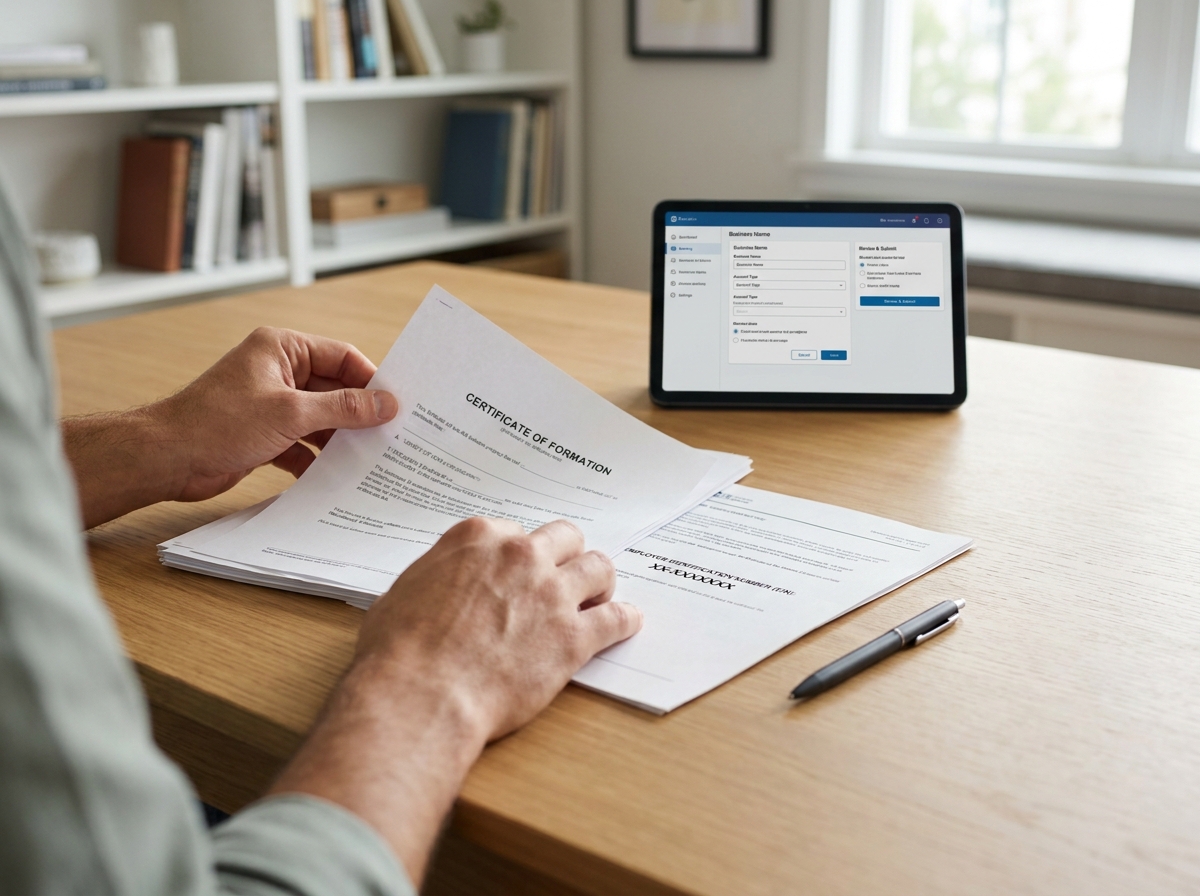
- Employer Identification Number (EIN): This nine-digit number is issued by the IRS and acts as your LLC's federal tax ID. It's akin to a Social Security Number for your business. Most banks require an EIN to open a business account. Lovie assists with obtaining your EIN after your LLC formation is complete, ensuring this crucial step is handled efficiently.
- Articles of Organization/Certificate of Formation: This is the legal document filed with the state to officially create your LLC. It proves your LLC's existence and legal standing. Banks will need a copy to verify your business entity. Lovie provides you with your official filed documents after formation.
- Operating Agreement: While not always legally required in every state (e.g., Delaware does not mandate it, but California does), banks often ask for your LLC's Operating Agreement. This internal document outlines the ownership structure, management responsibilities, and operational procedures of your LLC. It helps the bank understand who has the authority to act on behalf of the business.
- Business Licenses and Permits: Depending on your industry and location, you may need to provide copies of specific business licenses or permits. For instance, a restaurant LLC would need health and food service permits.
- Personal Identification: All individuals authorized to sign on the account (e.g., managing members) will need to provide government-issued photo identification, such as a driver's license or passport, and their Social Security Number.
- Proof of Business Address: This could be a utility bill, lease agreement, or a registered agent address if you are using one (which Lovie provides for 3 years).
The Process:
Once you have these documents, you can typically apply in person at a branch, or for online-only banks, through their digital application portal. The process usually involves filling out an application form, presenting your documents, and making an initial deposit. For online banks, the verification process might involve uploading scanned copies of documents and identity verification through video calls or secure online portals. Some banks, especially online ones, can complete the entire process within a few days once all documents are submitted. For physical banks, an appointment might be necessary. Ensure all information matches your formation documents exactly to avoid delays. Having your Lovie-prepared formation documents and EIN ready simplifies this significantly.
Optimizing Your LLC Banking Strategy for Long-Term Growth
Establishing your initial business bank account is just the first step. To truly leverage your banking relationship for your LLC's long-term success, you need a proactive and optimized banking strategy. This involves not only managing your day-to-day transactions but also thinking about how your bank can support your growth, mitigate risks, and simplify financial management as your business evolves. A well-thought-out strategy can save time, reduce costs, and provide valuable insights into your financial health.
Leveraging Digital Tools and Integrations
Modern business banking thrives on digital efficiency. Maximize the use of your bank's online portal and mobile app for remote deposits, bill payments, and real-time transaction monitoring. Integrate your business bank account with your accounting software (e.g., QuickBooks, Xero) to automate reconciliation, categorize expenses, and generate financial reports. This reduces manual errors, saves significant time during tax season, and provides a clearer, up-to-date picture of your LLC's financial performance. Many online banks, like Novo and Relay, are built with these integrations in mind, offering seamless connectivity that can transform your financial workflow. Utilizing features like budgeting tools and cash flow forecasts, often available through banking apps or integrated platforms, can help you make more informed decisions about spending and investments.
Building Business Credit
Your business bank account is a foundational element for building your LLC's credit history. Consistent, responsible banking behavior—maintaining healthy balances, avoiding overdrafts, and using business credit cards wisely—contributes positively to your business credit score. This is distinct from your personal credit and becomes essential for securing larger loans, lines of credit, or favorable terms with suppliers in the future. Many banks offer business credit cards or small business loans specifically designed to help LLCs establish and grow their credit profile. Consider these early on, even if for small amounts, to start building that history.
Regular Review and Adaptation
Your LLC's banking needs will evolve as it grows. What was the 'best' bank for your startup phase might not be the most optimal for a rapidly expanding enterprise. Conduct annual reviews of your bank accounts and services. Are the fees still competitive? Are the transaction limits sufficient? Does your bank offer new services that could benefit your current stage of growth, such as treasury management, payroll solutions, or more sophisticated lending products? Don't hesitate to explore new banking partners if your current one no longer meets your needs. Staying informed about new financial technologies and banking solutions can also provide opportunities to further optimize your strategy. For example, if your LLC starts engaging in significant international trade, exploring multi-currency accounts or specialized FX services might become a priority. Proactively adapting your banking strategy ensures your financial infrastructure always supports your LLC's strategic objectives and operational efficiency.
Frequently asked questions
Can I use my personal bank account for my LLC?
No, it is strongly advised against using your personal bank account for your LLC. While legally permissible in some very limited scenarios for single-member LLCs, it exposes you to the risk of 'piercing the corporate veil,' which can negate the personal liability protection your LLC provides. Maintaining separate accounts is crucial for legal protection, clear accounting, and professional credibility. Most banks require an EIN to open a business account, which personal accounts do not have.
What is an EIN and why do I need it for my LLC's bank account?
An EIN (Employer Identification Number) is a unique nine-digit federal tax ID issued by the IRS for businesses, similar to a Social Security Number for individuals. Most banks require an EIN to open a business bank account for an LLC, as it identifies your business for tax purposes and signifies its legal entity status. It's a mandatory document for nearly all LLCs, especially those with employees or multiple members. Lovie assists with obtaining your EIN as part of its formation service.
How long does it take to open a business bank account for an LLC?
The time it takes to open an LLC business bank account varies. If you have all required documents (EIN, Articles of Organization, Operating Agreement, ID) ready, some online banks can open an account in a few business days. Traditional banks might take one to two weeks, especially if an in-person appointment is needed. Delays often occur if documentation is incomplete or inaccurate. Preparing all documents in advance significantly speeds up the process.
Do I need an Operating Agreement to open a business bank account?
While not always a legal requirement in every state for LLC formation, many banks do request your LLC's Operating Agreement when opening a business account. This document clarifies the ownership structure, management roles, and authorized signers for the bank, ensuring they understand who has the authority to conduct transactions on behalf of the LLC. Having it ready expedites the account opening process.
Can international founders open a US business bank account for their LLC?
Yes, international founders can open a US business bank account for their LLC. The primary requirements are the LLC's Articles of Organization, an EIN, and often, a US mailing address. Some banks may require an in-person visit or a US-based authorized signatory. Online-only banks like Novo or Mercury are often more accessible for international founders due to their remote application processes. Lovie assists international founders with both LLC formation and EIN registration.
What are common fees associated with LLC business bank accounts?
Common fees include monthly maintenance fees (often waivable with minimum balances or transaction activity), transaction fees for exceeding limits, ATM fees (especially out-of-network), wire transfer fees (domestic and international), and overdraft fees. Some banks also charge for remote check deposits or specific business services like merchant processing. Always review the fee schedule carefully before choosing a bank.
What's the difference between a business checking and savings account for an LLC?
A business checking account is designed for day-to-day transactions, allowing frequent deposits, withdrawals, and payments. It's for operational cash flow. A business savings account is for holding reserves, earning interest, and is typically less transactional. It helps segregate funds for taxes, emergencies, or future investments. Many LLCs use both to manage their finances effectively and maximize interest earnings on idle cash.
Quick answers
What do I need to know about Best Business Bank Account For International Payments for my business?
Understanding Best Business Bank Account For International Payments is essential for business compliance and operational success. The specific requirements vary by state and industry.
How does Best Business Bank Account For International Payments affect my business formation?
This aspect of business formation directly impacts your legal standing, tax obligations, and operational flexibility.
Explore Formation Guides
State-specific formation guides, cost breakdowns, compliance checklists, and expert comparisons — updated for 2026.
Popular Guides
- Best Business Checking Accounts For LLC — US Company
- Best Business Credit Cards For New LLC — US Company
- Best Business Formation Services — US Company Formation
- Best Business in New York | Lovie — US Company Formation
- Best Business Insurance For LLC — US Company Formation Guide
- Best Business To Start IN Alabama — US Company Formation
- Best Business To Start IN Arizona — US Company Formation
- Best Business To Start IN Arkansas — US Company Formation
- Best Business To Start IN California 2023 — US Company
- Best Business To Start IN Colorado — US Company Formation
- Best Business To Start IN Florida 2023 — US Company
- Best Business To Start IN Florida — US Company Formation
- Best Business To Start IN Georgia — US Company Formation
- Best Business To Start IN Hawaii — US Company Formation
- Best Business To Start IN Illinois — US Company Formation

Lovie is not a government agency, law firm, or professional advisory organization. Lovie is a private business-formation service that prepares and submits filings to the appropriate state agencies on your behalf — we do not issue government documents, and state approval times are not controlled by Lovie. Information on this page is general and not legal, tax, or financial advice.