
On this page · 8 sections
- Why a Thorough Name Search Matters
- Understanding California Naming Rules
- California Secretary of State Search Tools
- Checking Fictitious Business Names (DBAs)
- Trademark Search and Domain Availability
- What to Do If Your Name is Taken
- Reserving Your California Business Name
- Filing Your California Entity with Confidence
Why a Thorough Name Search Matters for Your California Business
Establishing a business in California, the world's fifth-largest economy, demands meticulous attention to detail, starting with your company's name. A comprehensive name search is not merely a bureaucratic hurdle; it's a foundational step that protects your brand, prevents costly legal disputes, and ensures operational continuity. Imagine investing significant resources into branding, marketing, and legal documentation, only to discover your chosen name is already legally claimed by another entity. This scenario can force a complete rebranding, invalidate contracts, and lead to substantial financial losses and delays. California's dense business landscape, with over 4.2 million small businesses as of 2023, means unique names are increasingly scarce, making your due diligence even more critical. Beyond avoiding conflict, a unique and available name is vital for your business's identity and market positioning. You might also find our guide on setting up your California LLC useful here. It allows you to build a distinct brand that resonates with your target audience without confusion. Furthermore, the California Secretary of State (SOS) will reject formation documents for names that are not distinguishable from existing registered entities. This rejection can delay your launch by weeks or even months, especially given the SOS's typical processing times, which can fluctuate. A proactive name search ensures your application proceeds smoothly, saving you from administrative headaches and helping you get to market faster. This guide will equip you with the knowledge and tools to navigate this essential process effectively, setting your California LLC or Corporation up for success from day one.
Understanding California's Naming Rules for LLCs and Corporations
California's Corporations Code and Business and Professions Code outline specific requirements for business names, depending on the entity type. For Limited Liability Companies (LLCs), the name must contain the words "Limited Liability Company" or the abbreviation "LLC" or "L.L.C." These designators clearly communicate the liability structure to the public. For Corporations, the name must include "Corporation," "Incorporated," "Limited," or an abbreviation such as "Corp.," "Inc.," or "Ltd." Professional corporations may have additional requirements, often needing to include words like "Professional Corporation" or specific industry terms. Crucially, your chosen name must be "distinguishable in the records" from existing registered entities. This doesn't mean it has to be entirely unique, but it cannot be so similar that it would confuse the public. Minor differences like punctuation, articles ("A," "An," "The"), or common corporate designators usually aren't enough to make a name distinguishable if the core words are identical. For example, "Golden State Consulting LLC" might be rejected if "Golden State Consulting, Inc." already exists. This connects to our resource on forming an LLC in California, which covers the details. The California SOS applies its own subjective criteria for distinguishability, which can sometimes be more stringent than anticipated. Understanding these nuances upfront will save you time and prevent rejections. It's also important to avoid words that imply governmental affiliation or certain licensed professions (e.g., "bank," "trust," "university") without proper authorization or licensing. These restrictions are in place to protect consumers and maintain regulatory integrity within the state's economy. Consulting these regulations before initiating your search can narrow down suitable options considerably.
Using the California Secretary of State's Business Search Tools
The primary resource for checking the availability of an LLC or Corporation name in California is the Secretary of State's Business Search website. This online database provides public access to information on all legally registered business entities in the state. To perform a search, navigate to the California SOS website and locate the 'Business Search' portal. You can search by corporation name, limited liability company name, or even by entity number if you have it. For name searches, enter your desired business name, omitting any entity designators (e.g., search for 'Golden Gate Innovations' instead of 'Golden Gate Innovations LLC') to cast a wider net. The search results will display active and inactive entities that match or are similar to your query. It's vital to review not only exact matches but also names that are phonetically similar or differ by only a few characters. The SOS system will flag names as 'not available' if they are too similar to existing entries based on their internal distinguishability rules. Pay close attention to the status of the entity; an 'active' status means the name is currently in use. While an 'inactive' status might seem promising, it's still best to consult with Lovie or legal counsel, as some inactive names might still have residual rights or be in the process of revival. For related guidance, see our article on starting a business in California. Remember, this search primarily covers names registered with the SOS; it does not account for trademarks registered at the federal level or fictitious business names (DBAs) filed at the county level, which requires additional steps. ## Interpreting Search Results When reviewing search results, look for:
- Exact Matches: An exact match for an active entity means the name is unavailable. - Similar Names: Names that are very close phonetically or visually may also be rejected by the SOS. - Status: Ensure the matching name is truly inactive and not just temporarily suspended. An active name is a definitive no-go. - Entity Type: Note if similar names are for different entity types (e.g., a corporation vs. an LLC). While distinct, extreme similarity can still lead to rejection.
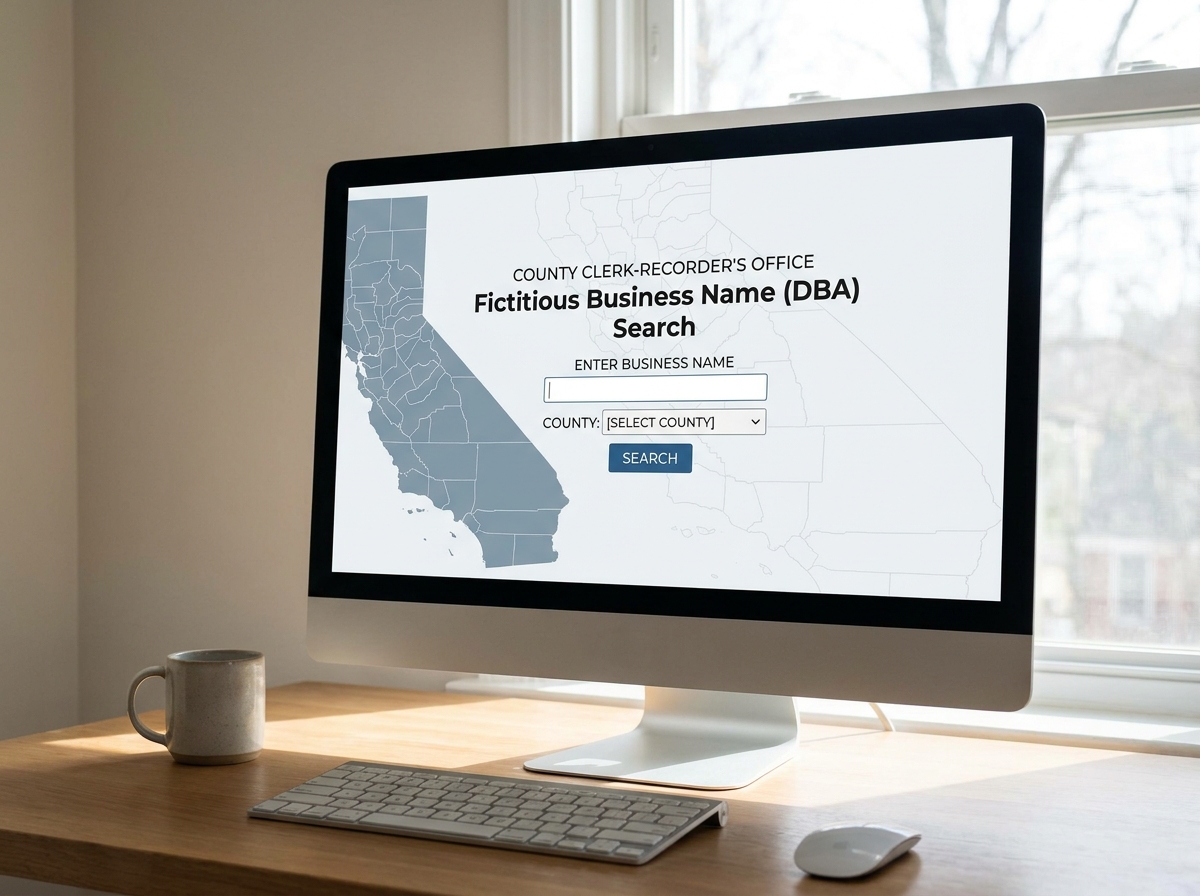
Checking Fictitious Business Names (DBAs) at the County Level
While the California Secretary of State's business search is crucial for LLC and Corporation names, it doesn't cover Fictitious Business Names (FBNs), commonly known as DBAs (Doing Business As). FBNs are registered at the county level and allow a business to operate under a name different from its legal registered name. For instance, 'Golden Gate Innovations LLC' might operate a subsidiary brand called 'Silicon Valley Solutions' under an FBN. Failing to check county FBN records could lead to market confusion or even legal challenges, especially if you plan to operate under a DBA yourself.
Each of California's 58 counties maintains its own FBN registry, often through the County Clerk's office. This means there isn't a single, statewide database for DBAs. To perform a thorough FBN search, you'll need to contact the County Clerk's office in the specific county (or counties) where you intend to conduct business. Many County Clerks now offer online search tools, but some may require an in-person visit or a mailed request. For example, Los Angeles County, the largest in California, provides an online FBN search portal, while smaller counties might have less sophisticated systems.
It's important to understand that an FBN does not grant exclusive rights to a name across the entire state, only within the county of registration. However, a prior FBN registration can still be a source of conflict. If your proposed LLC or Corporation name is identical to an FBN in your primary county of operation, it could lead to customer confusion and potential legal issues down the line. Therefore, this county-level search is a critical, albeit sometimes fragmented, step in your comprehensive name availability check. Lovie can assist in identifying the correct county resources for your specific operational footprint, streamlining this often overlooked part of the process.
Beyond the State: Trademark Search and Domain Availability
While the California Secretary of State search and county FBN checks are vital for legal entity formation, a truly comprehensive name availability strategy extends to federal trademarks and online presence. A name might be available in California, but if it infringes on a federally registered trademark, you could face severe legal repercussions, including injunctions and damages, regardless of state approval. The United States Patent and Trademark Office (USPTO) maintains a searchable database of all registered federal trademarks. Conducting a thorough search on the USPTO's Trademark Electronic Search System (TESS) is a non-negotiable step. Look for both exact matches and similar-sounding or visually similar marks, particularly in the same or related industries, to avoid potential infringement claims.
Simultaneously, securing your online identity is paramount in today's digital economy. Even if your business name is legally available and clear of trademarks, if the corresponding domain name (.com is highly preferred) and social media handles are taken, it significantly hinders your brand building and marketing efforts. Before finalizing your business name, check the availability of your desired domain name through reputable registrars (e.g., GoDaddy, Namecheap). Also, verify that corresponding social media handles (e.g., @yourbusinessname on X, Instagram, Facebook) are available. A cohesive online presence strengthens your brand and makes it easier for customers to find you.
This multi-layered approach—state, county, federal, and digital—ensures that your chosen name is not only legally viable but also strategically sound for long-term growth and brand recognition. Skipping any of these steps leaves your business vulnerable to future challenges, making the initial investment in a thorough search well worth the effort. Lovie understands the importance of a holistic approach to name selection and can guide you through these various checks, helping you secure a name that truly sets your business apart.
What To Do If Your Preferred California Business Name Is Taken
Discovering your ideal business name is already in use can be disheartening, but it's not the end of the road. This is a common scenario in a populous state like California, and there are several strategic approaches you can take. First, consider minor variations. Adding a geographic identifier (e.g., "Bay Area Innovators LLC" instead of "Innovators LLC"), a unique descriptor (e.g., "Apex Innovations Corp"), or a relevant keyword can often create a distinguishable name. For example, if "Golden State Consulting LLC" is taken, "Golden State Strategic Consulting LLC" might be available and equally effective. Be creative, but always ensure the new variation still clearly communicates your brand and mission.
Second, explore alternative legal entity designators. While "LLC" or "Inc." are common, sometimes using the full "Limited Liability Company" or "Incorporated" can make a name distinguishable if the abbreviation was the only conflict. However, this is less common with the California SOS's strict interpretation. Third, if the name is taken by an inactive entity, you might have options. While the California SOS generally holds inactive names for a period, it might be possible to inquire about its status and potential availability after a certain lapse. This often requires direct communication with the SOS and understanding their specific rules for name re-assignment.
Finally, if all variations of your primary choice are exhausted, be prepared to brainstorm entirely new names. View this as an opportunity to refine your brand identity. Perhaps the initial name was good, but a fresh perspective could lead to an even stronger, more memorable name. Lovie assists founders in navigating these challenges, providing guidance on how to creatively adapt your naming strategy while adhering to California's strict regulations. We help you explore viable alternatives and ensure your chosen name meets all statutory requirements before filing, minimizing delays and frustration.
Reserving Your California Business Name: Securing Your Spot
Once you've identified an available and distinguishable business name, you might want to reserve it to prevent others from claiming it while you finalize your formation plans. California offers a name reservation service through the Secretary of State's office. By filing a Name Reservation Request Form (Form Name Reservation Request), you can reserve your chosen name for a period of 60 days. This provides a crucial window to prepare and submit your formation documents without the risk of losing your desired name.
The filing fee for a Name Reservation Request is typically $10, as of 2026. This fee is non-refundable, and the reservation is not renewable. If you need more time after the 60-day period expires, you must file a new reservation request and pay another fee, provided the name is still available. It's important to note that a name reservation only holds the name for your specific entity type (e.g., LLC or Corporation). It does not prevent another entity from registering a similar name for a different entity type if the SOS deems it distinguishable, nor does it guarantee trademark protection.
While optional, name reservation is a strategic move for founders who anticipate a slight delay between their name search and the official filing of their Articles of Organization (for LLCs) or Articles of Incorporation (for Corporations). For example, if you're still gathering investor commitments or finalizing your operating agreement, a name reservation buys you peace of mind. For many Lovie founders, especially those with tight timelines or unique names, this step is a valuable safeguard. Lovie can assist with the preparation and submission of your Name Reservation Request, ensuring it is correctly filed with the California Secretary of State, giving you one less administrative task to worry about during your formation journey.

Filing Your California Entity with Confidence
After successfully navigating the name search and reservation process, the next critical step is officially forming your California LLC or Corporation. This involves preparing and submitting your formation documents—Articles of Organization for an LLC or Articles of Incorporation for a Corporation—to the California Secretary of State. These documents formally establish your legal entity and are essential for everything from opening a business bank account to securing licenses and permits. Errors or omissions in these filings can lead to rejections, significant delays, and potential legal complications, making accuracy paramount.
California is known for its detailed filing requirements, and the SOS reviews submissions meticulously. Beyond the name, your Articles must include specific information such as the registered agent's name and address, the purpose of the business, and details about initial members or directors. The state filing fee for Articles of Organization (LLC) or Articles of Incorporation (Corporation) is currently $70 as of 2026. While the process can be managed independently, many founders, particularly those new to California's specific regulations, opt for professional assistance to ensure compliance and efficiency. This is where Lovie provides invaluable support.
Lovie specializes in preparing and submitting all necessary formation documents on your behalf, handling the intricacies of state requirements. Our AI-powered platform streamlines the process, ensuring your filings are accurate and complete, minimizing the risk of rejection. Registered agent service is required in every state and is priced separately at $79/year ($49/year in Wyoming). This allows you to focus on building your business, confident that your formation is handled professionally and compliantly. With Lovie, you're not just filing; you're setting a solid foundation for your California venture, from name search to ongoing compliance.
Frequently asked questions
Can I use a business name if it's identical to an inactive California company?
Generally, the California Secretary of State will not allow the use of a business name that is identical or confusingly similar to an inactive company for a certain period. The SOS maintains records of dissolved or cancelled entities and typically reserves their names to prevent confusion and potential issues if the entity were to be revived. While the exact holding period can vary, it's safer to choose a name that is clearly distinguishable from all existing and recently inactive entities to avoid potential rejections and future complications. Always confirm current availability directly with the SOS.
What is the difference between a legal business name and a Fictitious Business Name (DBA) in California?
A legal business name is the official name under which your LLC or Corporation is registered with the California Secretary of State. This is the name used on legal documents, contracts, and for tax purposes. A Fictitious Business Name (DBA) is a name your business operates under that is different from its legal name. For example, 'Golden State Innovations LLC' might legally own a retail storefront called 'The Tech Hub.' 'The Tech Hub' would be the DBA, registered at the county level. DBAs allow businesses to operate multiple brands or trade names without forming a separate legal entity for each, but they do not create a separate legal entity or provide statewide name protection.
How long does a California name reservation last, and can it be renewed?
A California business name reservation, filed with the Secretary of State, lasts for a period of 60 days. The filing fee for this is $10. Importantly, these reservations are not renewable. If your 60-day period expires and you still need to reserve the name, you must file a completely new Name Reservation Request form and pay another $10 fee, assuming the name is still available and hasn't been claimed by another entity in the interim. It's crucial to plan your formation timeline carefully around this 60-day window.
Does a California business name search check for federal trademarks?
No, a California business name search conducted through the Secretary of State's office only checks for the availability of names for state-level entity registration (LLCs, Corporations, etc.) within California's records. It does not check for federal trademarks registered with the United States Patent and Trademark Office (USPTO). To ensure your chosen name does not infringe on existing federal trademarks, you must conduct a separate and comprehensive search using the USPTO's Trademark Electronic Search System (TESS). This is a critical step to avoid potential legal issues.
What happens if I file formation documents with an unavailable name?
If you submit your Articles of Organization (for an LLC) or Articles of Incorporation (for a Corporation) to the California Secretary of State with a name that is not distinguishable from an existing registered entity, your filing will be rejected. This rejection will lead to significant delays in your business formation process. You will need to amend your documents with a new, available name and resubmit them, incurring additional processing time. This is why a thorough name search and potentially a name reservation are highly recommended before submitting your official formation papers.
Are there specific words or phrases I should avoid in a California business name?
Yes, California law restricts the use of certain words and phrases in business names. You should avoid terms that suggest governmental affiliation (e.g., 'Federal,' 'State,' 'Bureau') or imply a licensed profession (e.g., 'Bank,' 'Trust,' 'University,' 'Attorney,' 'Engineer') unless your business is properly licensed and authorized to use them. These restrictions are in place to protect the public and prevent misrepresentation. Always consult the California Corporations Code for detailed prohibitions, or use a service like Lovie to ensure your name is compliant with all state regulations.
California Formation Data Insights
| State Filing Fee | $75 |
| Annual Fee | $20 |
| First Year Total | $895 |
| Processing Time | 11.7 days avg (official: 10-15 days) |
| Corporate Tax Rate | 8.84% |
Key Insights
- California'de LLC kurulum maliyeti ulusal ortalamanın $671 üzerinde — toplam ilk yıl maliyeti $895.
- Lovie platformu üzerinden California LLC başvuruları ortalama 11.7 iş gününde onaylanmaktadır (eyalet resmi süresi: 10-15 gün).
- California merkezli işletmeler için EIN onay süresi ortalama 4.7 gündür.
- California kurumlar vergisi oranı %8.84 ile ulusal ortalamanın (%6.57) üzerindedir.
Data sources: State Secretary of State offices, IRS, Tax Foundation (2026). Platform metrics based on anonymized Lovie user data.
Key Concepts: Business Formation
US Business Formation guides entrepreneurs through the business formation process with actionable steps. Key components include LLC formation, entity registration, and state filing, each playing a critical role in the business formation process. Understanding liability protection and tax optimization is essential, as these factors directly impact legal compliance.
When evaluating business formation options, factors such as business entity types and formation process should inform your decision-making process.
Entity Relationships
- Business Formation requires LLC formation
- Business Formation includes entity registration
- Business Formation establishes state filing
- Business Formation defines business structure selection
Quick answers
What do I need to know about California Company Name Search for my business?
Understanding California Company Name Search is essential for business compliance and operational success. The specific requirements vary by state and industry.
How does California Company Name Search affect my business formation?
This aspect of business formation directly impacts your legal standing, tax obligations, and operational flexibility.
Explore Formation Guides
State-specific formation guides, cost breakdowns, compliance checklists, and expert comparisons — updated for 2026.
LLC Formation Guides
- How to Form an LLC for Virtual Assistant Hawaii
- How to Form an LLC for Web Developer West Virginia
- How to Form an LLC for Drone Services Wyoming
- How to Form an LLC for Freelancing California
Popular Guides
Cost by Entity & State
- Sole Proprietorship Cost Alabama Formation Costs
- Nonprofit Cost Michigan Formation Costs (2026) | Lovie
- C Corp Cost South Carolina Formation Costs (2026) | Lovie

Lovie is not a government agency, law firm, or professional advisory organization. Lovie is a private business-formation service that prepares and submits filings to the appropriate state agencies on your behalf — we do not issue government documents, and state approval times are not controlled by Lovie. Information on this page is general and not legal, tax, or financial advice.