On this page · 8 sections
- What is a California DBA (FBN)?
- Who Needs a California DBA?
- The California DBA Registration Process
- County Filing and Publication Requirements
- DBA Costs and Renewal in California
- Key Benefits of Registering a California DBA
- Common Pitfalls and How to Avoid Them
- DBA vs. LLC vs. Corporation: Understanding the Differences
What is a California DBA (FBN)?
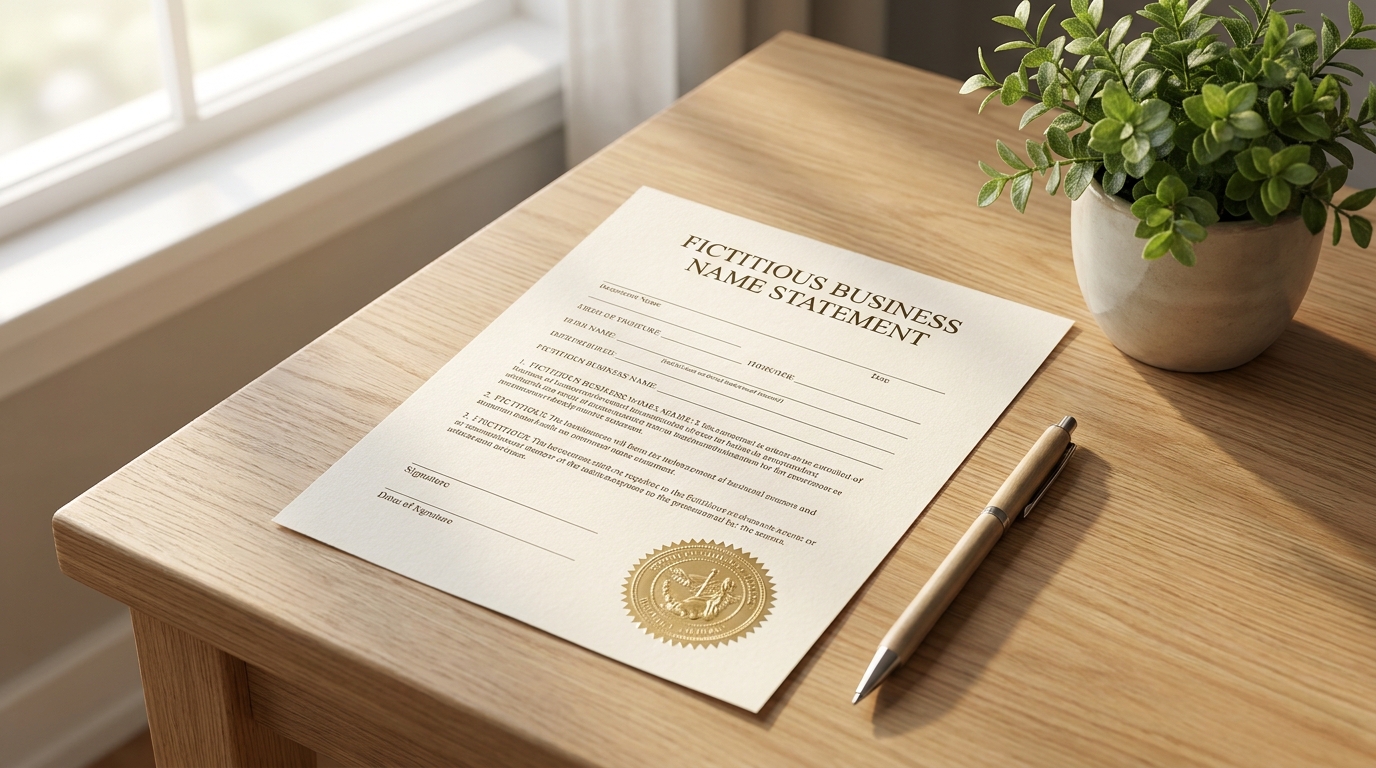
In California, what is commonly known as a Doing Business As (DBA) name is officially termed a Fictitious Business Name (FBN). This legal designation allows an individual, partnership, or corporate entity to conduct business activities under a name different from its legally registered or personal name. For instance, if Jane Doe, a sole proprietor, wants to open a boutique called 'Golden State Goods,' she would need to file an FBN statement because 'Golden State Goods' is not her legal personal name. Similarly, an LLC named 'Tech Innovators LLC' might file an FBN to operate a specific product line under 'Future Gadgets.' The primary purpose of the FBN statute, specifically California Business and Professions Code Sections 17900-17930, is public transparency. It ensures that consumers and creditors can easily identify the true legal entity or individual behind a business operating under an assumed name. This transparency is vital for consumer protection, as it provides a clear path for legal recourse if necessary. For more details, see our guide on LLC registration in California. Without an FBN registration, conducting business under an assumed name can lead to significant legal and financial complications, including difficulty opening business bank accounts or entering into contracts under the assumed name. It's a foundational step for many entrepreneurs looking to establish a distinct brand identity without forming a separate legal entity like an LLC or corporation immediately. The FBN is not a business entity itself; rather, it is a registration of a name under which an existing legal entity operates. It does not provide liability protection, which is a common misconception. That protection comes from the underlying business structure, such as an LLC or a corporation.
Who Needs a California DBA?
Understanding whether you need to file a California Fictitious Business Name (FBN) statement is crucial for compliance. The requirement primarily hinges on your legal business structure and the name you wish to use for public operations. Generally, a DBA is required if you are a sole proprietorship or a general partnership operating under a name that does not include the full legal names of all owners. For example, if John Smith starts a consulting business called 'Smith Consulting,' he might not need an FBN if 'Smith Consulting' is clearly identifiable with his legal name. However, if he calls it 'Golden Gate Strategies,' an FBN is mandatory. The same applies to partnerships: 'Garcia & Lee Law Firm' might be acceptable, but 'Bay Area Legal Services' would require an FBN. Corporations and Limited Liability Companies (LLCs), which already have unique legal names registered with the California Secretary of State, also need an FBN if they wish to conduct business under a name different from their official registered name. You can learn more about forming an LLC in California to understand the full picture. For instance, 'Innovate Solutions LLC' might want to market a specific division as 'Quantum Leap Tech.' In this scenario, 'Quantum Leap Tech' would need to be registered as an FBN by 'Innovate Solutions LLC.' Banks typically require proof of FBN registration to open a business bank account under the assumed name, ensuring that the business is legally permitted to use that name. This is a critical practical reason why many businesses file an FBN. Failure to file an FBN when required can result in legal penalties, including fines, and could impede your ability to enforce contracts made under the unregistered name. It's not just about branding; it's about legal standing and operational legitimacy. Always verify your specific situation against California's Business and Professions Code to ensure full compliance.
The California DBA Registration Process: Step-by-Step
Registering a Fictitious Business Name (FBN) in California involves a series of steps designed to ensure public notice and prevent name confusion. The process begins with a crucial name availability search. While the state does not offer a centralized FBN database, you should search the FBN records of the county clerk's office where you intend to file. This helps ensure your chosen name isn't already in use, preventing potential conflicts or rejection of your filing. You'll also want to conduct a general web search and check the California Secretary of State's business entity name database, although this is primarily for LLCs and corporations, it can provide additional insight into existing business names. After confirming name availability, the next step is to complete the Fictitious Business Name Statement form. This form typically requires details such as the proposed FBN, the legal name and address of the registrant(s), the business entity type (e.g., sole proprietorship, LLC), the date you first started transacting business under the FBN (if applicable), and the county where the principal place of business is located. The form must be signed under penalty of perjury. Once completed, you will file this statement with the county clerk in the county where your principal place of business is located. If your business operates in multiple counties under the same FBN, you generally only need to file in the county of your principal office, provided you also publish the FBN in that county. We cover this in depth in our resource on how to register an LLC in California. However, if you have multiple principal places of business in different counties, you might need to file in each of those counties. Filing fees vary by county but are typically around $20-$40, plus an additional fee for each additional name or registrant. This initial filing is a critical step, but it's only half the battle. The publication requirement, which follows, is equally important for compliance. Many founders find the nuances of county-specific rules and publication requirements cumbersome. This is where services like Lovie can streamline the process, guiding you through each step and ensuring all forms are correctly prepared and submitted, helping you avoid common administrative delays. While Lovie focuses on LLC and C-Corp formation, understanding FBNs is key for many founders who later opt for more robust structures. If you're considering forming an LLC, Lovie can prepare and submit all your formation documents, manage state fees, and secure your EIN, offering a comprehensive solution beyond just FBN registration.
County Filing and Publication Requirements
The California Fictitious Business Name (FBN) registration process is unique due to its mandatory publication requirement. After you file your FBN Statement with the county clerk, California Business and Professions Code Section 17917 mandates that you must publish a notice of your FBN in a newspaper of general circulation in the county where the statement was filed. This publication must occur within 30 days of filing the FBN Statement. The notice must be published once a week for four consecutive weeks. This requirement serves to publicly announce your intention to operate under the fictitious name, further enhancing transparency for consumers and creditors. Choosing the right newspaper is important. It must be adjudicated as a newspaper of general circulation by a superior court in the county. Many county clerk offices provide a list of approved newspapers, or you can find them through legal publishing services. The newspaper will typically provide you with an 'Affidavit of Publication' once the four-week period is complete. This affidavit is crucial. While you don't usually refile it with the county clerk, you must retain it as proof of compliance. It's a vital document to keep with your business records. The cost of publication can vary significantly, ranging from approximately $30 to $150, depending on the newspaper and the county. This is a separate cost from the county filing fee. Neglecting the publication requirement can render your FBN registration invalid, exposing your business to the same legal and financial risks as if you had never filed. It's a common oversight for new entrepreneurs, underscoring the importance of meticulous attention to detail during the FBN process. The strict timeline of 30 days for initial publication is often a point of stress for founders, especially when dealing with busy county offices and newspaper schedules. Ensuring this step is completed correctly and on time is paramount for maintaining the legal validity of your FBN. This dual-step process—filing with the county and then publishing—is a hallmark of California's approach to assumed business names, distinguishing it from many other states that may only require a simple state or county filing.
DBA Costs and Renewal in California
Understanding the financial and temporal commitments for a California Fictitious Business Name (FBN) is key to long-term compliance. The initial filing fee with the county clerk varies by county, but in 2026, it typically ranges from $20 to $40. For example, Los Angeles County charges $26 for the first business name and registrant, while San Francisco County charges $50. Be aware that some counties charge additional fees for extra business names or additional registrants on the same form. Beyond the filing fee, the mandatory publication in a newspaper of general circulation will incur its own cost, usually between $30 and $150, depending on the publication and county. This brings the total initial cost for registering an FBN in California to roughly $50-$190. An FBN Statement is not permanent; it generally expires five years from the date it was filed with the county clerk. To continue operating under the fictitious name, you must file a new FBN Statement and repeat the publication process. This renewal process is identical to the initial registration, meaning you'll incur both the county filing fee and the newspaper publication cost again. There are specific circumstances that also require a new FBN filing and publication before the five-year expiration. These include any change in the facts contained in the original statement, such as a change in the ownership structure of the business or a change in the address of the principal place of business. For instance, if a sole proprietorship that filed an FBN decides to bring on a partner, forming a general partnership, a new FBN statement reflecting the change in ownership must be filed and published. Neglecting to renew or update your FBN can lead to serious legal and operational issues, including an inability to maintain your business bank account or pursue legal action under the unregistered name. It's a straightforward but critical compliance task that many founders overlook. Keeping track of the five-year renewal cycle is essential for uninterrupted business operations. For those building a more complex structure, Lovie simplifies compliance. Our AI-driven platform monitors regulatory changes and helps keep your LLC or C-Corp in good standing, far beyond just FBN renewals.
Key Benefits of Registering a California DBA
Registering a Fictitious Business Name (FBN) in California offers several practical advantages, especially for sole proprietors and partnerships, that extend beyond mere legal compliance. Primarily, it enables sole proprietors and general partnerships to operate under a professional business name without the complexity and cost of forming a formal legal entity like an LLC or corporation. This is particularly appealing for small businesses and startups testing a new concept, allowing them to establish a distinct brand identity quickly and affordably. For example, a freelance graphic designer operating as 'Jane Doe' can use an FBN to market her services as 'Creative Canvas Designs,' giving her business a more polished and memorable presence. Another significant benefit is the ability to open a dedicated business bank account. Most financial institutions require proof of FBN registration to open an account under an assumed business name, separating personal and business finances. This separation is crucial for accurate bookkeeping, simplified tax preparation, and projecting a professional image to clients and vendors. Without an FBN, a sole proprietor might be limited to using a personal bank account, which can complicate financial management and tax reporting. An FBN also grants some level of public notice and brand recognition. While it doesn't offer exclusive rights to the name like a trademark, it does publicly associate your legal entity with your chosen business name within the county. This can deter others from using the exact same name in your local area, though it's not a foolproof protection. Furthermore, it allows businesses to operate multiple ventures or brands under a single legal entity. An LLC, for example, can file several FBNs to manage different product lines or services under distinct brand names, all while maintaining the liability protection of the parent LLC. This flexibility is invaluable for diversified businesses. While an FBN doesn't offer liability protection, it's an important step for establishing a legitimate and professional business presence in California.
Common Pitfalls and How to Avoid Them
Navigating the California Fictitious Business Name (FBN) process can be straightforward, but several common pitfalls can lead to delays or non-compliance. One of the most frequent mistakes is failing to conduct a thorough name search before filing. While the county clerk doesn't necessarily reject a name based on existing FBNs in other counties, using a name already in active use could lead to trademark infringement issues or consumer confusion. Always perform a comprehensive search of county FBN records, state business entity databases, and even general web searches to ensure your chosen name is available and unique. Another significant pitfall is missing the mandatory publication deadline. California law requires the FBN statement to be published in an approved newspaper within 30 days of filing with the county clerk. Failure to publish within this timeframe renders the FBN registration invalid, meaning you'll have to refile the statement and restart the entire process, incurring additional fees and delays. Keep a strict timeline and engage with an approved newspaper immediately after filing. Many entrepreneurs also mistakenly believe an FBN provides liability protection or exclusive rights to a business name. An FBN is merely a registration of an assumed name; it does not create a separate legal entity or shield personal assets from business debts and liabilities. For liability protection, you need to form an LLC or a corporation. Similarly, an FBN doesn't grant statewide or national exclusive rights to a name; only a registered trademark can offer that broader protection. Failing to renew the FBN every five years, or neglecting to file a new FBN statement when there's a change in ownership or business address, are also common oversights. These errors can result in an invalid FBN, making it difficult to maintain business bank accounts or enter into legal agreements under the fictitious name. Maintaining meticulous records and setting calendar reminders for renewal dates are simple but effective strategies to avoid these compliance issues. By being aware of these common missteps, founders can navigate the FBN process smoothly and ensure their business operates legally in California. Lovie's $29 one-time fee covers formation preparation and filing, with compliance reminders included; state filing fees are paid directly to your state, and registered agent service is priced separately at $79/year ($49/year in Wyoming).
DBA vs. LLC vs. Corporation: Understanding the Differences
The choice between operating under a Fictitious Business Name (FBN/DBA), forming a Limited Liability Company (LLC), or establishing a Corporation (C-Corp or S-Corp) is a fundamental decision for any California entrepreneur, each offering distinct legal and operational implications. A California FBN simply allows an existing legal entity (an individual, partnership, LLC, or corporation) to operate under an assumed name. It provides no liability protection whatsoever. For a sole proprietor, an FBN allows them to brand their business professionally, but their personal assets remain fully exposed to business debts and lawsuits. It's the simplest and least expensive option for branding, but offers no legal separation. In contrast, an LLC is a formal legal entity registered with the California Secretary of State. Its primary benefit is providing limited liability protection to its owners (members), shielding their personal assets from business debts and legal claims. An LLC can also elect various tax treatments, including being taxed as a sole proprietorship, partnership, S-Corp, or C-Corp. Forming an LLC involves more complex paperwork and higher state fees than an FBN, including an $800 annual franchise tax in California. However, the liability protection and increased credibility often outweigh these costs for growing businesses. Corporations (C-Corps and S-Corps) are the most complex business structures, offering the strongest liability protection for shareholders and typically designed for businesses seeking outside investment or planning to go public. Like LLCs, they are registered with the California Secretary of State. Corporations involve extensive regulatory compliance, formal corporate governance structures (board of directors, shareholder meetings), and specific tax rules. C-Corps are subject to double taxation (corporate profits taxed, then dividends to shareholders taxed), while S-Corps offer pass-through taxation to avoid this. The costs and administrative burdens for corporations are generally higher than for LLCs. When choosing, consider your need for personal liability protection, taxation preferences, future growth plans, and fundraising objectives. If you're starting small with minimal risk, an FBN might suffice for branding. But if you foresee growth, employees, or significant assets, an LLC or corporation is almost certainly the wiser choice. Lovie specializes in making LLC and C-Corp formation seamless. Our platform handles all state filings, EIN registration, and ongoing compliance, ensuring you get the right structure without the headache, allowing you to focus on your vision.
Frequently asked questions
Can I register a California DBA online?
While the initial Fictitious Business Name (FBN) Statement form can often be downloaded online from your specific county clerk's website, the actual filing generally requires submission in person or by mail to the county clerk's office. The mandatory newspaper publication also requires direct interaction with an approved publisher. There isn't a fully online, centralized state system for California DBA registration; it remains a county-level process.
Does a California DBA protect my business name?
No, a California DBA (FBN) does not provide exclusive rights or protection for your business name. It merely registers your intent to operate under that name within a specific county, primarily for public transparency. It does not prevent others from using the same name, nor does it grant trademark rights. For name protection, you would need to pursue state or federal trademark registration.
What happens if I don't register my California DBA?
Failing to register a required California DBA (FBN) can lead to several legal and operational problems. You may be unable to open a business bank account under the assumed name, hindering financial management. You could face fines or penalties for non-compliance with California Business and Professions Code. Furthermore, you might be legally prohibited from filing a lawsuit or enforcing contracts under the unregistered fictitious name.
How long is a California DBA valid?
A California Fictitious Business Name (FBN) Statement is valid for five years from the date it was filed with the county clerk. After five years, or if there's a change in the facts presented in the original statement (like ownership or address), you must file a new FBN Statement and repeat the newspaper publication process to remain compliant.
Can an LLC or Corporation file a California DBA?
Yes, an existing LLC or Corporation in California can and often does file a DBA (FBN). This is necessary if the LLC or Corporation wishes to conduct business under a name different from its official, legal name registered with the California Secretary of State. For example, 'Tech Solutions LLC' might file an FBN to operate a specific service line as 'Innovate Digital Agency'.
Is the newspaper publication really mandatory for a California DBA?
Yes, the newspaper publication requirement for a California DBA (FBN) is absolutely mandatory under state law (Business and Professions Code Section 17917). You must publish the FBN statement in an approved newspaper of general circulation in the county of filing, once a week for four consecutive weeks, within 30 days of the initial filing. Failure to do so invalidates your FBN registration.
California Formation Data Insights
| State Filing Fee | $75 |
| Annual Fee | $20 |
| First Year Total | $895 |
| Processing Time | 11.7 days avg (official: 10-15 days) |
| Corporate Tax Rate | 8.84% |
Key Insights
- California'de LLC kurulum maliyeti ulusal ortalamanın $671 üzerinde — toplam ilk yıl maliyeti $895.
- Lovie platformu üzerinden California LLC başvuruları ortalama 11.7 iş gününde onaylanmaktadır (eyalet resmi süresi: 10-15 gün).
- California merkezli işletmeler için EIN onay süresi ortalama 4.7 gündür.
- California kurumlar vergisi oranı %8.84 ile ulusal ortalamanın (%6.57) üzerindedir.
Data sources: State Secretary of State offices, IRS, Tax Foundation (2026). Platform metrics based on anonymized Lovie user data.
Key Concepts: Business Formation
US Business Formation guides entrepreneurs through the business formation process with actionable steps. Key components include LLC formation, entity registration, and state filing, each playing a critical role in the business formation process. Understanding liability protection and tax optimization is essential, as these factors directly impact legal compliance.
When evaluating business formation options, factors such as business entity types and formation process should inform your decision-making process.
Entity Relationships
- Business Formation requires LLC formation
- Business Formation includes entity registration
- Business Formation establishes state filing
- Business Formation defines business structure selection
Quick answers
What do I need to know about California Corporation Search for my business?
Understanding California Corporation Search is essential for business compliance and operational success. The specific requirements vary by state and industry.
How does California Corporation Search affect my business formation?
This aspect of business formation directly impacts your legal standing, tax obligations, and operational flexibility.
Explore Formation Guides
State-specific formation guides, cost breakdowns, compliance checklists, and expert comparisons — updated for 2026.
LLC Formation Guides
- How to Form an LLC for Virtual Assistant Hawaii
- How to Form an LLC for Web Developer West Virginia
- How to Form an LLC for Drone Services Wyoming
- How to Form an LLC for Freelancing California
Popular Guides
Cost by Entity & State
- Sole Proprietorship Cost Alabama Formation Costs
- Nonprofit Cost Michigan Formation Costs (2026) | Lovie
- C Corp Cost South Carolina Formation Costs (2026) | Lovie

Lovie is not a government agency, law firm, or professional advisory organization. Lovie is a private business-formation service that prepares and submits filings to the appropriate state agencies on your behalf — we do not issue government documents, and state approval times are not controlled by Lovie. Information on this page is general and not legal, tax, or financial advice.