
On this page · 8 sections
- What Is an EIN and Why Does It Matter?
- Method 1: Check Your Original Business Documents
- Method 2: Find Your EIN on Past Tax Returns
- Method 3: Use Bank Records or Business Permits
- Method 4: Call the IRS Business & Specialty Tax Line
- When You Need a New EIN vs. Finding an Old One
- The EIN Application Process Explained
- Common EIN Mistakes and Compliance Pitfalls
What Is an EIN and Why Does It Matter?
The Employer Identification Number (EIN) is a unique nine-digit number that the Internal Revenue Service (IRS) assigns to business entities in the United States. Think of it as a Social Security Number (SSN) for your company. Its primary purpose is for tax administration, but its role in your business operations extends far beyond filing your annual returns. You'll need an EIN to perform fundamental business activities like hiring employees, opening a business bank account, establishing business credit, and applying for necessary state and local licenses or permits. The number is formatted as XX-XXXXXXX and is assigned to your business for its entire lifespan, regardless of changes in name or location. Any business structured as a corporation or a partnership is required to obtain an EIN. For Limited Liability Companies (LLCs), the requirement depends on the structure. A multi-member LLC must have an EIN. For related guidance, see our article on starting a business in Arkansas. A single-member LLC technically doesn't need one unless it hires employees or chooses to be taxed as a corporation; however, it's a practical necessity. Most banks will refuse to open a business checking account for an LLC without an EIN, as it's the simplest way to distinguish the business's finances from the owner's personal funds. This separation is the cornerstone of the liability protection an LLC provides. Without it, you risk 'piercing the corporate veil,' which could make your personal assets vulnerable to business debts and lawsuits. Understanding the EIN's central role is the first step in managing your business's legal and financial health effectively. It’s not just a tax number; it’s a key that unlocks your company's ability to operate professionally and scale securely.
Method 1: Check Your Original Business Documents
Before you spend time on hold with the IRS, the most efficient way to find your EIN is to check the documents you already have. The most important document is the original EIN confirmation letter you received from the IRS. This official notice, known as Form CP 575, is mailed to your business address after your EIN is assigned. It serves as the primary, authoritative record of your number. If you applied online, you may have downloaded a digital version of this confirmation. Search your computer and cloud storage for 'CP 575' or 'EIN Confirmation.'
If you can't locate the CP 575, expand your search to other foundational business paperwork. Your company formation documents, while not issued by the IRS, might have the EIN recorded on them if a third-party service like Lovie assisted with the application. For more details, see our guide on how to register an LLC in California. Review your copy of the articles of organization (for an LLC) or articles of incorporation (for a corporation). Similarly, applications for business loans or lines of credit almost always require an EIN, so any saved copies of those applications are a prime location. Finally, check any state, county, or city business licenses or permits you've obtained. Many government agencies require the federal EIN for their own forms and often print it directly on the issued permit. Taking a systematic approach to searching these key documents first can often resolve the issue in minutes, saving you significant time and effort.

Method 2: Find Your EIN on Past Tax Returns
For any business that has been operating for at least one tax cycle, your previous federal tax returns are a guaranteed source for your EIN. The IRS requires the EIN to be listed prominently on all business tax filings, making this a reliable method for recovery. The exact location of the EIN depends on the type of return your business files. ## Where to Look on Tax Forms
- Form 1120 (C-Corporations): Your EIN will be in Box B at the top of the first page. - Form 1120-S (S-Corporations): Look for Box D at the top of page one. - Form 1065 (Partnerships): The EIN is located in Box D at the top of the form. - Schedule C (Form 1040 for Sole Proprietors): If you are a sole proprietor with an EIN, it will be in Box D on the Schedule C form. You can learn more about starting a business in Colorado to understand the full picture. - Form 941 (Employer's Quarterly Federal Tax Return): The EIN is located in the header of every page. If you used a tax professional or service like TurboTax, they will have digital or physical copies of your past filings. Contacting your accountant is often the quickest path; they maintain detailed records for all their clients and can provide your EIN immediately. If you filed yourself using software, log into your account and access your prior-year returns. The IRS also provides a 'Get Transcript' tool on their website, which allows you to view or download summaries of past tax returns, though this process requires a multi-step identity verification. Using past tax filings is a straightforward and official way to retrieve your EIN, especially for established businesses with a history of tax compliance.
Method 3: Use Bank Records or Business Permits
Your business's financial and regulatory relationships provide another reliable avenue for locating your EIN. When you opened your business bank account, the bank was required to obtain and verify your EIN for federal reporting purposes. This means your EIN is permanently associated with your account.
The easiest way to access it is by reviewing your account opening documents. If you don't have those, look at your monthly bank statements; some banks print the business's Tax ID number directly on the statement. If you can't find it on any paperwork, simply contact your bank. You can call your bank's business support line or visit a branch in person. After verifying your identity as an authorized signatory on the account, a bank representative can look up your account details and provide you with the EIN they have on file. This also applies to other financial accounts, such as business credit cards or loans. The lenders would have required the EIN on the application and will have it in their records.
Beyond banking, consider your interactions with other government bodies. Did you apply for a seller's permit from your state's department of revenue? Or a professional license from a state board? Or a local health permit for a restaurant? Nearly all of these applications require your federal EIN. Check any copies of these applications you've saved or the physical permits themselves. Government-issued licenses often display the EIN as a primary identifier for the business entity. This method leverages the fact that your EIN is a public-facing (though not publicly searchable) identifier used in dozens of official business interactions.
Method 4: Call the IRS Business & Specialty Tax Line
If you've exhausted all other options and still cannot find your EIN, the final and most direct method is to contact the IRS. You can call the Business & Specialty Tax Line at 800-829-4933. The line is open Monday through Friday, from 7:00 a.m. to 7:00 p.m. local time. Be prepared for potentially long wait times, especially during peak tax season, so it's best to call early in the morning or later in the week.
Before you call, you must be prepared to prove you are authorized to receive this information. The IRS will only disclose the EIN to a sole proprietor, a partner in a partnership, a corporate officer, a trustee of a trust, or an executor of an estate. You will need to provide identifying information about yourself and the business. This includes your name, address, Social Security Number, and your official title or role within the company. The IRS agent will ask you a series of security questions to verify your identity before they provide the number. They will not give the EIN to just any employee. Once your identity is confirmed, the agent will provide the EIN to you over the phone. Make sure to write it down carefully and store it in a secure location immediately. While this method is the most time-consuming, it is a guaranteed way to recover your EIN directly from the source.
When You Need a New EIN vs. Finding an Old One
A common point of confusion for founders is determining whether they need to find a lost EIN or apply for a completely new one. The rule is simple: an EIN is assigned to a specific business entity and stays with it for life. You do not need a new EIN if you simply change your business name or move to a new location. In those cases, you just need to inform the IRS of the change.
However, there are specific circumstances where applying for a new EIN is mandatory because you are, in effect, creating a new legal entity. These situations include:
- Changing Your Business Structure: If you operate as a sole proprietorship and decide to form an LLC or a corporation, the new entity requires its own EIN. The same applies if you convert an LLC into a C-Corporation.
- Acquiring a Business: If you purchase or inherit an existing business, you will need to obtain a new EIN for the entity under your ownership.
- Creating a New Entity: If you are a sole proprietor who files for bankruptcy, you will need a new EIN for the bankruptcy estate. Similarly, incorporating or forming a partnership or LLC creates a new entity requiring a new EIN.
If your situation falls into one of these categories, your task isn't to find an old number, but to obtain a new one. This is a critical step in the formation process. If you determine you need a new EIN because you're forming a new LLC or C-Corp, Lovie's platform handles the entire process. We prepare and submit the Form SS-4 on your behalf as part of our all-in-one formation package, ensuring it's done correctly from day one.
The EIN Application Process Explained
If you've determined you need a new EIN, the next step is to apply to the IRS using Form SS-4, 'Application for Employer Identification Number.' There are several ways to submit this application, each with different processing times.
Application Methods
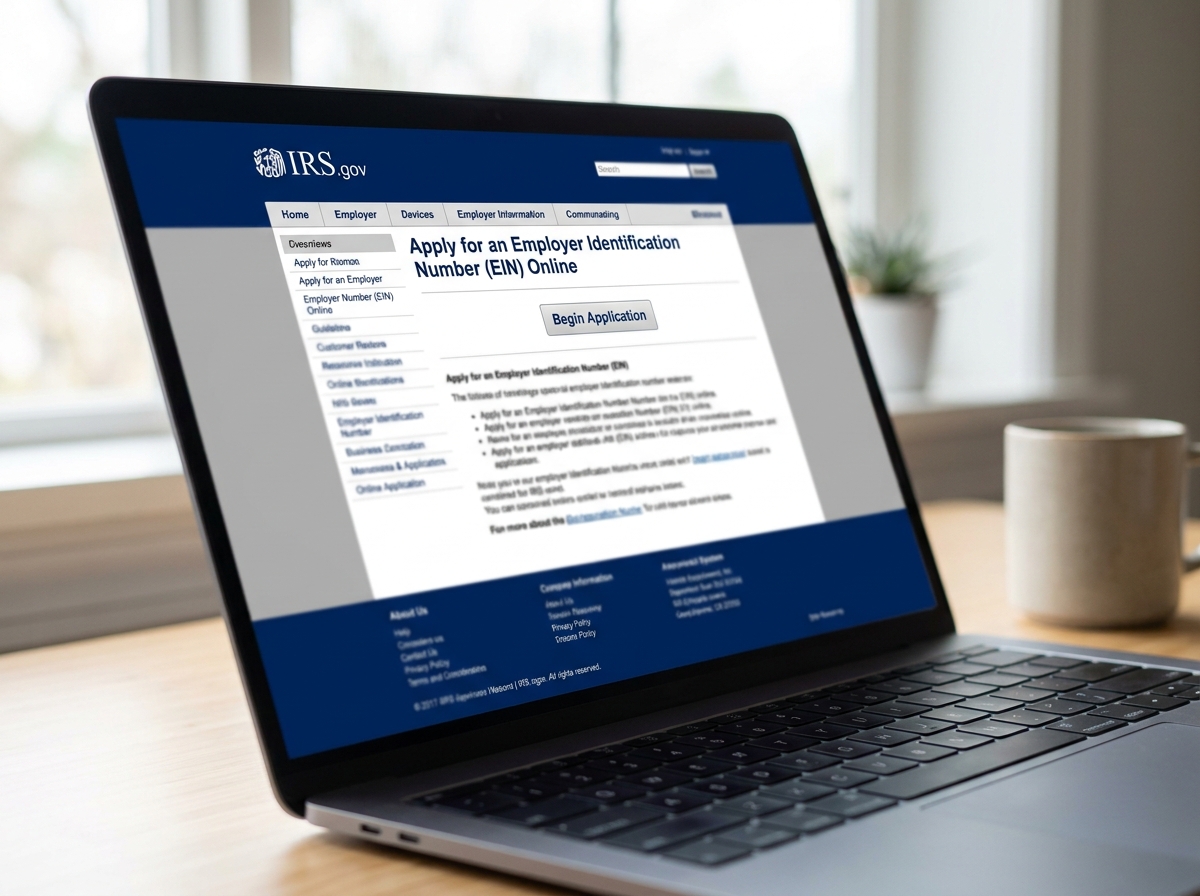
- Online: This is the fastest and most recommended method for domestic businesses. The application is an interactive interview on the IRS website. Upon completion of all required fields, you receive your EIN instantly. This service is available Monday to Friday, 7 a.m. to 10 p.m. Eastern Time. You can only apply for one EIN per responsible party per day.
- Fax: You can complete a PDF of Form SS-4 and fax it to the appropriate number based on your location (found on the IRS website). If you provide a return fax number, you can typically expect to receive your EIN back in about four business days.
- Mail: The slowest method is to mail the completed Form SS-4 to the IRS. Processing can take four to five weeks. This is generally only used when other methods are not an option.
Regardless of the method, you will need to designate a 'responsible party' on the application. This is the individual who ultimately owns or controls the entity or who exercises ultimate effective control over it. For most small businesses, this is the founder, owner, or CEO. The process itself is straightforward, but accuracy is crucial. Any errors on the Form SS-4 can lead to delays or incorrect tax classifications.
Common EIN Mistakes and Compliance Pitfalls
Navigating the EIN process is generally simple, but a few common mistakes can cause significant delays and compliance headaches for founders. Understanding these pitfalls can ensure a smooth setup for your new venture.
Mistake 1: Applying for an EIN Too Early
A frequent error is applying for an EIN before your business entity has been officially formed and approved by the state. The IRS application asks for the legal name and formation date of your business. If you apply for the EIN before your LLC or corporation is approved, the name might not be available, or the details may change. This creates a mismatch between state and federal records. The correct sequence is always: 1. File formation documents with the state (e.g., the California Secretary of State). 2. Wait for state approval. 3. Apply for the EIN using the approved legal name.
Mistake 2: Using an SSN Instead of an EIN
Once your LLC or corporation has an EIN, you must use it for all business-related activities. Using your personal Social Security Number on business bank accounts, vendor forms, or tax filings can compromise the liability shield your entity provides. Consistently using the EIN reinforces the legal separation between you and your business.
Mistake 3: Neglecting to Update Your Information
While you don't need a new EIN for minor changes, you are required to notify the IRS. If your business address or the designated responsible party changes, you must file Form 8822-B, 'Change of Address or Responsible Party.' Failing to do so can result in missed tax notices and compliance issues. Lovie's $499 one-time fee covers the state filing fee, a year of registered agent service, your EIN application, five scanned mailpieces a year, and one domain name for a year. It is the same price in every state. Our system tracks your formation status and prompts for the EIN application at the right time, and we provide guidance on maintaining compliance long after your company is formed.
Frequently asked questions
Can I look up a company's EIN online?
Generally, no. An EIN is a sensitive piece of tax information and is not available in a public database for privacy and security reasons. The main exception is for non-profit organizations, whose EINs are often publicly available through databases like Guidestar or on their Form 990 filings, which are public record.
How long does it take to get an EIN?
The time it takes to get an EIN depends on your application method. If you apply online via the IRS website, you will receive your EIN immediately upon successful completion of the application. If you apply by fax, you can typically expect a response within four business days. Applying by mail is the slowest method, taking approximately four to five weeks.
Do I need an EIN for a single-member LLC?
A single-member LLC is only required by the IRS to have an EIN if it plans to hire employees or if it elects to be taxed as a corporation. However, it is highly recommended to get one regardless. Most banks require an EIN to open a business bank account, which is essential for separating business and personal finances and maintaining your liability protection.
What is the difference between an EIN and a TIN?
TIN stands for Taxpayer Identification Number, which is a general term used for all types of tax processing numbers. An EIN (Employer Identification Number) is a specific type of TIN that is issued to business entities. Other types of TINs include the Social Security Number (SSN) for individuals and the Individual Taxpayer Identification Number (ITIN) for non-residents.
I lost my EIN confirmation letter (CP 575), can I get another one?
The IRS does not re-issue the original CP 575 notice. However, you can request a replacement document called an EIN Verification Letter, or 147C Letter. You can obtain this by calling the IRS Business & Specialty Tax Line. This letter serves as an official confirmation of your EIN and can be used for purposes like opening a bank account.
Can a non-US resident get an EIN for a US company?
Yes, international founders who form a US company can and must obtain an EIN to operate and bank in the US. However, non-US residents without an ITIN or SSN cannot use the online application. They must apply by calling the IRS directly or by mailing or faxing Form SS-4. The phone call can be challenging due to time zones and wait times, which is why many international founders use a service to assist with the filing.
Quick answers
What do I need to know about How To Find Business Ein Number for my business?
Understanding How To Find Business Ein Number is essential for business compliance and operational success. The specific requirements vary by state and industry.
How does How To Find Business Ein Number affect my business formation?
This aspect of business formation directly impacts your legal standing, tax obligations, and operational flexibility.
Explore Formation Guides
State-specific formation guides, cost breakdowns, compliance checklists, and expert comparisons — updated for 2026.
Popular Guides
- How To Find EIN For A Business — US Company Formation Guide
- How to Find EIN for Business | Lovie — US Company Formation
- How To Find EIN Number For Business — US Company Formation
- How To Find EIN Number Of A Company — US Company Formation
- How To Find LLC Operating Agreement — US Company Formation
- How To Find Missouri Charter Number — US Company Formation
- How To Find My Business EIN Number — US Company Formation
- How To Find My Operating Agreement For LLC — US Company
- How To Find My State Tax ID Number — US Company Formation
- How To Find Out Who Owns A Business IN Florida — US Company
- How To Find Out Who Owns An LLC — US Company Formation Guide
- How To Find Your EIN Number Online — US Company Formation
- How to Find Your EIN: A Complete Guide | Lovie
- How to Form a Florida LLC | Lovie — US Company Formation
- How To Form A LLC IN California — US Company Formation Guide

Lovie is not a government agency, law firm, or professional advisory organization. Lovie is a private business-formation service that prepares and submits filings to the appropriate state agencies on your behalf — we do not issue government documents, and state approval times are not controlled by Lovie. Information on this page is general and not legal, tax, or financial advice.