On this page · 8 sections
- Why an Ohio Business Search Matters
- Understanding the Ohio Secretary of State Database
- Step-by-Step: Performing Your Ohio Business Search
- Ohio Business Naming Rules and Requirements
- LLC and Corporation Name Distinguishability
- Reserving Your Ohio Business Name
- What to Do If Your Name is Taken
- The Role of Trademark Searches
Why an Ohio Business Search Matters for Your Business
Before officially establishing any business entity in Ohio, whether it's a Limited Liability Company (LLC), a Corporation, or even registering a Fictitious Name (DBA), conducting a comprehensive Ohio business name search is not merely a suggestion—it's a foundational legal and strategic imperative. This initial step serves multiple critical functions that directly impact your venture's trajectory. Primarily, it ensures your proposed business name is available for use and hasn't already been claimed by another entity registered with the Ohio Secretary of State. Ohio, like all states, has strict naming conventions designed to prevent consumer confusion and protect established businesses. Ignoring this step can lead to significant delays, costly rebranding efforts, or even legal challenges down the line. Imagine investing in branding, marketing materials, and domain names, only to discover your chosen name is unavailable or infringes on another's rights. The financial and reputational costs can be substantial. This connects to our resource on LLC registration in Ohio, which covers the details. A thorough search helps you avoid such pitfalls, securing a unique identity from the outset. This early due diligence is a hallmark of meticulous founder preparation, setting a robust foundation for legal compliance and market differentiation. It's about protecting your brand before it even launches, ensuring a smooth registration process with state authorities. For founders using Lovie, this step is integrated seamlessly, removing the guesswork and providing clear guidance on name availability. We simplify the complexities of state-specific regulations, allowing you to focus on building your business rather than navigating bureaucratic hurdles. This proactive approach is essential for any founder aiming for long-term success and legal peace of mind in Ohio's competitive market.
Navigating the Ohio Secretary of State Business Search Portal
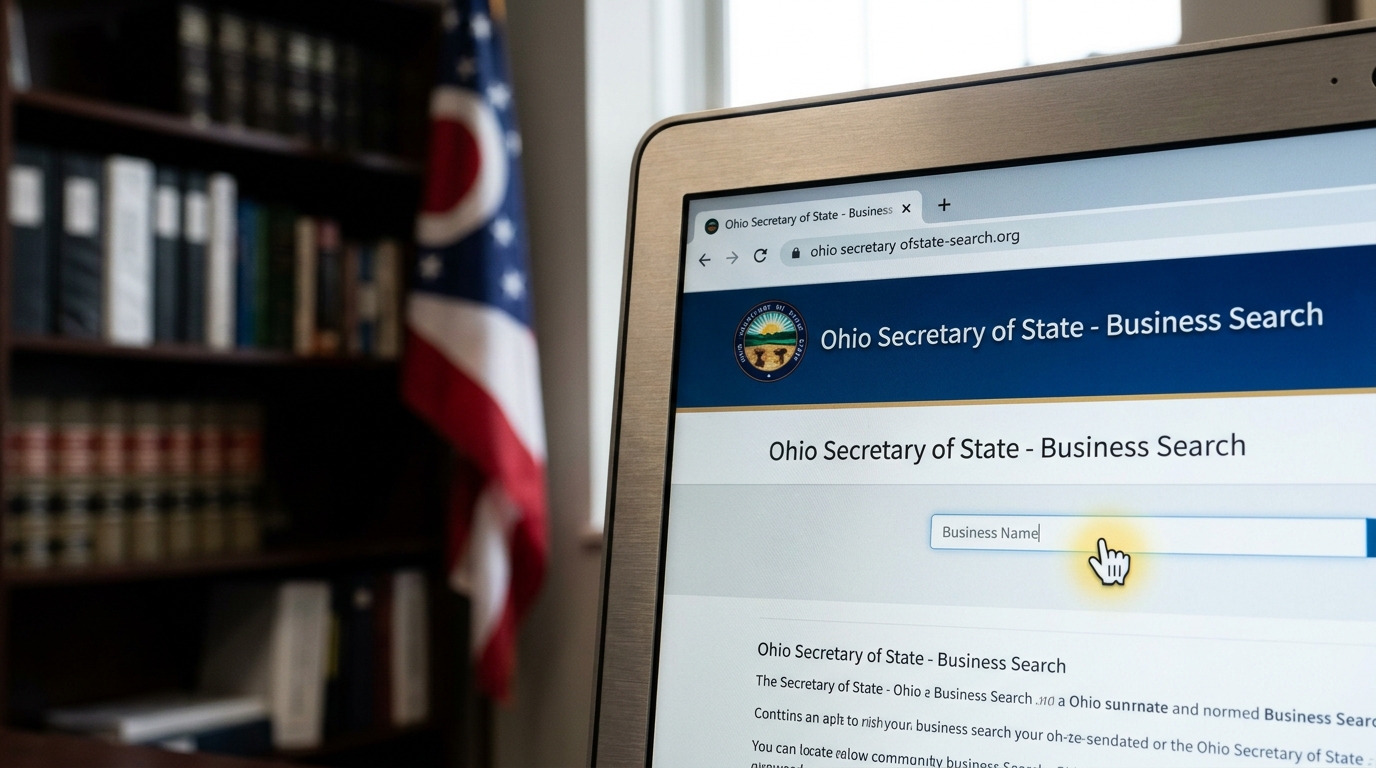
The primary tool for performing an Ohio business search is the Ohio Secretary of State's (SOS) Business Search database. This publicly accessible online portal is the official record keeper for all business entities registered within the state. It allows anyone to query information about corporations, LLCs, non-profit organizations, partnerships, and other entity types. Understanding how to effectively use this database is crucial. The SOS database is updated regularly, reflecting the most current status of registered businesses. When you perform a search, you're not just looking for an exact match; you're also assessing similar names that might be considered indistinguishable under Ohio's naming statutes. The database provides various search criteria, including: 1. Business Name: The most common search method. You can enter full names or keywords. 2. Business ID: A unique identifier assigned by the SOS to each registered entity. 3. For related guidance, see our article on starting a business in Ohio. Statutory Agent: Search by the name of the registered agent. 4. Filing Number: Another identifier for specific filings. While the SOS database is comprehensive for state-registered entities, it does not include federal trademarks or local business registrations. Therefore, a successful search here is a necessary, but not always sufficient, step. It's the first major hurdle for your chosen name. For instance, if you plan to form an Ohio LLC, the name you select must be distinguishable from any existing name in this database. The system is designed to prevent identical or confusingly similar names from being registered, upholding the integrity of business identities across the state. Lovie leverages direct integrations with state databases like Ohio's SOS to provide real-time name availability checks as part of its formation process, streamlining this critical step for founders. This ensures that the name you choose is not only creative but also legally viable in Ohio.
Step-by-Step: Performing Your Ohio Business Search Effectively
Conducting a thorough Ohio business search requires a systematic approach to ensure accuracy and reduce the risk of future complications. Here’s a step-by-step guide to navigate the Ohio Secretary of State’s online portal: 1. Access the Ohio SOS Business Search: Start by visiting the official Ohio Secretary of State website. Look for the 'Business Services' section, and then locate the 'Business Name Search' or 'Business Entity Search' tool. 2. Choose Your Search Criteria: The portal typically offers several ways to search. For name availability, select 'Business Name'. 3. Enter Your Proposed Name: Begin with the exact name you intend to use. For example, if you want 'Buckeye Innovations LLC', search for that. Then, try variations. Omit entity designators like 'LLC', 'Inc.', 'Corporation', etc., in some searches, as these are often ignored for distinguishability purposes. 4. Analyze Search Results: The system will display a list of entities that match or are similar to your query. Pay close attention to: - Exact Matches: If your name is an exact match for an active entity, it's unavailable. For more details, see our guide on forming an LLC in Ohio. - Similar Names: Ohio's naming rules consider names 'indistinguishable' if they are too similar, even with minor differences (e.g., 'Ohio Innovations LLC' vs. 'Ohio Innovations, Inc.'). Look for names that sound similar, have similar spellings, or convey the same meaning. - Inactive Entities: An entity might appear as 'inactive' or 'cancelled'. While these names might eventually become available, relying on this is risky. It's best to aim for a truly unique name. 5. Refine Your Search: If your initial search yields too many similar names, try synonyms, different spellings, or adding unique keywords that differentiate your business. 6. Document Your Findings: Keep records of your searches, including dates and results. This documentation can be helpful if you need to demonstrate due diligence later. This meticulous process helps you identify potential conflicts early. Lovie’s platform automates much of this analysis, providing immediate feedback on name availability and guiding you toward compliant choices, saving founders valuable time and effort in this critical phase of company formation.
Understanding Ohio's Business Naming Rules and Requirements
Ohio's General Corporation Law and Limited Liability Company Act stipulate specific rules governing business names to ensure clarity and prevent deception. Adhering to these regulations is crucial for a successful filing. The core principle is 'distinguishability'. Your chosen name must be distinguishable on the records of the Ohio Secretary of State from other active business names. This means more than just being unique; it must not be so similar that it could confuse the public about the entity's identity. For example, 'Ohio Tech Solutions LLC' might be considered too similar to 'Ohio Tech Solutions, Inc.' even if they are different entity types. Certain words and phrases are restricted or require special approval. For instance, words implying government affiliation (e.g., 'Federal,' 'State,' 'Bureau') or professional licenses (e.g., 'Bank,' 'Trust,' 'Attorney,' 'Engineer') often require approval from relevant state agencies or licensing boards. You cannot simply append 'LLC' or 'Inc.' to an existing name and expect it to be considered distinguishable. Ohio's administrative code outlines specific criteria for determining distinguishability, often disregarding articles (a, an, the), conjunctions (and, or), and minor punctuation. The chosen name must also include an appropriate entity designator. For an LLC, this means using 'Limited Liability Company,' 'LLC,' 'L.L.C.,' 'Ltd.,' or 'Limited.' Corporations must include 'Corporation,' 'Incorporated,' 'Company,' 'Limited,' 'Corp.,' 'Inc.,' or 'Co.' Understanding these nuances is critical. Lovie’s AI-powered platform incorporates Ohio’s specific naming rules into its name availability checker, providing real-time feedback and flagging potential issues before submission. This proactive approach helps founders select a compliant and effective business name without needing to become experts in state statutes.
LLC and Corporation Name Distinguishability Standards in Ohio
When forming an LLC or Corporation in Ohio, the concept of 'distinguishability' is paramount and often misunderstood. It’s not enough for your chosen name to be merely different; it must be demonstrably distinct from existing names on the Ohio Secretary of State’s register to avoid public confusion. Ohio Revised Code (ORC) Section 1705.05 for LLCs and Section 1701.05 for Corporations govern these naming standards. The SOS applies specific criteria when evaluating distinguishability. Minor variations in spelling, punctuation, or the use of articles (like 'a,' 'an,' 'the') are generally disregarded. For example, 'The Buckeye Innovations LLC' would likely be considered indistinguishable from 'Buckeye Innovations LLC'. Similarly, differences in entity designators ('LLC' vs. 'Inc.') alone do not make a name distinguishable if the core part of the name is identical or highly similar. The SOS will analyze the substantive part of the name. If 'Ohio Widgets, Inc.' already exists, then 'Ohio Widgets LLC' would likely be rejected. Furthermore, pluralizing a word or changing a verb tense typically doesn't create distinguishability (e.g., 'Runners Club LLC' and 'Runner's Club LLC'). The goal is to prevent any reasonable person from mistaking one entity for another. This strict interpretation protects both consumers and existing businesses from unfair competition or confusion. Founders should aim for names that are phonetically, visually, and semantically unique. This often involves brainstorming names that are genuinely original or incorporate uncommon words relevant to their niche. Lovie’s internal name validation engine simulates the Ohio SOS’s review process, offering a robust preliminary check that helps founders iterate on names until a compliant and unique option is found, significantly reducing the chances of rejection due to naming conflicts. This provides a crucial layer of confidence during the formation process.
How to Reserve Your Ohio Business Name with the SOS
Once you’ve identified an available and distinguishable name for your Ohio business, you have the option to formally reserve it with the Ohio Secretary of State. This is a strategic move for founders who are not immediately ready to file their formation documents but want to secure their chosen name. By reserving a name, you prevent other entities from registering it for a specific period, giving you peace of mind as you finalize your business plans. The process for name reservation in Ohio is straightforward: 1. File Form 533: You must complete and submit a 'Name Reservation' form (Form 533) to the Ohio Secretary of State. This form requires your proposed business name and applicant information. 2. Pay the Filing Fee: As of 2026, the filing fee for an Ohio name reservation is $39. This fee is non-refundable. 3. Reservation Period: If approved, your name will be reserved for a period of 180 days. This means no other entity can register that name during this time. 4. Renewal: Ohio law does not explicitly provide for renewals of name reservations. If your 180-day period expires and you haven't filed your formation documents, the name becomes available to the public again. You would need to file a new Name Reservation form and pay another fee. This reservation period is particularly useful for international founders, real estate investors, or those who need additional time to gather necessary permits or funding before formally launching. While reserving a name is an extra step and cost, it offers invaluable protection against losing your desired brand identity. Lovie can assist founders in preparing and submitting Form 533, ensuring all details are accurate and filed correctly. This service streamlines the name reservation process, allowing you to secure your brand identity without administrative overhead, and integrates seamlessly with our full company formation offering when you're ready to proceed with your LLC or Corporation filing.
What to Do If Your Preferred Ohio Business Name is Taken
Discovering that your ideal Ohio business name is already in use can be disappointing, but it's a common hurdle for founders. It's crucial not to view this as a setback, but rather an opportunity for creative problem-solving. Here are several effective strategies to navigate this situation: 1. Brainstorm Variations: Small modifications can sometimes make a name distinguishable. Consider: - Adding a geographic identifier: 'Columbus Tech Innovations LLC' instead of 'Tech Innovations LLC'. - Using a descriptive word: 'Elite Tech Solutions LLC' instead of 'Tech Solutions LLC'. - Rearranging words: 'Innovate Ohio Tech LLC' instead of 'Ohio Tech Innovate LLC'. - Using synonyms: 'Peak Performance LLC' instead of 'Summit Performance LLC'. - Adding an initial or number: 'J&K Innovations LLC' or 'TechPro 360 LLC'. 2. Check for Inactive Entities: While risky, if the exact name is for an inactive or cancelled entity, you might consider it. However, this relies on the name not being reinstated or reserved. It’s generally safer to find a truly unique name. 3. Consider a Fictitious Name (DBA): If your core legal entity name is available but your desired brand name isn't, you might form your legal entity under an available name (e.g., 'Ohio Holdings LLC') and then register a Fictitious Name (Doing Business As) for your preferred brand (e.g., 'Buckeye Innovations'). This allows you to operate publicly under the desired name while maintaining a different legal name. 4. Re-evaluate Your Brand Identity: Use this as a chance to refine your brand. Could a different name better convey your mission or resonate with your target audience? Sometimes, a forced name change leads to a stronger brand. 5. Seek Professional Guidance: Lovie’s platform provides tools and support to help you brainstorm and validate alternative names quickly. Our system flags potential conflicts in real-time, guiding you towards compliant and available options, saving you from repeated rejections and delays. This iterative process is designed to find a name that meets both your branding aspirations and Ohio's legal requirements without unnecessary friction.
The Critical Role of Federal Trademark Searches for Ohio Businesses
While an Ohio business name search with the Secretary of State is essential for state-level registration, it is not sufficient to protect your brand entirely or prevent potential legal disputes. A state business name registration only grants you the right to use that name within Ohio for the specific entity type you registered. It does not provide federal trademark protection. For comprehensive brand protection and to avoid costly infringement lawsuits, a federal trademark search through the United States Patent and Trademark Office (USPTO) is equally critical. A federal trademark protects your brand name, logo, or slogan nationwide, preventing others from using it in connection with similar goods or services. Neglecting a trademark search could lead to: - Cease and Desist Letters: An existing federal trademark holder could demand you stop using your business name, even if it's legally registered with the Ohio SOS. - Lawsuits: Infringement lawsuits can result in significant legal fees, damages, and forced rebranding. - Loss of Brand Equity: If you're forced to change your name after building a brand, you lose all accumulated goodwill and market recognition. This is particularly relevant for e-commerce founders, AI operators, or any business with a national or international reach. The USPTO database operates independently of state business registries. A name available in Ohio might still be a registered trademark federally. Therefore, a two-pronged approach—state business search followed by a federal trademark search—is the gold standard for name vetting. While Lovie focuses on state business formation, we strongly advise all founders to consider a federal trademark search as part of their comprehensive brand protection strategy. We can provide resources and guidance on how to pursue this, helping you safeguard your intellectual property and ensure your Ohio business name is secure on all fronts. This holistic view of name protection is vital for any founder building a scalable and defensible business.
Frequently asked questions
What is the primary purpose of an Ohio business search?
The primary purpose of an Ohio business search is to confirm that your desired business name is available and distinguishable from existing registered entities with the Ohio Secretary of State. This prevents legal conflicts, ensures compliance with state naming regulations, and helps establish a unique business identity within Ohio before you file your formation documents.
Does an Ohio business search guarantee my name is trademarked?
No, an Ohio business search only verifies availability at the state level for business entity registration. It does not confer federal trademark rights. To protect your business name nationwide from infringement, you must conduct a separate federal trademark search through the United States Patent and Trademark Office (USPTO) and, if available, register your trademark.
Can I use 'LLC' or 'Inc.' in my search to make my name unique?
No, merely adding an entity designator like 'LLC' or 'Inc.' to a name that is otherwise indistinguishable from an existing entity will generally not make it unique enough for registration in Ohio. The Ohio Secretary of State evaluates the core, substantive part of the name for distinguishability, often disregarding these common designators for comparison purposes.
What if my desired Ohio business name is 'inactive' or 'cancelled' in the search results?
If your desired name appears as 'inactive' or 'cancelled', it might eventually become available. However, relying on this is risky. The entity could be reinstated, or another party could reserve it before you file. It's generally safer and more efficient to choose a truly unique name to avoid potential delays or conflicts.
Is there a fee to perform an Ohio business name search?
No, performing a basic business name search through the Ohio Secretary of State's online portal is free. You can search the database as many times as needed to check name availability. However, there is a fee if you choose to formally reserve an available name.
Quick answers
What do I need to know about Ohio Business Search for my business?
Understanding Ohio Business Search is essential for business compliance and operational success. The specific requirements vary by state and industry.
How does Ohio Business Search affect my business formation?
This aspect of business formation directly impacts your legal standing, tax obligations, and operational flexibility.
Explore Formation Guides
State-specific formation guides, cost breakdowns, compliance checklists, and expert comparisons — updated for 2026.
Popular Guides
- Ohio Certificate Of Good Standing — US Company Formation
- Ohio Company | Lovie — US Company Formation
- Ohio Corporation Search | Lovie — US Company Formation
- Ohio DBA Registration | Lovie — US Company Formation
- Ohio DBA: Filing A Fictitious Name in Ohio | Lovie
- Ohio Entity Search | Lovie — US Company Formation
- Ohio Foreign Qualification — US Company Formation Guide
- Ohio Handyman Laws | Lovie — US Company Formation
- Ohio LLC Amendment Form | Lovie — US Company Formation
- Ohio LLC Annual Fees — US Company Formation Guide
- Ohio LLC Cost | Lovie — US Company Formation
- Ohio LLC Creation | Lovie — US Company Formation
- Ohio LLC Fee | Lovie — US Company Formation
- Ohio LLC Fees | Lovie — US Company Formation Services
- Ohio LLC Filing Fee | Lovie — US Company Formation

Lovie is not a government agency, law firm, or professional advisory organization. Lovie is a private business-formation service that prepares and submits filings to the appropriate state agencies on your behalf — we do not issue government documents, and state approval times are not controlled by Lovie. Information on this page is general and not legal, tax, or financial advice.