
On this page · 8 sections
- Understanding the Alabama SOS Business Search
- Why a Business Name Search is Critical
- How to Perform an Alabama Business Search Step-by-Step
- Interpreting Your Alabama SOS Business Search Results
- Alabama Business Name Availability Rules
- Beyond the SOS: Additional Name Checks
- Reserving Your Alabama Business Name
- Filing Your Alabama Entity After Search
Understanding the Alabama SOS Business Search
Starting a business in Alabama requires careful planning, and a fundamental step is ensuring your chosen business name is unique and available. The Alabama Secretary of State (SOS) provides an essential online tool: the Business Entity Records Search. This public database allows aspiring entrepreneurs, like yourself, to search for existing businesses registered within the state, including Limited Liability Companies (LLCs), corporations (both C-Corps and S-Corps), and other legal entities. Think of it as the official directory of all legally recognized businesses operating under Alabama state law. The primary purpose of this search is to prevent name conflicts, ensuring that your new venture doesn't inadvertently adopt a name already in use by another registered entity. This isn't merely a suggestion; it's a critical compliance requirement. For related guidance, see our article on LLC registration in Alabama. Alabama's business naming statutes are designed to maintain order and clarity in the commercial landscape, protecting both new businesses and existing ones from confusion and potential legal disputes. Understanding how to effectively use this resource is paramount before you proceed with any formal registration, saving you time, money, and potential headaches down the line. It's the digital handshake with the state, confirming your proposed business identity fits within the existing framework. The SOS database is constantly updated, reflecting new registrations, dissolutions, and amendments, making it the most authoritative source for business name availability in Alabama. This guide will demystify the process, providing you with the knowledge to confidently navigate the Alabama SOS portal.
Why a Business Name Search is Critical
Before you invest in branding, marketing materials, or even a domain name, a thorough business name search is non-negotiable. The legal ramifications of choosing an already registered name can be severe. If your chosen name is too similar to an existing entity's name, the Alabama Secretary of State will reject your filing documents. This leads to delays, requiring you to resubmit with a new name, incurring additional processing time and potentially extra fees. Beyond state rejection, there's the risk of trademark infringement. While the SOS search primarily checks for exact or confusingly similar names within its registry, it doesn't cover federal trademarks. An existing business, even if not registered with the Alabama SOS, might have common law or federally registered trademark rights to a similar name. Discovering this after you've launched can result in costly rebranding, legal battles, and even damages. For more details, see our guide on starting a business in Alabama. Moreover, a unique name helps establish your brand identity. In a competitive market, a distinct name ensures customers can easily find and remember your business. It builds credibility and avoids confusion with competitors. From a compliance perspective, the Alabama Business and Nonprofit Entity Code (Title 10A) mandates that entity names be distinguishable upon the records of the Secretary of State. Failing to meet this standard will halt your formation process. By proactively conducting an SOS search, you're not just fulfilling a bureaucratic requirement; you're safeguarding your business's future, reputation, and financial stability. It's a foundational step that underpins all subsequent operational and legal activities.
How to Perform an Alabama Business Search Step-by-Step
Performing an Alabama business search is a straightforward process when you know where to look. Here's a detailed, step-by-step guide to navigate the official Alabama Secretary of State website effectively:1. Access the Official SOS Website: Begin by visiting the Alabama Secretary of State's Business Entity Records Search portal. A direct link is usually available on the main SOS website under 'Business Services' or 'Entity Search.'2. Locate the Search Interface: On the search page, you'll typically find several search options. The most common and effective method is searching by 'Entity Name.'3. Enter Your Proposed Name: In the designated search field, enter the business name you wish to check. Start with the exact name you have in mind, but be prepared to try variations. The search is not case-sensitive, but punctuation can sometimes affect results. ## Search Tips for Better Results- Start Broad, Then Narrow: Initially, try searching for the core elements of your name, omitting common suffixes like 'LLC,' 'Inc.,' or 'Corp.' For example, if your name is 'Crimson Tide Logistics LLC,' first search 'Crimson Tide Logistics.'- Experiment with Keywords: If your initial search yields too many results or none at all, try searching for unique keywords within your proposed name. You can learn more about how to register an LLC in Alabama to understand the full picture. This can help uncover similar names that might not be an exact match but are still too close for comfort.- Consider Misspellings/Variations: While the SOS aims for exact matches or very close similarities, it's wise to manually consider common misspellings or phonetic variations that another business might use.4. Execute the Search: Click the 'Search' or 'Submit' button. The system will then display a list of registered entities that match or are similar to your search query.5. Review the Results: Carefully examine the results. Pay close attention to the 'Entity Name' and 'Status' columns. An 'Active' status indicates the business is currently registered and operating. We'll cover interpreting these results in more detail in the next section. This systematic approach ensures you cover your bases and gather all necessary information.

Interpreting Your Alabama SOS Business Search Results
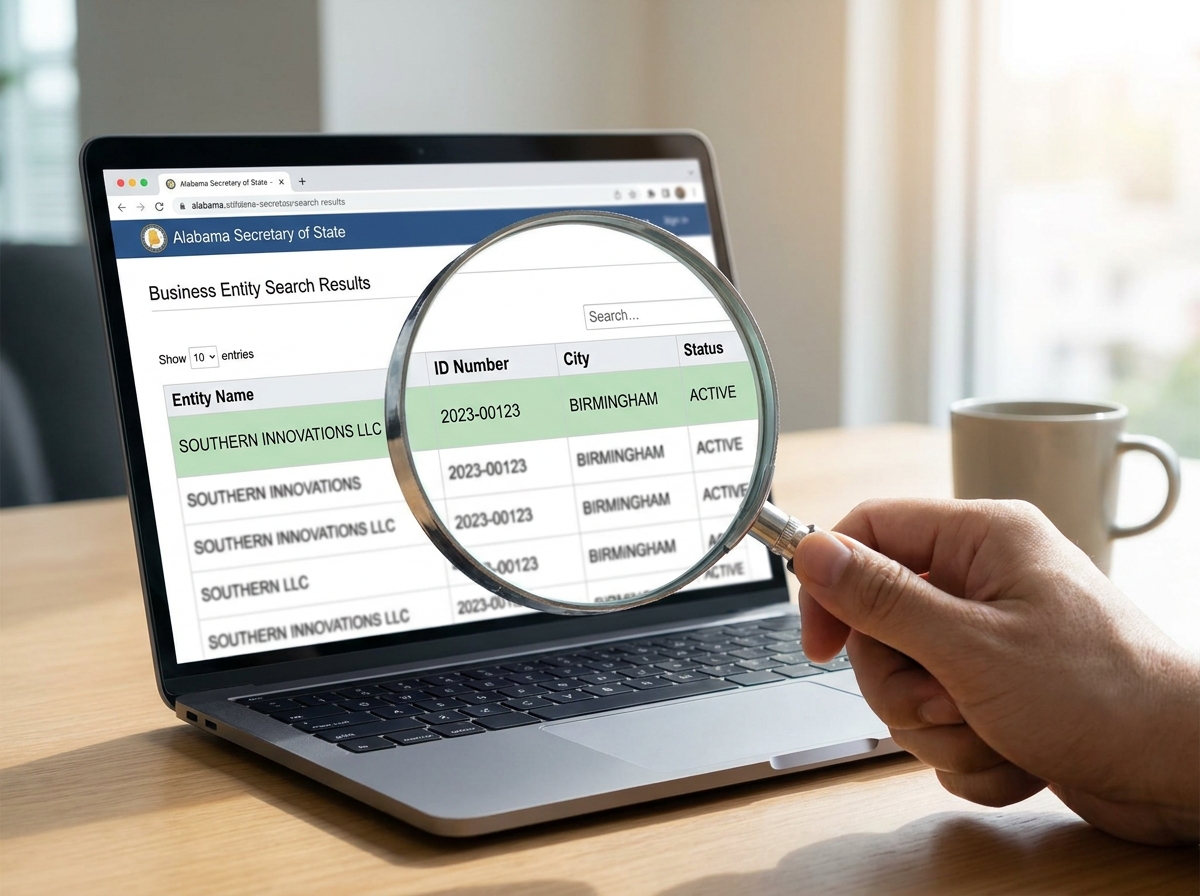
Once you've executed your search on the Alabama SOS website, you'll be presented with a list of results. Understanding what these results mean is crucial to determining your proposed name's availability. Each entry typically includes the Entity Name, Entity Type (e.g., LLC, Corporation, Non-Profit), and most importantly, the Current Status. ## Key Status Indicators- Active / In Good Standing: This means the business is currently registered and legally operating in Alabama. If your proposed name is an exact match or confusingly similar to an 'Active' entity, your name will likely be rejected. You cannot use this name.- Inactive / Dissolved / Withdrawn: These statuses indicate the business is no longer active with the state. While the name might technically be available, caution is advised. There could still be lingering common law trademark rights, or the business might be reinstated. It's often safer to choose a completely unique name.- Reserved: A name with this status is temporarily held by another party who intends to use it soon. You cannot use a reserved name. ## What 'Confusingly Similar' MeansAlabama law dictates that a business name must be 'distinguishable upon the records' from other names. This doesn't just mean exact matches. The SOS will consider names confusingly similar if they:1. Sound alike: Even with different spellings (e.g., 'Quick Fix' vs. 'kwik-Fix').2. Look alike: Minor variations in spelling, punctuation, or word order (e.g., 'Alabama Tech Solutions' vs. 'Alabama Technology Solutions').3. Have similar meanings: Using synonyms or descriptive terms that convey the same impression.The presence of corporate designators like 'LLC' or 'Inc.' does not typically make an otherwise identical name distinguishable. For example, 'Birmingham Builders, LLC' is considered too similar to 'Birmingham Builders, Inc.' Always aim for a name that is clearly and unequivocally distinct from any active entity.
Alabama Business Name Availability Rules
Alabama's regulations governing business name availability are outlined primarily in Title 10A of the Code of Alabama, specifically addressing various entity types like LLCs and corporations. Understanding these rules is crucial to ensure your chosen name passes state scrutiny. The fundamental principle is 'distinguishability.' Your proposed name must be distinguishable from any existing business entity name already on file with the Alabama Secretary of State. This means more than just adding a period or changing a letter; the name must create a unique impression. ## Key Rules and Considerations1. Required Designators: Each entity type has specific words or abbreviations it must include. For an LLC, your name must contain 'Limited Liability Company,' 'L.L.C.,' or 'LLC.' Corporations must include 'Corporation,' 'Incorporated,' 'Company,' 'Limited,' or an abbreviation thereof (e.g., 'Corp.,' 'Inc.,' 'Co.,' 'Ltd.'). These designators do not contribute to distinguishability.2. Prohibited Words: Certain words are restricted or require special approval. For instance, words implying governmental affiliation (e.g., 'FBI,' 'Treasury') are generally prohibited. Words like 'Bank,' 'Trust,' or 'Insurance' often require approval from specific regulatory bodies (e.g., the Alabama State Banking Department) before the SOS will accept them.3. Punctuation and Symbols: The SOS typically disregards punctuation, articles ('a,' 'an,' 'the'), and conjunctions ('and,' 'or') when determining distinguishability. Minor differences like 'Smith Co.' vs. 'Smith & Co.' are often considered too similar. Numbers are generally considered different from their word equivalents (e.g., '24/7 Solutions' might be distinguishable from 'Twenty-Four Seven Solutions').4. Plural vs. Singular: Changing a word from singular to plural or vice-versa usually does not make a name distinguishable. For example, 'Alabama Builder' and 'Alabama Builders' would likely be deemed too similar.Adhering to these guidelines from the outset will significantly streamline your business formation process and prevent unnecessary delays. Always consult the official Alabama Code or the SOS website for the most current and comprehensive naming requirements, as rules can occasionally be updated.
Beyond the SOS: Additional Name Checks
While the Alabama SOS business search is indispensable for state-level registration, it's just one piece of the puzzle. A truly comprehensive name availability check extends beyond the state's corporate registry to protect your business from future legal issues and establish a strong brand. ## Federal Trademark SearchThe SOS search doesn't check for federal trademarks. The United States Patent and Trademark Office (USPTO) maintains a separate database for federally registered trademarks. If another business has a federal trademark on a name or logo similar to yours, regardless of whether they operate in Alabama, you could face legal challenges. A search on the USPTO's Trademark Electronic Search System (TESS) is highly recommended. This is especially crucial if you plan to operate your business across state lines or internationally. ## Domain Name and Social Media AvailabilityIn today's digital age, your online presence is as important as your legal name. Before finalizing your business name, check for domain name availability (e.g., .com, .net, .org) and corresponding social media handles (e.g., Instagram, Twitter, Facebook). A mismatch between your business name and your online identity can confuse customers and dilute your brand. Aim for consistency across all platforms. ## Local Business Name RegistriesWhile less common for formal entities like LLCs, some municipalities or counties might have local business licensing requirements or fictitious name (DBA) registries. These typically apply to sole proprietorships or partnerships operating under a name different from the owner's legal name. Always verify with your local city or county clerk's office, especially if you plan to operate a DBA. Performing these additional checks demonstrates due diligence and provides a more robust foundation for your new business. It minimizes the risk of costly rebrands or legal disputes down the line, ensuring your chosen name is truly yours across all relevant spheres. For founders seeking to streamline this complex process, Lovie assists with comprehensive name availability checks and filing, ensuring all bases are covered from state to federal levels.
Reserving Your Alabama Business Name
Once you've conducted a thorough search and confirmed your desired business name is available, Alabama law allows you to formally reserve it with the Secretary of State. This is a strategic move, especially if you're not immediately ready to file your formation documents but want to secure your chosen name. A name reservation prevents others from registering a confusingly similar name while you finalize your business plans. ## How to Reserve a NameTo reserve a business name in Alabama, you must file an 'Application to Reserve a Name' (Form LLC-10 for LLCs, Form C-10 for Corporations) with the Alabama Secretary of State. This form typically requires:1. The proposed name you wish to reserve.2. Your name and address (as the applicant).3. The type of entity for which the name is being reserved (e.g., LLC, Corporation).The filing fee for a name reservation in Alabama is $28. This fee is current as of 2026 and should be paid to the Secretary of State. Upon approval, the name is reserved for a period of 120 days. This four-month window provides ample time to prepare and submit your formation documents without the worry of losing your chosen name. ## Renewing a ReservationIf you need more time, you can typically renew your name reservation. Alabama law allows for successive 120-day reservation periods. To renew, you would file a new application and pay the associated fee again before your current reservation expires. However, it's important to note that a name reservation is only valid for your specific entity type. If you reserve a name for an LLC, you cannot then use that reservation to form a corporation under the same name without filing a new reservation or forming the corporation directly. While reserving a name adds a small initial cost and administrative step, it offers peace of mind and strategic control over your brand identity during the critical pre-formation phase. For many founders, especially those with complex business models or funding rounds, this interim step is invaluable.
Filing Your Alabama Entity After Search
With your business name secured, the next major step is to officially form your business entity with the Alabama Secretary of State. This involves submitting the appropriate formation documents. For an LLC, you'll file the 'Certificate of Formation' (Form LLC-1). For a corporation, it's the 'Certificate of Incorporation' (Form C-1). ## Essential Information for FilingBoth forms generally require:1. The exact name of your business entity.2. The name and address of your Registered Agent. An Alabama Registered Agent is a crucial requirement, serving as the official point of contact for legal and state correspondence. They must have a physical street address in Alabama.3. The principal office address of your business.4. The purpose of your business (a general statement is usually sufficient).5. For LLCs: The names and addresses of the organizers.6. For Corporations: The names and addresses of the incorporators, and details regarding authorized shares.## Filing Fees and Processing TimesAs of 2026, the filing fee for an Alabama LLC Certificate of Formation is $200. For a Corporation's Certificate of Incorporation, the fee is also typically $200. These fees are paid to the Alabama Secretary of State.Standard processing times vary but generally take 5-7 business days for online filings. Expedited processing is usually available for an additional fee if you need faster turnaround. Once your documents are accepted and processed, the state will issue a Certificate of Existence (for LLCs) or Certificate of Incorporation (for Corporations), officially bringing your business into legal existence. This document is a foundational piece of your business's legal identity. While the filing process can seem daunting with its specific forms and requirements, services like Lovie simplify this step. Lovie's AI-powered platform prepares and submits all necessary formation documents on your behalf, including registered agent service, ensuring accuracy and compliance with Alabama state regulations. This allows you to focus on building your business, knowing the foundational paperwork is handled expertly.
Frequently asked questions
How long does the Alabama business name search take?
The initial Alabama business name search on the Secretary of State's website is instantaneous. You enter your desired name, click search, and results are displayed immediately. However, thoroughly reviewing these results and considering variations can take more time. If you decide to reserve a name, the processing of the 'Application to Reserve a Name' typically takes 1-2 business days for online filings.
Can I use a business name if it's 'inactive' in Alabama?
While an 'inactive' status technically means the name is not currently in use by a registered entity, it's generally advisable to proceed with caution. The previous entity might still hold common law trademark rights, or they could potentially reinstate their business. To avoid future legal issues, it's often safer and more strategic to choose a name that is completely unique and has no active or recently inactive matches in the SOS database.
What if my desired name is taken by an Alabama DBA?
The Alabama Secretary of State's business search primarily covers formally registered entities like LLCs and corporations. DBAs (Doing Business As), also known as trade names or fictitious names, are typically registered at the county level in Alabama. The SOS search will not show county-level DBA registrations. Therefore, even if your name is clear with the SOS, you should also check with the county probate office where you plan to operate to ensure no local DBA conflicts exist.
Does the Alabama SOS search check for federal trademarks?
No, the Alabama Secretary of State's business entity records search only checks for names registered with the Alabama SOS. It does not perform a search of federal trademarks registered with the United States Patent and Trademark Office (USPTO). To conduct a federal trademark search, you must visit the USPTO's website and use their Trademark Electronic Search System (TESS) to avoid potential infringement issues.
What is the fee to reserve a business name in Alabama?
As of 2026, the fee to reserve a business name with the Alabama Secretary of State is $28. This fee secures your chosen name for a period of 120 days, allowing you time to prepare and file your full formation documents without concern that another entity might register your preferred name.
What happens if my chosen name is rejected by the Alabama SOS?
If your chosen business name is deemed not distinguishable from an existing name on file, the Alabama Secretary of State will reject your formation documents. You will receive notification, typically detailing the reason for rejection. You would then need to amend your filing with a new, distinguishable name and resubmit it, which will lead to delays in your business formation. A thorough initial search minimizes this risk.
Do I need a lawyer for the Alabama business name search?
While you can perform the Alabama business name search yourself, legal counsel can provide a more in-depth analysis of name availability, including potential common law trademark issues that go beyond the state's database. For most founders, a diligent search using the SOS portal and a follow-up federal trademark search on the USPTO website is a solid starting point. Lovie also assists with name availability guidance as part of its formation services.
Alabama Formation Data Insights
| State Filing Fee | $183 |
| Annual Fee | $0 (No annual fee) |
| First Year Total | $183 |
| Processing Time | 6.1 days avg (official: 5-10 days) |
| Corporate Tax Rate | 6.5% |
Key Insights
- Alabama'de LLC kurulum maliyeti ulusal ortalamanın $41 altında — toplam ilk yıl maliyeti $183.
- Lovie platformu üzerinden Alabama LLC başvuruları ortalama 6.1 iş gününde onaylanmaktadır (eyalet resmi süresi: 5-10 gün).
- Alabama merkezli işletmeler için EIN onay süresi ortalama 7.4 gündür.
- Alabama kurumlar vergisi oranı %6.5'dir (ulusal ortalama: %6.57).
Data sources: State Secretary of State offices, IRS, Tax Foundation (2026). Platform metrics based on anonymized Lovie user data.
Key Concepts: Business Formation
US Business Formation guides entrepreneurs through the business formation process with actionable steps. Key components include LLC formation, entity registration, and state filing, each playing a critical role in the business formation process. Understanding liability protection and tax optimization is essential, as these factors directly impact legal compliance.
When evaluating business formation options, factors such as business entity types and formation process should inform your decision-making process.
Entity Relationships
- Business Formation requires LLC formation
- Business Formation includes entity registration
- Business Formation establishes state filing
- Business Formation defines business structure selection
Quick answers
What do I need to know about Small Businesses In for my business?
Understanding Small Businesses In is essential for business compliance and operational success. The specific requirements vary by state and industry.
How does Small Businesses In affect my business formation?
This aspect of business formation directly impacts your legal standing, tax obligations, and operational flexibility.
Explore Formation Guides
State-specific formation guides, cost breakdowns, compliance checklists, and expert comparisons — updated for 2026.
LLC Formation Guides
- How to Form an LLC for Virtual Assistant Hawaii
- How to Form an LLC for Web Developer West Virginia
- How to Form an LLC for Drone Services Wyoming
- How to Form an LLC for Freelancing California
Popular Guides
Cost by Entity & State
- Sole Proprietorship Cost Alabama Formation Costs
- Nonprofit Cost Michigan Formation Costs (2026) | Lovie
- C Corp Cost South Carolina Formation Costs (2026) | Lovie

Lovie is not a government agency, law firm, or professional advisory organization. Lovie is a private business-formation service that prepares and submits filings to the appropriate state agencies on your behalf — we do not issue government documents, and state approval times are not controlled by Lovie. Information on this page is general and not legal, tax, or financial advice.