
On this page · 8 sections
Understanding LLC Renewal Fees
Maintaining an LLC involves more than just the initial formation. One crucial aspect of ongoing compliance is paying your LLC renewal fee, often referred to as an annual report fee, franchise tax, or business license renewal. These fees are statutory requirements levied by individual states to keep your business in good standing and ensure the state has up-to-date information on your entity. The nomenclature varies significantly: some states like Delaware charge an annual franchise tax, while others like California require an annual statement of information and a separate annual tax. Understanding these distinctions is fundamental. It's not merely a fee; it’s a commitment to maintaining your limited liability protection and legal standing. Our resource on LLC registration in Arkansas breaks this down further. This payment confirms your LLC is still active and operating within state regulations, providing transparency and accountability. Without this regular filing, your LLC's status can become delinquent, jeopardizing its legal protections and potentially exposing personal assets to business liabilities. This guide will walk you through the general steps involved in paying your LLC renewal fee, common variations by state, and what to expect. While Lovie can handle much of the compliance heavy lifting for your business formation, knowing these details empowers you to manage your company effectively. We'll cover where to find information, typical payment methods, and important deadlines to keep your LLC active and compliant nationwide.
Why LLC Renewal is Critical for Your Business
Failure to pay your LLC renewal fee can lead to severe consequences, far beyond a simple late charge. The primary risk is the administrative dissolution of your LLC by the state. When this occurs, your business loses its legal entity status, effectively nullifying the limited liability protection that was the core reason for forming an LLC. This means your personal assets, such as your home and savings, could become vulnerable to business debts and lawsuits. Furthermore, a dissolved LLC cannot legally conduct business, enter into contracts, or maintain bank accounts, causing significant operational disruptions. Beyond dissolution, states typically impose penalties and interest on late filings. For instance, New York's Department of State charges a $50 per year penalty for late biennial statements. If you're exploring this further, our guide on how to register an LLC in California is a helpful next step. In California, the Franchise Tax Board may levy a $250 penalty for failure to file a Statement of Information, in addition to the annual minimum franchise tax. These costs can quickly accumulate, making proactive compliance far more economical than reactive damage control. Maintaining good standing also impacts your ability to obtain loans, secure investments, or even renew business licenses in certain industries. Banks and investors frequently check a company's standing with the Secretary of State before engaging in transactions. A lapse in compliance signals instability and can deter potential partners. Ensuring timely renewal is a foundational aspect of responsible business stewardship, protecting both your personal finances and your company's operational viability.
Finding Your State-Specific Requirements and Due Dates
The first step to paying your LLC renewal fee is identifying the specific requirements for your state. Every state has its own unique regulations, filing frequencies, and fee structures. The most reliable source of this information is always the Secretary of State's office or the equivalent business filing division in your state. For example, in Texas, you'll consult the Texas Secretary of State website for information on the Public Information Report and Franchise Tax. In Florida, the Department of State, Division of Corporations, handles annual report filings. Most states offer an online business search portal where you can look up your LLC by name or entity ID. This portal typically provides details about your LLC's current status, registered agent information, and, crucially, your next annual report or renewal due date. Many states also offer email notifications as a courtesy, but relying solely on these can be risky. Founders should proactively mark these dates on their calendars. ## Key Information to Look For: 1. Filing Frequency: Is it annual, biennial (every two years), or another interval? 2. For a deeper dive, see our resource on how to register an LLC in Colorado. Due Date: Is it based on your formation date, a specific calendar date (e.g., January 1st), or another metric? 3. Required Forms: Are there specific forms (e.g., Annual Report, Statement of Information) that need to be completed? 4. Fee Amount: What is the exact fee for your LLC type? This can vary. 5. Filing Method: Can you file online, by mail, or both? Pro tip: Always use the official state government website, not third-party aggregators, to ensure accuracy and avoid scams. Bookmarking these pages can save considerable time each year.

Common Payment Methods and Platforms for LLC Renewals
Once you've identified your state's requirements and deadlines, the next step is typically making the payment. Most states have modernized their systems, offering convenient online portals. The preferred method for most founders is online payment through the state's official Secretary of State website or an equivalent business services portal. These platforms usually accept major credit cards (Visa, Mastercard, American Express, Discover) and sometimes offer ACH transfers directly from your business bank account. Online filing is generally the fastest and most secure method, providing instant confirmation of submission and often a digital receipt. However, it's crucial to verify that you are on the official government website to avoid phishing scams. Look for '.gov' in the URL and secure connection indicators. Some states still offer the option to file and pay by mail. This usually involves downloading a form, completing it manually, attaching a check or money order, and sending it to the state agency. While still valid, mail-in options come with longer processing times and a higher risk of delays or lost documents. If you choose this method, always send it via certified mail with a return receipt requested to have proof of submission. A few states might even offer in-person filing, though this is less common and often only beneficial for urgent, last-minute situations. Always review the payment options available on your state's specific filing page. For founders who prefer to focus on their core business, services like Lovie proactively monitor these deadlines and handle the payment and filing processes across all 50 states, ensuring timely compliance without the manual effort.
Understanding Deadlines, Penalties, and Reinstatement Processes
Missing a renewal deadline can trigger a cascade of issues. As mentioned, penalties vary significantly by state. For example, in Arizona, if an LLC fails to file its annual report by the due date (often the anniversary of its formation), it will be assessed a late fee of $25. Continuing to operate without filing can lead to administrative dissolution. California, notoriously strict, imposes a $250 penalty for failure to file a Statement of Information, in addition to the $800 annual franchise tax for most LLCs. If your LLC is administratively dissolved or revoked, you'll need to go through a reinstatement process to restore its good standing. Reinstatement typically involves: 1. Filing all overdue reports: You'll need to submit every annual report or statement of information that was missed. 2. Paying all accumulated fees and penalties: This includes all original renewal fees, late fees, and any reinstatement fees the state assesses. Reinstatement fees can be substantial; for example, some states charge an additional $100-$300 just for the reinstatement application. 3. Submitting a reinstatement application: A specific form usually needs to be completed, affirming your intention to resume business and certify compliance. The reinstatement process can be complex and time-consuming, often requiring more effort and expense than simply filing on time. It's a clear demonstration of why proactive compliance management is not just a best practice, but a business imperative. Understanding these potential pitfalls reinforces the value of diligent record-keeping and a robust system for tracking compliance dates. Lovie's $29 one-time fee covers formation preparation and filing, with compliance reminders included; state filing fees are paid directly to your state, and registered agent service is priced separately at $79/year ($49/year in Wyoming).
State Spotlight: Variations in Fees and Filing
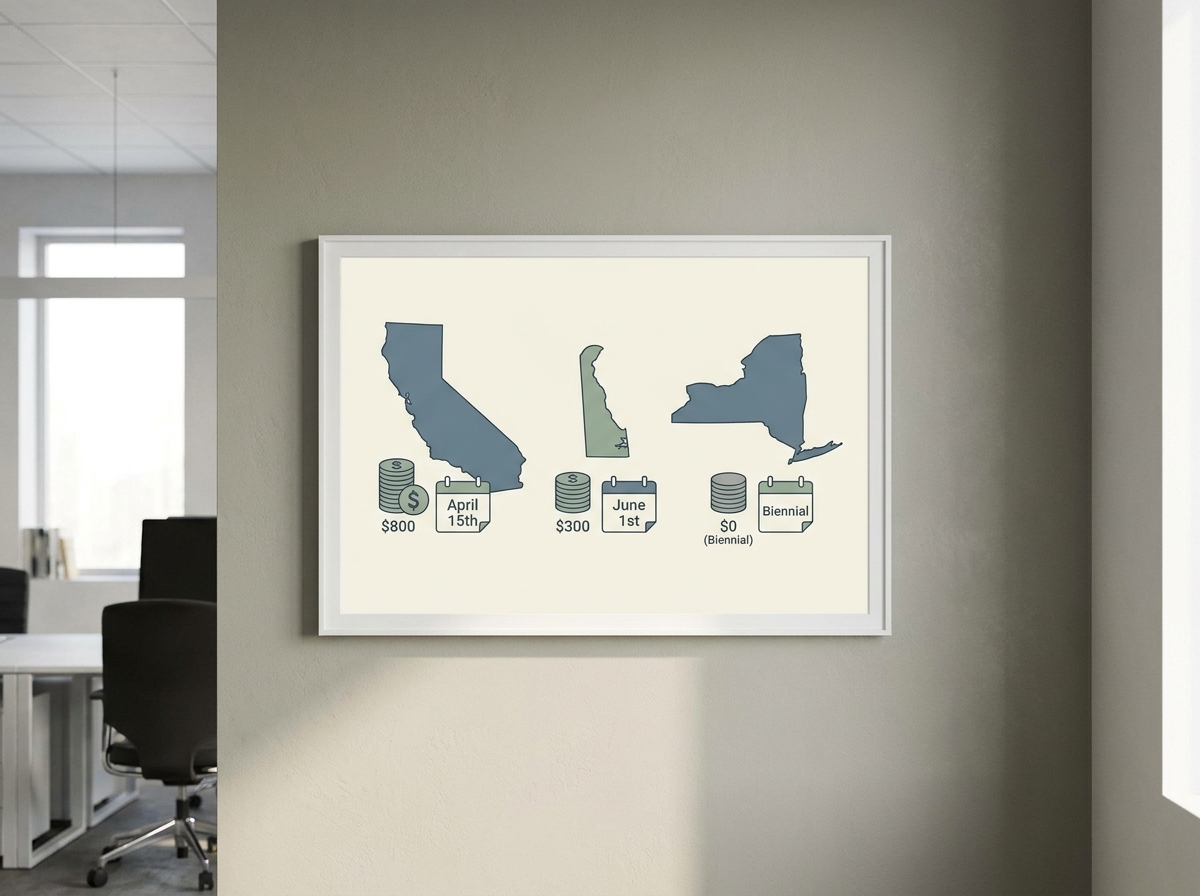
The landscape of LLC renewal fees and filing requirements is a patchwork across the United States. Let's look at a few examples to illustrate the diversity: ## Delaware: The Corporate Haven Delaware charges an annual Franchise Tax of $300 for LLCs, due by June 1st each year. This is a flat fee, regardless of income. Failing to pay incurs a penalty of $200 plus 1.5% interest per month on the unpaid balance. The filing is straightforward and done online via the Delaware Division of Corporations website. ## California: The High-Cost Compliance California has one of the highest base fees, with an annual minimum Franchise Tax of $800 for most LLCs, due by the 15th day of the fourth month after filing. Additionally, an annual Statement of Information must be filed every two years (biennially) within 90 days of the LLC's formation anniversary. The Statement of Information fee is $20. Late filing penalties for the Statement of Information are $25, plus potential forfeiture of the right to transact business. ## New York: Biennial Filings New York LLCs must file a Biennial Statement every two years, due in the calendar month of their original formation. The filing fee is $9. Failure to file can result in the LLC being marked 'past due' and eventually 'delinquent,' impacting its ability to conduct business. While the fee is low, the biennial nature means it's easier to forget. ## Texas: Franchise Tax Based on Revenue In Texas, LLCs must file an annual Franchise Tax report. While many small LLCs may owe no tax if their revenue is below the 'No Tax Due' threshold (over $1.2 million for 2026), the report itself must still be filed. The Public Information Report (PIR) is also due annually by May 15th. Failure to file the PIR or Franchise Tax Report can lead to forfeiture of the LLC's right to transact business. These examples underscore the complexity. A founder operating in multiple states, or even just one, faces a unique set of rules. This is where a unified compliance solution becomes invaluable.
Automating Your LLC Compliance with Lovie's AI Platform
Navigating the labyrinth of state-specific LLC renewal fees and compliance deadlines can be a significant drain on a founder's time and resources. This is precisely where Lovie, the AI-powered company formation platform, offers a transformative solution. Lovie's single $29 one-time fee is designed to eliminate the complexity and anxiety associated with ongoing LLC compliance. Our platform proactively monitors all your state-specific deadlines, ensuring that annual reports, franchise taxes, and other required filings are prepared and submitted on your behalf, preventing late fees and administrative dissolution. Imagine never having to worry about missing a June 1st deadline in Delaware or an April 15th filing in California again. Lovie handles the full spectrum of compliance tasks, not just the renewal fees. This includes 3 years of registered agent service in every state, digital mail scanning, AI-driven compliance monitoring that adapts to regulatory changes, and even operating agreement templates. For international founders, or those managing multiple entities, this centralized approach is invaluable. Our system provides instant filing-status visibility, so you always know the current standing of your LLC without needing to navigate opaque state government websites. We prepare and submit all necessary filings, including all state fees, ensuring a complete, transparent, and hassle-free experience. Lovie is a private business-formation service that streamlines your compliance, allowing you to focus on building your business, not bureaucratic hurdles. With Lovie, you gain peace of mind, knowing your LLC remains in good standing across all 50 states, always compliant and protected. Ready to simplify your compliance? Start your LLC formation with Lovie today and experience automated peace of mind.
Tips for Seamless LLC Compliance Year After Year
Maintaining seamless LLC compliance doesn't have to be a burden. With a few strategic practices, you can ensure your business remains in good standing without constant stress. ## 1. Centralize Your Records Create a dedicated digital folder for all your LLC formation documents, including your Articles of Organization, EIN confirmation, operating agreement, and all annual report filings. Keep digital copies of payment receipts and confirmation notices. A cloud-based storage solution (like Google Drive or Dropbox) with clear folder structures makes these accessible from anywhere. ## 2. Implement a Robust Calendar System Beyond state reminders, set up your own calendar alerts for all critical dates. Use a digital calendar (Google Calendar, Outlook Calendar) with multiple reminders leading up to the due date – perhaps 60, 30, and 7 days prior. Include links to the relevant state filing pages directly in the calendar event. ## 3. Review Your Registered Agent Annually Your registered agent is the official point of contact for legal and tax correspondence. Ensure their information is always current and that they are reliably forwarding important documents. If you move or your agent changes, update the state immediately. ## 4. Stay Informed While Lovie’s AI monitors for regulatory changes, it’s still wise to periodically check your state’s Secretary of State website for any significant updates to business filing requirements or fee structures. Subscribe to their newsletters if available. ## 5. Budget for Renewal Fees Treat renewal fees as a standard operating expense. Budget for them annually, ensuring funds are available when due. This prevents last-minute scrambling and potential late payments. ## 6. Consider Professional Services For founders who prioritize their time on core business activities, leveraging a service like Lovie can be the most efficient and error-free approach. Automated monitoring, filing, and payment management ensure that compliance is handled expertly, allowing you to focus on growth.
Frequently asked questions
What happens if I miss my LLC renewal deadline?
If you miss your LLC renewal deadline, your LLC's status will typically become delinquent or revoked by the state. This can lead to penalties, interest charges, and eventually administrative dissolution of your LLC. Administrative dissolution means you lose your limited liability protection, making your personal assets vulnerable to business debts and lawsuits, and you may lose the legal right to conduct business in that state. Reinstatement is possible but usually involves paying all back fees, penalties, and a separate reinstatement fee, which can be costly and time-consuming.
Are LLC renewal fees the same in every state?
No, LLC renewal fees vary significantly by state. Some states, like Delaware, charge a flat annual franchise tax (e.g., $300), while others, like California, impose an $800 annual minimum franchise tax plus a separate biennial fee for a Statement of Information. The frequency of filing also differs, with some states requiring annual reports and others biennial (every two years). It's crucial to check the specific requirements on your state's Secretary of State website.
Can I pay my LLC renewal fee online?
Yes, most states now offer online payment options for LLC renewal fees and annual reports through their official Secretary of State or equivalent business services websites. Online payment is generally the fastest and most secure method, typically accepting major credit cards or ACH transfers. Always ensure you are on the official '.gov' website to avoid fraudulent sites.
What is a 'registered agent' and how does it relate to LLC renewal?
A registered agent is a person or entity officially designated to receive legal documents, such as service of process, and official government correspondence on behalf of your LLC. While not directly a 'renewal fee,' maintaining an active and accurate registered agent is a mandatory ongoing compliance requirement in all states. If your registered agent information is not current, your LLC can fall out of good standing, sometimes triggering similar penalties or even administrative dissolution. Many annual reports or renewal forms require you to confirm or update your registered agent's details.
Is an LLC renewal fee the same as a franchise tax?
The terms 'LLC renewal fee' and 'franchise tax' are often used interchangeably or describe related but distinct ongoing fees. Some states, like Delaware and California, use 'franchise tax' to refer to their annual fee for the privilege of doing business in the state, which acts as the primary annual renewal cost. Other states might have a separate 'annual report fee' or 'statement of information fee.' The key is that both are recurring statutory payments essential for maintaining your LLC's good standing.
How can I avoid missing future LLC renewal deadlines?
To avoid missing future LLC renewal deadlines, implement a robust compliance strategy. This includes centralizing all your LLC documents, setting multiple reminders on a digital calendar with links to state filing portals, and regularly reviewing your registered agent information. For comprehensive peace of mind, consider using an automated compliance service like Lovie, which monitors deadlines, prepares, and submits all required filings on your behalf across all 50 states.
Key Concepts: Business Formation
US Business Formation guides entrepreneurs through the business formation process with actionable steps. Key components include LLC formation, entity registration, and state filing, each playing a critical role in the business formation process. Understanding liability protection and tax optimization is essential, as these factors directly impact legal compliance.
When evaluating business formation options, factors such as business entity types and formation process should inform your decision-making process.
Entity Relationships
- Business Formation requires LLC formation
- Business Formation includes entity registration
- Business Formation establishes state filing
- Business Formation defines business structure selection
Quick answers
What do I need to know about How To Pay Llc Renewal Fee for my business?
Understanding How To Pay Llc Renewal Fee is essential for business compliance and operational success. The specific requirements vary by state and industry.
How does How To Pay Llc Renewal Fee affect my business formation?
This aspect of business formation directly impacts your legal standing, tax obligations, and operational flexibility.
Explore Formation Guides
State-specific formation guides, cost breakdowns, compliance checklists, and expert comparisons — updated for 2026.
LLC Formation Guides
- How to Form an LLC for Virtual Assistant Hawaii
- How to Form an LLC for Web Developer West Virginia
- How to Form an LLC for Drone Services Wyoming
- How to Form an LLC for Freelancing California
Popular Guides
Cost by Entity & State
- Sole Proprietorship Cost Alabama Formation Costs
- Nonprofit Cost Michigan Formation Costs (2026) | Lovie
- C Corp Cost South Carolina Formation Costs (2026) | Lovie

Lovie is not a government agency, law firm, or professional advisory organization. Lovie is a private business-formation service that prepares and submits filings to the appropriate state agencies on your behalf — we do not issue government documents, and state approval times are not controlled by Lovie. Information on this page is general and not legal, tax, or financial advice.