
On this page · 8 sections
- Understanding the South Carolina SOS Business Search
- Why a Business Entity Search is Crucial
- How to Perform a South Carolina Business Search
- Interpreting Your South Carolina Business Search Results
- Business Name Availability and Naming Requirements
- Reserving a Business Name in South Carolina
- Common Issues and Troubleshooting Your Search
- Beyond the SOS: Additional Due Diligence
Understanding the South Carolina SOS Business Search
The South Carolina Secretary of State (SOS) serves as the central repository for all officially registered business entities within the state. This includes Limited Liability Companies (LLCs), corporations (both S-Corps and C-Corps), non-profit organizations, partnerships, and various other legal structures. The SOS maintains a publicly accessible online database, often referred to as the Business Filings Search portal, which allows anyone to look up information on these entities. This tool is indispensable for founders, investors, legal professionals, and even consumers. When you perform a South Carolina business entity search, you are querying this official database to retrieve critical details about a specific company. This might include its legal name, entity type, filing date, current status (active, dissolved, revoked), registered agent information, and principal office address. The accuracy and timeliness of this information are paramount, as it directly reflects the official records held by the state. You can learn more about setting up your South Carolina LLC to understand the full picture. Understanding the scope and limitations of this database is the first step toward effective due diligence. It's not just about finding a name; it's about understanding a company's legal standing and history within the state. This process is distinct from searching for trade names or DBAs (Doing Business As), which are often registered at the county level or with different state agencies. The SOS search focuses specifically on legally recognized entities, providing a foundational layer of information for anyone interacting with the South Carolina business landscape. For example, a search will confirm if 'Palmetto Tech Solutions LLC' is a valid, active entity registered in the state, and not just a brand name. This distinction is crucial for both compliance and strategic decision-making.
Why a Business Entity Search is Crucial for Founders
For any founder embarking on the journey of establishing a new business in South Carolina, a thorough business entity search is not merely a recommendation; it's a critical prerequisite. The primary reason is name availability. South Carolina state law mandates that your chosen business name must be distinguishable from any other entity already registered with the SOS. Failing to perform this search can lead to your formation documents being rejected, causing significant delays and additional costs. Imagine investing time and resources into branding, only to discover your name is unavailable – a frustrating and avoidable setback. Beyond name clearance, the search serves several other vital functions. It allows you to conduct due diligence on potential partners, vendors, or competitors, verifying their legal existence and current standing. An 'active' status indicates a company is in good standing with the state, while a 'dissolved' or 'revoked' status signals potential issues that warrant further investigation. We cover this in depth in our resource on how to register an LLC in South Carolina. For instance, if you're considering a merger or acquisition, confirming the target company's legal status is non-negotiable. Furthermore, the search provides access to the registered agent's information, which is the official point of contact for legal and tax correspondence. This is invaluable for service of process or understanding who officially represents the company. Lastly, it ensures compliance with state regulations. By proactively checking the database, you are demonstrating a commitment to operating legally and avoiding potential infringements. This foundational step provides peace of mind and builds a solid legal framework for your venture. Lovie assists founders by streamlining the entire formation process, including initial name availability checks, ensuring you meet these critical requirements efficiently.
How to Perform a South Carolina Business Search Online
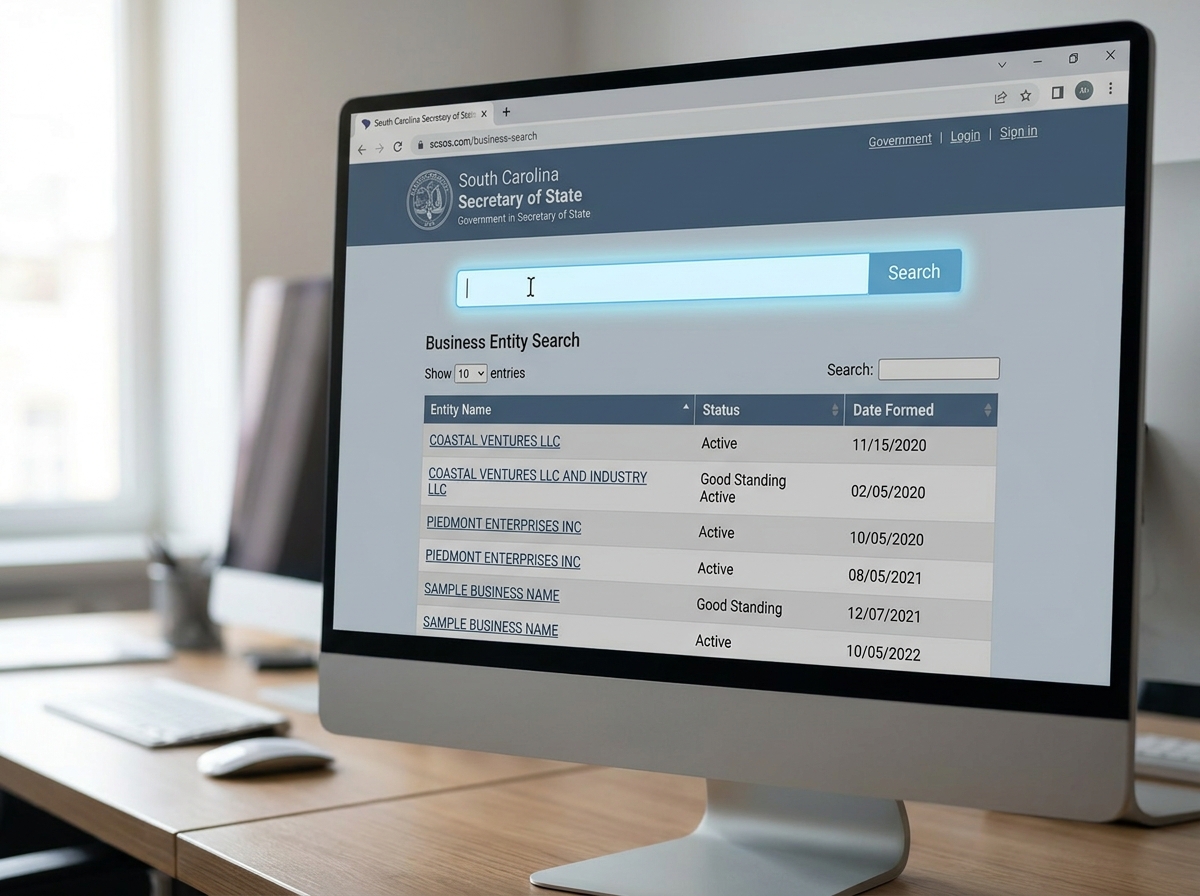
Performing a business entity search in South Carolina is a straightforward process, primarily conducted through the South Carolina Secretary of State's online portal. Here's a step-by-step guide to navigate the system effectively:1. Access the SC SOS Website: Begin by visiting the official South Carolina Secretary of State website. Look for the 'Business Filings' or 'Corporations' section, which typically hosts the search tool. The direct link is usually straightforward to find under 'Online Services'.2. Locate the Business Name Search Tool: Within the business filings section, you'll find a link specifically for 'Business Name Search' or 'Entity Search'. Click on this to proceed to the search interface.3. Enter Your Search Criteria: The portal will usually offer several search options: by business name, by registered agent name, or by SOS ID number. For most founders, searching by 'Business Name' is the primary method. Enter the full or partial name you wish to investigate. Check out our guide on LLC registration in South Carolina for step-by-step instructions. Be mindful of spelling, as even minor errors can yield different results.4. Refine Your Search (Optional): Some systems allow for refinement options, such as searching for 'Starts With,' 'Contains,' or 'Exact Match.' Starting with a 'Contains' or 'Starts With' search can be beneficial for broader exploration, while 'Exact Match' is crucial for final verification.5. Review the Results: Once you submit your query, the system will display a list of entities that match your criteria. Each entry typically includes the entity name, SOS ID, entity type (e.g., LLC, Corporation), and current status.6. Examine Specific Entity Details: Click on the specific business name to view detailed information. This expanded view will provide the registered agent's name and address, principal office address, date of formation, and a more precise current status. For example, a search for 'Palmetto Innovations' might return 'Palmetto Innovations LLC' as an active entity with a specific registered agent and formation date of October 15, 2022. This detailed information is vital for due diligence.
Interpreting Your South Carolina Business Search Results
Once you've performed a South Carolina business entity search, understanding the results is as important as the search itself. The information provided by the SOS database is highly structured and carries specific legal implications. Key fields to analyze include:1. Entity Name: This is the exact legal name as registered with the state. Variations in spelling, punctuation, or entity designators (e.g., 'LLC' vs. 'L.L.C.') can distinguish one entity from another.2. SOS ID/Filing Number: A unique identification number assigned by the Secretary of State. This is a crucial identifier for official state communications and filings.3. Entity Type: Specifies the legal structure, such as 'Domestic Limited Liability Company,' 'Foreign Corporation,' 'Non-Profit Corporation,' or 'Limited Partnership.' This impacts liability, taxation, and operational requirements.4. Status: This is perhaps the most critical field. Common statuses include: - Active/In Good Standing: The entity has met all state requirements and is legally permitted to conduct business. - Dissolved: The entity has formally ceased operations and its legal existence has been terminated. - Revoked/Forfeited: The entity has failed to meet ongoing state requirements (e.g., annual reports, registered agent) and its authority to transact business has been rescinded by the state. This does not mean it's dissolved, but rather that it's out of compliance. - Withdrawn: A foreign entity (formed in another state) has ceased operations in South Carolina.5. Date of Formation/Registration: The date the entity was officially registered with the South Carolina SOS.6. Registered Agent: The name and address of the individual or entity designated to receive legal and official correspondence on behalf of the business. This information must be current.7. Principal Office Address: The main business address on file with the state.A 'Revoked' status, for example, means the entity cannot legally conduct business in South Carolina until it rectifies the issues and is reinstated. This insight is invaluable for founders, as it prevents potential dealings with non-compliant businesses or inadvertently choosing a name associated with a problematic entity. Lovie's $29 one-time fee covers formation preparation and filing, with compliance reminders included; state filing fees are paid directly to your state, and registered agent service is priced separately at $79/year ($49/year in Wyoming).
South Carolina Business Name Availability and Naming Requirements
South Carolina has specific statutory requirements for business names, designed to prevent confusion and ensure each registered entity is uniquely identifiable. Adhering to these rules from the outset saves considerable time and resources. The primary rule, as governed by Title 33, Chapter 44 (for LLCs) and Chapter 1 (for Corporations) of the South Carolina Code of Laws, is that your chosen name must be 'distinguishable upon the records' of the Secretary of State from any other active entity. This means more than just being identical; names that are too similar, even with minor variations, may be rejected.## Key Naming Conventions and Restrictions1. Required Designators: All entities must include a specific designator indicating their legal structure. For an LLC, this must be 'Limited Liability Company,' 'LLC,' or 'L.L.C.' For a corporation, it could be 'Corporation,' 'Incorporated,' 'Company,' 'Limited,' or abbreviations like 'Corp.,' 'Inc.,' 'Co.,' or 'Ltd.'2. Prohibited Words: Certain words are restricted or require special approval. For example, names implying a governmental affiliation or professional services (e.g., 'Bank,' 'University,' 'Insurance,' 'Attorney') often require additional licensing or regulatory body approval. Using words like 'Federal,' 'United States,' or 'State of South Carolina' is generally prohibited if it implies a government connection.3. Distinguishability: The SOS often considers names distinguishable if they differ by more than just: - Punctuation (e.g., 'A.B.C. LLC' is not distinguishable from 'ABC LLC') - Articles ('A,' 'An,' 'The') - Corporate designators (e.g., 'Palmetto Ventures LLC' is not distinguishable from 'Palmetto Ventures, Inc.' if both are active) - Pluralization or possessive forms (e.g., 'Founder's Hub LLC' and 'Founders Hub LLC' might be considered too similar)It's crucial to understand that simply adding a designator or minor punctuation might not make a name unique enough. The SOS examiner reviews names for potential public confusion. For example, 'Charleston Coffee Co. LLC' might be rejected if 'Charleston Coffee Company Inc.' is already registered. Lovie’s AI-powered platform helps navigate these complexities by suggesting names and flagging potential conflicts, significantly reducing the chances of rejection during filing.
Reserving a Business Name in South Carolina
Once you've identified a unique and compliant business name through your entity search, founders often want to secure it before they are ready to file their formation documents. South Carolina offers a name reservation service for this exact purpose, allowing you to hold a name for a specific period, preventing others from registering it. This is particularly useful if you need time to finalize your business plan, secure funding, or gather all necessary information before formally incorporating or forming your LLC.## The Name Reservation Process1. Application Submission: To reserve a name, you must submit an 'Application to Reserve a Name' (Form 103 for corporations, Form 410 for LLCs) to the South Carolina Secretary of State. This application typically requires the proposed name and the applicant's name and address.2. Filing Fee: As of 2026, the filing fee for a name reservation in South Carolina is $25. This fee is non-refundable and must accompany your application.3. Reservation Period: If approved, your chosen name will be reserved for a period of 120 days. This gives you a four-month window to complete your formation filings.4. Renewal: The name reservation can be renewed for an additional 120-day period by filing a new application and paying another $25 fee before the initial reservation expires. There is no limit to the number of times a name can be renewed, allowing founders ample time to prepare.5. Transferability: A reserved name can also be transferred to another party by filing a 'Notice of Transfer of Reserved Name' with the SOS, which may incur a small fee.This reservation process ensures that your chosen name is protected while you handle other startup logistics. It acts as a placeholder, offering peace of mind that your branding efforts will not be undermined by a name conflict. Without this step, even a unique name found today could be registered by another party tomorrow. For founders using Lovie, our platform can assist in preparing and submitting these name reservation applications, seamlessly integrating this critical step into your overall company formation strategy. This proactive approach is a hallmark of diligent business planning and helps avoid unnecessary stress during the launch phase.
Common Issues and Troubleshooting Your Search
Even with a clear process, founders can encounter common hurdles during a South Carolina business entity search. Knowing how to troubleshoot these issues can prevent frustration and delays.## Frequent Problems and Solutions1. No Results Found: - Cause: This often occurs due to spelling errors, using abbreviations incorrectly, or searching for a business that operates under a 'Doing Business As' (DBA) name rather than its legal entity name. It could also mean the business is not registered with the SC SOS (e.g., a sole proprietorship or partnership without a formal filing). - Solution: Double-check your spelling. Try variations of the name, including and excluding common entity designators (LLC, Inc.). Consider searching for partial names or using the 'Contains' search option if available. If still no results, the business might be an unregistered type or registered in another state.2. Too Many Results: - Cause: A broad search term (e.g., 'Palmetto') can yield hundreds or thousands of results, making it difficult to find your target. - Solution: Refine your search. Add more specific keywords, locations, or try searching by SOS ID if you have it. Look for additional filters on the search page, such as entity type.3. Name Appears Taken, But You See No Active Business: - Cause: The name might be reserved by another party, or the entity may be 'Revoked' or 'Inactive' but still on record, preventing new registrations. South Carolina law states that even a dissolved entity's name can remain unavailable for a period. - Solution: Examine the status carefully. If it's 'Reserved,' note the expiration date. If it's 'Revoked' or 'Dissolved,' the name might still be unavailable. Contacting the SOS directly might provide clarity on specific name availability rules.4. Website Glitches or Maintenance: - Cause: State websites can experience downtime or technical issues. - Solution: Try again later, perhaps during off-peak hours. Clear your browser cache or try a different browser.If you find yourself stuck, remember that Lovie’s platform provides a streamlined process for name availability checks and can guide you through the complexities, minimizing these common issues and ensuring a smooth path to formation. Our support team is also available 24/7 to assist with any questions.
Beyond the SOS: Additional Due Diligence for Your Business Name
While the South Carolina Secretary of State's business entity search is the foundational step, comprehensive due diligence extends beyond this single database. A name might be available with the SOS but could still infringe on other intellectual property rights or create market confusion. Smart founders consider these additional checks:1. Trademark Search: The SOS search only covers state-registered entities. It does not check federal trademarks registered with the United States Patent and Trademark Office (USPTO). A business name, logo, or slogan could be federally trademarked, even if the entity isn't registered in South Carolina. Using a federally trademarked name can lead to severe legal consequences, including cease-and-desist orders and costly lawsuits. A search on the USPTO's Trademark Electronic Search System (TESS) is highly recommended.2. Domain Name and Social Media Availability: In today's digital landscape, securing a corresponding domain name (.com is still king) and consistent social media handles is almost as important as the legal name. Check popular platforms like Twitter, Instagram, Facebook, and LinkedIn, as well as domain registrars. A great legal name is less valuable if your digital presence is disjointed or unavailable.3. Fictitious Business Names/DBAs: Some businesses operate under a 'Doing Business As' (DBA) name, also known as a fictitious business name. These are often registered at the county level or with a different state agency, not the SOS. If you are searching for a specific business, check county clerk offices for DBA registrations, especially for sole proprietorships or general partnerships.4. Industry-Specific Registries: Certain industries have their own licensing or registration boards. For example, healthcare practices, financial services, or construction companies might have names registered with specific state professional licensing boards. Always check relevant industry registries if your business falls into a regulated sector.By performing these additional layers of checks, you create a robust shield against future legal challenges and ensure a cohesive brand identity across all platforms. Lovie simplifies the initial state filing, but encourages founders to consider these broader due diligence steps for comprehensive protection. This holistic approach ensures your new venture is not just legally compliant but also strategically positioned for success.

Frequently asked questions
What is the South Carolina Secretary of State business search?
The South Carolina Secretary of State (SOS) business search is an online tool provided by the state to look up information on registered business entities. This public database allows users to find details about LLCs, corporations, and other formal business structures filed with the SOS, including their legal name, entity type, current status, and registered agent information. It's a critical resource for verifying business existence and checking name availability before forming a new entity.
How much does it cost to search for a business in South Carolina?
Performing a basic business entity search on the South Carolina Secretary of State's website is completely free. The state provides this public service at no charge to allow individuals and businesses to access essential information about registered entities. However, there may be fees for obtaining certified copies of documents or for specific expedited services.
Can I search for an LLC by owner name in South Carolina?
Generally, the South Carolina Secretary of State's online business entity search primarily allows searches by business name, SOS ID number, or registered agent name. It typically does not provide a direct search function by individual owner or member names for LLCs or corporations, as this information is not always publicly indexed in the main search portal due to privacy considerations. You may need to access specific filed documents, like the Articles of Organization, for ownership details, which might require a formal request.
What does 'Active in Good Standing' mean for a South Carolina business?
When a South Carolina business entity is listed as 'Active in Good Standing,' it means the company has met all of its statutory obligations with the South Carolina Secretary of State. This includes filing necessary reports, maintaining a registered agent, and paying any required fees. Businesses in good standing are legally authorized to conduct operations in the state and often require this status for licenses, permits, and financial transactions.
How long does a business name reservation last in South Carolina?
In South Carolina, a business name reservation is valid for a period of 120 days from the date of approval. If you need more time, the reservation can be renewed for additional 120-day periods by filing a new application and paying the associated fee before the current reservation expires. This allows founders to secure a name while finalizing other aspects of their business formation.
What happens if I try to register a name that is already taken?
If you attempt to register a business name that is already taken or is not distinguishable from an existing entity on file with the South Carolina Secretary of State, your formation documents (e.g., Articles of Organization for an LLC or Articles of Incorporation for a corporation) will likely be rejected. This will cause delays in your business formation process and require you to choose an alternative name and resubmit your paperwork.
Does the South Carolina SOS search include DBAs or trade names?
No, the South Carolina Secretary of State's primary business entity search database typically does not include 'Doing Business As' (DBA) names, also known as trade names or fictitious business names. DBAs are generally registered at the county level in South Carolina, not with the state SOS. The SOS search focuses on the legal names of formally structured entities like LLCs and corporations.
Can I perform a South Carolina business search by registered agent?
Yes, the South Carolina Secretary of State's online business search portal usually offers the option to search for businesses by their registered agent's name. This can be a useful feature if you know the registered agent but not the exact legal name of the entity you are trying to find. This functionality helps in identifying all businesses associated with a particular registered agent.
South Carolina Formation Data Insights
| State Filing Fee | $110 |
| Annual Fee | $0 (No annual fee) |
| First Year Total | $110 |
| Processing Time | 6.3 days avg (official: 5-10 days) |
| Corporate Tax Rate | 5% |
Key Insights
- South Carolina'de LLC kurulum maliyeti ulusal ortalamanın $114 altında — toplam ilk yıl maliyeti $110.
- Lovie platformu üzerinden South Carolina LLC başvuruları ortalama 6.3 iş gününde onaylanmaktadır (eyalet resmi süresi: 5-10 gün).
- South Carolina merkezli işletmeler için EIN onay süresi ortalama 6.5 gündür.
- South Carolina kurumlar vergisi oranı %5.0'dir (ulusal ortalama: %6.57).
Data sources: State Secretary of State offices, IRS, Tax Foundation (2026). Platform metrics based on anonymized Lovie user data.
Key Concepts: Business Formation
US Business Formation guides entrepreneurs through the business formation process with actionable steps. Key components include LLC formation, entity registration, and state filing, each playing a critical role in the business formation process. Understanding liability protection and tax optimization is essential, as these factors directly impact legal compliance.
When evaluating business formation options, factors such as business entity types and formation process should inform your decision-making process.
Entity Relationships
- Business Formation requires LLC formation
- Business Formation includes entity registration
- Business Formation establishes state filing
- Business Formation defines business structure selection
Quick answers
What do I need to know about South Carolina Business Entity Search for my business?
Understanding South Carolina Business Entity Search is essential for business compliance and operational success. The specific requirements vary by state and industry.
How does South Carolina Business Entity Search affect my business formation?
This aspect of business formation directly impacts your legal standing, tax obligations, and operational flexibility.
Explore Formation Guides
State-specific formation guides, cost breakdowns, compliance checklists, and expert comparisons — updated for 2026.
LLC Formation Guides
- How to Form an LLC for Virtual Assistant Hawaii
- How to Form an LLC for Web Developer West Virginia
- How to Form an LLC for Drone Services Wyoming
- How to Form an LLC for Freelancing California
Popular Guides
Cost by Entity & State
- Sole Proprietorship Cost Alabama Formation Costs
- Nonprofit Cost Michigan Formation Costs (2026) | Lovie
- C Corp Cost South Carolina Formation Costs (2026) | Lovie

Lovie is not a government agency, law firm, or professional advisory organization. Lovie is a private business-formation service that prepares and submits filings to the appropriate state agencies on your behalf — we do not issue government documents, and state approval times are not controlled by Lovie. Information on this page is general and not legal, tax, or financial advice.